Nikkor-N(·C) 5cm f/1.1
Nippon Kogaku · Nikon S + LTM · 1956 · Gauss type
Also known as: Nikkor 5cm f/1.1 · Nikkor 50mm f/1.1 · Nikkor-N 50mm f/1.1 · Nikkor-N.C 50mm f/1.1 · Nippon Kogaku 50mm f/1.1 · Nikkor-N 5cm f/1.1 · Nikkor-N·C 5cm f/1.1 · Nikkor 50mm f/1.1 · Nikon 50mm f/1.1 · Nippon Kogaku 5cm f/1.1 · 5cm f1.1 · 50mm f1.1
Variants & identification
| Variant | Mount | Years | Serial ranges | Production |
|---|---|---|---|---|
| Internal mount (N·C) | Nikon S | 1956 | 119601–121131 (block shared with the LTM units) | 835 (factory records via Rotoloni, latest ed.; older Rotoloni-edition estimate was ~1,500 total for the internal-mount version) |
| External mount (N) | Nikon S | 1959 | 140701–142498, from June 1959 | 1,547 (factory records via Rotoloni, latest ed.) |
| Leica screw mount | LTM | — | Interleaved within the internal-mount 119601–121131 block — not a contiguous batch (expert consensus) Serial-confirmed cluster: 120174 · 120191 · 120219 (no published lowest or highest LTM serials exist) | 211 (factory records via Rotoloni, latest ed.; older Rotoloni-edition estimate was ~200–300 LTM) |
How to tell them apart
Internal mount (N·C):
- Engraved Nikkor-N·C
- Internal bayonet — no lens-side focusing helical; focuses via the camera body's helical/focusing wheel, front rotates
External mount (N):
- External S-mount with its own focusing helical — the front no longer rotates
- Marked Nikkor-N (no ·C)
- "Pat. Pend." engraved examples exist
Leica screw mount:
- Internal-mount-era design in Leica screw mount — all 211 LTM units used the internal-mount design
- External mount (N): Redesigned mid-1958, released ~June 1959. Previous sales for the page: 141005 Westlicht €2,880 · 142048 in a Leitz SP set €19,375 · Flints 140775 £2,728 (2021) · 142107 £310 (2021, poor) · 140901 £1,000 (2025/26).
- Leica screw mount: Serial-confirmed examples, surveyed August 2026: 120174 (Leitz Auction 42, 2022, black front rim, with hood + finder — €33,600; independently confirmed via the lot page), 120191 (Jo Geier, ~1957, €39,999 ask), 120219 (Yahoo JP, May 2025, near-unused, ~$24,000 ask) — a tight 1201xx cluster spanning 46 numbers. Plus 2–3 serial-unpublished units: OC Camera current stock ($49,999 ask), Westlicht May 2007 (>$11,300 sold), Photo Coeln 2008 stock (€7,600+ ask, possibly the same lens as the Westlicht one).
Serial-range notes
- 120155
- Reported as Che Guevara's internal-mount lens, on a Nikon S2 (body 6195473) — gifted via Dr. Oscar Fernández Mel and displayed at the La Cabaña museum, Havana. Serials published in a first-hand RFF thread; single lineage, unverified.
- 120617, 140786, 141656
- Kenkyukai-documented examples: 120617 (internal mount); 140786 and 141656 (external mount).
Specifications
- Formula
- Gauss type
- Designed by
- Murakami Saburo (村上三郎)
- Construction
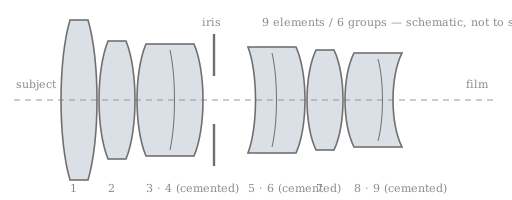
- 9 elements / 6 groups
- Aperture range
- f/1.1
- Min. focus
- 0.91 m
- Weight
- 345 g
- Filter
- 62 mm
- Years manufactured
- 1956
- Country
- Japan
What reviewers say
- Anson (Tahusa) (blog) — Stunned by the sharpness when focus hits at f/1.1, with swirly rugby-ball bokeh and extremely natural, creamy transitions; of the ultra-fast 50s he's shot, only this and the Noctilux steal his heart — "if you are a bokeh person, you don't want to miss this" — though he warns the twelve aperture blades are extremely fragile and balsam separation is very common.
- Michael Nguyen (Japan Camera Hunter) (blog) — Sharp in the center but soft in the corners at f/1.1, improving steadily stopped down; renders fine thin lines and subtle tones with a slightly cold, masculine Nikon look — paired with the SP it epitomizes Japanese engineering, ergonomic quirks and all.
- Haruo Sato (佐藤治夫), Nikon 1001 Nights No.7 (blog) — A slight central contrast drop but good resolving power at f/1.1–1.4, while peripheral coma flare draws a soft veil; contrast and resolution improve markedly by f/2–2.8, and from f/4 the whole frame is sharp with excellent blur characteristics.
- Gigantoptik (기간트옵틱) (blog) — A demanding, unpredictable lens he loves anyway — wide open the flare and swirling coma make images "somewhat dizzy," yet when conditions align it "records an unrepeatable nostalgia into eternity," and stopped down it serves as an all-rounder. via machine translation — corrections welcome
Optical formula — Gauss type
History
When the Nikkor-N·C 5cm f/1.1 appeared in February 1956, it was only the second lens in history to break past f/1.2. The first had come three years earlier from Teikoku Kogaku (later Zunow Kogaku), whose Zunow 5cm f/1.1 extended the familiar Sonnar concept — and Nippon Kogaku’s answer was pointedly not a Sonnar. Saburo Murakami (村上三郎), manager of the company’s 3rd Mathematics Section, built a nine-element, six-group design that Nikon itself describes as Gaussian, hanging its speed on three convex elements of newly developed lanthanum rare-earth glass. The design and prototyping took him two years, worked out with an abacus and a sheet of logarithms; the patent was filed in 1957 and granted in the United States the following year.
The lens’s production story is really a tale of two mounts. The original version — 835 made, serials 119601–121131 — used Nikon’s internal bayonet, which meant all of its considerable weight (over twelve ounces) rode on the camera body’s own focusing helical. The strain was real enough that internal-mount lenses went back to the factory for mount adjustment. Nikon redesigned the barrel in mid-1958, and from around June 1959 the external-mount Nikkor-N (1,547 made, serials 140701–142498, with early examples engraved “Pat. Pend.”) carried its own helical, so the front no longer rotates with focus. Either way the front is imposing: a 62mm filter thread, and an enormous hood that shipped with its own case and a 62mm UV filter.
Rarest of all are the 211 Leica-screw-mount lenses, all built on the internal-mount design — and, by expert consensus, interleaved within the internal-mount serial block rather than issued as a contiguous batch; no published lowest or highest LTM serials exist. The handful of serial-confirmed survivors form a tight cluster in the 1201xx range and now trade at five-figure prices. That cluster sits just above the most storied serial of all: 120155, an internal-mount lens reported as Che Guevara’s, mounted on his Nikon S2 and displayed at the La Cabaña fortress museum in Havana. The serials trace to a single first-hand forum lineage, so the attribution should be read as reported rather than confirmed — but it is a remarkable footnote for a lens this rare.
Nikon’s own retrospective essay on the f/1.1 ends with a fitting piece of lore: essay author Haruo Sato’s (佐藤治夫) personal example had been sitting on a desk as a damaged paperweight until master prototyper Kazuya Udagawa (宇田川和也) tracked down the original blueprints, repaired the diaphragm blades himself, and rebuilt the lens to specification — then promptly fell for the way it drew still lifes and portraits.
This history is AI-written, from the sources listed at the foot of the page. Where the record is silent it says so rather than filling the gap — but no human wrote these sentences.
Example photos
More sample photos elsewhere
These photographers keep all rights to their work — enjoy it at the source.
Sample photo wanted — shot with a Nikkor-N(·C) 5cm f/1.1? We'd love to feature it (with credit).
Live listings
Asking price, USD: a median of $4,000 across 17 fixed-price listings on 2026-10-19 (middle half $3,300–$4,000). Tracked since 2026-09-06, 11 days: up 4% from $3,800.
By day
| Date | Median | Middle half | Listings |
|---|---|---|---|
| 2026-10-19 | $4,000 | $3,300–$4,000 | 17 |
| 2026-10-18 | $3,900 | $3,300–$4,000 | 18 |
| 2026-10-17 | $3,900 | $3,300–$4,000 | 18 |
| 2026-10-16 | $4,000 | $3,300–$4,000 | 17 |
| 2026-10-15 | $4,000 | $3,000–$4,000 | 16 |
| 2026-09-21 | $4,000 | $3,000–$4,000 | 15 |
| 2026-09-19 | $4,000 | $3,000–$4,000 | 15 |
| 2026-09-18 | $4,000 | $3,000–$4,000 | 15 |
| 2026-09-11 | $4,000 | $3,000–$4,000 | 14 |
| 2026-09-09 | $4,000 | $3,000–$4,000 | 15 |
| 2026-09-06 | $3,800 | $2,800–$4,000 | 16 |
Asking prices from the listings scanned, not sales; junk-flagged rows and auction lots excluded; other currencies are not converted.
- Nikkor-N 5cm f/1.1 (external bayonet), Fair — SN 141006
- Nikkor-N.C 5cm f1.1 S Mount Rangefinder Lens (read) [BAR]
- Nikon NIKKOR-N 5cm F1.1 for S mount Rangefinder Camera Lenses Tested [Read Cond]
- Nikkor-N.C 5cm f1.1 S Mount Rangefinder Lens (read) [BAR]
- Nikon Nippon Kogaku Nikkor-N 5cm 50mm f/1.1 Lens Nikon S Mount Near MINT Japan
- Nikon Nippon Kogaku Nikkor-N 50mm F/1.1 for Nikon S Mount #435
- CLA'd [Vintage MINT] Nikon Nikkor-N 5cm 50mm f/1.1 External Mount Lens JAPAN
- Nikon Nippon Kogaku Nikkor-N 50mm F/1.1 for Nikon S CLA By KantoCamera #59982 A4
- Nikon Rangefinder Nikkor-N 5cm f1.1 fast lens. External Mount. 1547 Made. CLA'D!
- Nikon Rangefinder Nikkor-N 5cm f1.1 fast lens. External Mount. ONLY 1547 Made.
- Nikon RF Nikkor-N 5cm/1.1 external mount #140836, c.1959, 1547 made, CLA'd DAG 2024, Ex++/Mint-
- Nikon RF Nikkor-N 5cm/1.1 external mount #141635, c.1959, 1547 made, Ex++/Mint-
- Nikon RF Nikkor-N 5cm/1.1 external mount #141736, c.1959, 1547 made, CLA'd DAG 2024, Ex
- [RARE] Nippon Kogaku Nikkor-N 50mm F1.1 - Nikon S Mount - Internal S Mount
- Nikon 5cm f/1.1 Internal Version L#120216
- Nikon NIKKOR-N 5cm F1.1 External Bayonet S Mount Rare Vintage from Japan E0521
- Nikon Nikkor-N 5cm 50mm F1.1 S Mount Rangefinder Manual Focus Lens M0927
Listings updated 2026-10-19. Links go to the shop or marketplace that carries the item.