S Nokton 50mm f/1.5 Aspherical
Cosina Voigtländer · Nikon S · 2003 · Double Gauss, aspherical
Also known as: Voigtländer S Nokton 50mm F1.5 Aspherical · Voigtlander S Nokton 50mm f/1.5 Aspherical · Cosina Voigtlander S Nokton 50/1.5 · CV S Nokton 50mm 1.5 · Nokton 50mm f/1.5 Aspherical (Nikon S) · S NOKTON 50mmF1.5 Aspherical · S NOKTON 50mm F1.5 ASPHERICAL · S ノクトン 50mm F1.5 アスフェリカル
Variants & identification
| Variant | Mount | Years | Serial ranges | Production |
|---|---|---|---|---|
| Nikon S (2003) | Nikon S | 2003 | — | Sources conflict — 700 per CameraQuest, ~600 per lens-db |
How to tell them apart
- Mounts on the outer bayonet and carries its own focusing helicoid — focus it by the lens barrel, not by the body's focusing wheel, which drives inner-mount 50s
- Named with an S prefix — S Nokton 50mm F1.5 Aspherical — the S being the mount code; the Leica-screw, VM and Vintage Line namesakes carry no S
- 52mm filter thread, with a 60mm push-on front cap interchangeable with the Leica screw-mount Nokton 50/1.5
- Nikon S (2003): A re-mounting, not a redesign: the same optical block as the 1999 Leica-screw-mount Nokton 50mm f/1.5 Aspherical, which later returned in VM mount as well. Sold in Nikon S only — no Contax rangefinder version ever followed. Ships with a standard hood; the LH-3 hood from the 35/1.2 Nokton also fits. A single production run, and the last of it: the S/SC line was closed out in March 2007, two years after the Bessa R2S and R2C bodies ended in April 2005.
Specifications
- Formula
- Double Gauss, aspherical
- Construction
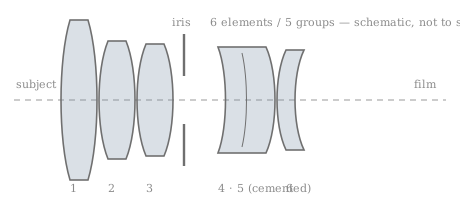
- 6 elements / 5 groups
- Aperture range
- f/1.5–f/16
- Diaphragm blades
- 10
- Min. focus
- 0.9 m
- Filter
- 52 mm
- Years manufactured
- 2003
- Country
- Japan
- Coating
- Multi-coated
- Original price
- $550 at the May 2003 launch (today $938), $399 by October
What reviewers say
- Stephen Gandy (CameraQuest) (blog) — The US importer's verdict on the lens he sold: the only aspherical 50 ever produced in Nikon rangefinder mount, and only the second fifty of any kind made in external mount after the legendary 50/1.1 Nikkor — very smooth focusing and aperture rings, and very high quality machining and finish.
- ys-223 (アルファ・プラスアルファ) (blog) — On film from a Nikon S2 it draws solidly with nothing breaking down, but a digital test shows its age: the centre stays soft until f/2.8 and the corners until f/5.6, colour fringing persists a stop past wide open, contrast drops and ghosts appear into the light, and the highlight discs come out onion-ringed and bubbly — clipped to lemons at the edges wide open, uniformly ten-sided once stopped down. Not a lens he would pick for night illuminations. via machine translation — corrections welcome
- Gigantoptik (기간트옵틱) (blog) — He had forgotten the lens existed until a friend's two sample frames won him over with smooth, calm rendering and a dignified background blur — and it answered the thirst that creeps up on an old-lens shooter for one modern lens trustworthy in any situation, the only standard-focal-length aspherical available to Nikon or Contax rangefinder users. via machine translation — corrections welcome
- Matt Osborne (MrLeica) (blog) — A modern aspherical lens usable on any Nikon S body that "achieves excellent results" — he observed very little difference between it and Voigtländer's 2021 M-mount Nokton 50mm f/1.5, and shoots the S-mount lens on his Contax-mount Bessa R2C.
Optical formula — Double Gauss, aspherical
History
In the Nikon rangefinder system a 50mm lens normally carries no focusing helicoid of its own: it seats on the inner bayonet, and the camera body’s helicoid and focusing wheel do the work. Exactly one lens of the classic era broke that rule — the 1959 rebuild of the 50/1.1 Nikkor, moved out onto the outer bayonet with a focusing mount of its own. Forty-four years later the S Nokton 50mm f/1.5 Aspherical became the second, and it remains the last: the only other fifty ever built for the outer bayonet, and the only aspherical 50 ever produced in the mount. Stephen Gandy, who imported it into the United States, sold it on precisely those two distinctions.
The lens was not designed for Nikon at all. It is Cosina’s 1999 Leica-screw-mount Nokton 50mm f/1.5 Aspherical re-mounted — a double Gauss of six elements in five groups with aspherical surfaces on both faces of the rearmost group, ten blades, a 52mm filter thread, f/1.5 to f/16, 0.9m close focus. The same block later came back in VM mount, which is the trap for anyone shopping: three lenses, one name, one optical design, and only the one carrying an S will focus correctly on a Nikon body. Cosina’s naming encodes the split. Its SC wides — the 21/4, 25/4, 28/3.5 and 35/2.5 — are a single version that serves both Nikon and Contax rangefinders, because at those focal lengths depth of field papers over the two systems’ different helicoid travel. From 50mm up, where the difference actually bites, the lenses are S: Nikon only. Gandy’s launch page wondered whether a Contax version might follow. None ever did.
It arrived in May 2003, into the short window Cosina had opened at Photokina 2002 with the Bessa R2S and R2C — the first new bodies in either classic mount in four decades, and the first ever in them with TTL metering. The window closed fast. The $550 introductory price had fallen to $399 by that October; the R2S and R2C were discontinued in April 2005, and the whole S/SC lens line was closed out in March 2007. How many were built is the one figure nobody can settle. CameraQuest, the US distributor, published a count for every lens in the line — no Japanese source ever has — and gives 700 for this one; lens-db put it at roughly 600, and that site is now offline. Either way it is a single production run, and a small one.
As a lens it divides along a predictable line: the people shooting it on film like it, and the people testing it on a sensor find 2003. A Japanese owner shooting a Nikon S2 called the rendering solid, nothing breaking down, then put it on an α7R IV and watched the centre stay soft until f/2.8, the corners until f/5.6, colour fringing hold on a stop past wide open, contrast collapse into backlight, and the out-of-focus highlights come back onion-ringed and full of bubbles — clipped to lemon shapes at the frame edge wide open, and uniformly decagonal once stopped down. Not a lens for night illuminations, was his verdict. The counterweight is what draws people to it in the first place: a Korean collector who had let the lens slip his mind entirely, until a friend posted two frames, talked himself into one for its smooth, quiet rendering and dignified blur; and Matt Osborne, who runs it on a Contax-mount R2C, sees very little difference between it and Voigtländer’s 2021 M-mount Nokton 50/1.5. That was always the point of it. Among shelves of fifty-year-old Nikkors and Sonnars, this was the one lens a Nikon rangefinder shooter could pick up in 2003 and simply trust.
This history is AI-written, from the sources listed at the foot of the page. Where the record is silent it says so rather than filling the gap — but no human wrote these sentences.
Example photos
More sample photos elsewhere
- Philip McAllister ("the underlord") — "Voigtlander S Nokton 50mmF1.5" tag set on Flickr: Nikon S2 / Nikon S3 2000 film work, Liverpool & North Wales (44 photos)
- Tom Abrahamsson ("T&T and Mr B", rapidwinder) — Bessa R2S + S-Nokton 50mm f/1.5 test rolls on Flickr, Vancouver, Ilford FP4+ / Orwo UN54 (11 photos)
- Danny Chan (chan_danny) — "Cosina Voigtländer S Nokton 50mm f/1.5 Aspherical" tag set on Flickr: Nikon S3, Hong Kong street B&W on Arista Premium 400 (7 photos)
These photographers keep all rights to their work — enjoy it at the source.
Sample photo wanted — shot with a S Nokton 50mm f/1.5 Aspherical? We'd love to feature it (with credit).
Live listings
Listings updated 2026-10-19. Links go to the shop or marketplace that carries the item.