Fujinon 5cm f/1.2
Fuji Photo Film · Nikon S + LTM + Contax RF · 1954 · Sonnar / double Gauss
Also known as: Fujinon 50mm f/1.2 · Fujinon 5cm F1.2 · Fujinon 5cm f1.2 · Fuji Fujinon 50mm F1.2 · Fujinon 50mm F1.2 LTM · フジノン 5cm F1.2
Variants & identification
| Variant | Mount | Years | Serial ranges | Production |
|---|---|---|---|---|
| LTM (early silver barrel) | LTM | 1954 | 500xxx (block shared with the black LTM and Contax versions) | ~100, a single dealer estimate¹ |
| LTM (later black barrel) | LTM | — | 500xxx (block shared with the silver LTM and Contax versions) | ~800, a figure circulating in two sources¹ |
| Nikon S | Nikon S | — | 260xxx (observed 2600xx–2601xx, none higher) | ~50 by the same circulating figure, but a Japanese specialist puts S and Contax together at a few dozen — under 100, with quasi-prototypes mixed into early production¹ |
| Contax RF | Contax RF | — | 500xxx (shared with LTM — serial alone doesn't distinguish the mounts) | Counted within the few-dozen S + Contax estimate¹ |
- Serial blocks (koiwide, from examples seen): "No.260xxx" for the Nikon S mount, "No.500xxx" for the Leica thread — and, a Contax-mount owner wrote in to say, for the Contax mount too, so 500xxx does not identify the thread by itself. koiwide reads the design as a Sonnar front group with a Gauss-like rear, notes that Tokyo Kōgaku's Simlar 5cm f/1.5 used the same idea, and puts the lens's poor sales down to Fuji's weak name as a lens maker and its having no camera body of its own to sell it on.
- Fuji published no production figures for this lens.
How to tell them apart
LTM (early silver barrel):
- Silver/white machined-brass barrel
- Odd f/1.6 intermediate stop on the aperture scale
- Click-stop aperture (unlike the stepless S version)
- ~403 g (a Bushnell ad says 410 g); MFD 3 ft; 58mm filter via two-piece attachment ring
LTM (later black barrel):
- Black aluminum barrel
- Click-stop aperture (unlike the stepless S version)
- ~403 g (a Bushnell ad says 410 g); MFD 3 ft; 58mm filter via two-piece attachment ring
Nikon S:
- "N" engraved at the mount base (photo-verified; Contax version reads "C")
- Inner bayonet, focuses via the body helical — aperture scale engraved twice because the lens rotates with the helicoid (Yaotomi, S example in hand)
- Stepless aperture — no click stops, unlike the LTM version
- Rare f/1.6 intermediate stop on early examples — an early-batch tell (Yaotomi's S example 260090)
- 305 g vs the LTM's ~403 g; MFD 3.5 ft
Contax RF:
- "C" engraved at the mount base
- LTM (early silver barrel): Whether silver barrels carry the confirmed 9-element pre-production design stays unresolved: Fotoborse described their white example as 9e/6g with the f/1.6 stop, while MAP TIMES calls the silver an 8e Sonnar with no optical difference. The 9e trial design itself is confirmed (designer Doi's own 1955 Shashin Kogyo account; the June 1954 Asahi Camera memo and Oct 1954 Asahi Camera test both show 9 elements — two thin rear elements later merged into one).
- LTM (later black barrel): The silver-vs-9-element question bears on this variant too: Fotoborse described a white example as 6g/9e with the f/1.6 stop; MAP TIMES calls the silver an 8e Sonnar with no optical difference. If the silver barrels are optically different, the black barrels are the definitive 8e/4g production design.
Serial-range notes
- 500xxx
- One block shared by LTM and Contax RF versions — serial alone doesn't distinguish the mounts.
- 2600xx (earliest S batch)
- Early examples carry the rare f/1.6 intermediate stop engraving — an early-batch tell (Yaotomi's S example 260090).
Specifications
- Formula
- Sonnar / double Gauss
- Construction
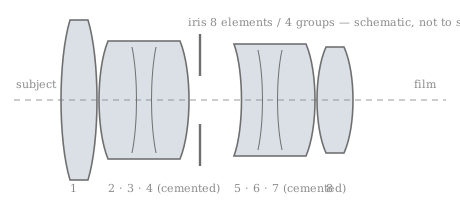
- 8 elements / 4 groups
- Aperture range
- f/1.2–f/16
- Diaphragm blades
- 12
- Min. focus
- 1.07 m
- Filter
- 58 mm
- Years manufactured
- 1954
- Country
- Japan
- Original price
- Reported ~¥70,000–90,000 (Showa 30 era) — single shop-blog source, unconfirmed, though consistent with the 1959 US list price of $299.50 (today $3,230), ≈ ¥108,000 at ¥360/$
What reviewers say
- Michael Nguyen (Japan Camera Hunter) (blog) — Exceeded his high expectations — "clinically sharp yet romantic and airy," with rendering recalling 1960s Zeiss Planars; as an actual shooter he'd pick it over a Leica Noctilux f/1.0.
- koiWide (blog) — Its appeal is character, not technical superiority: dreamy, low-contrast rendering with abundant enveloping flare "like old Japanese cinema," and foreground bokeh softer than the background. via machine translation — corrections welcome
- Hayata Camera Lab (ハヤタ・カメララボ) (blog) — A repair specialist's bench verdict: impressed by the sharp center wide open with surprisingly little breakdown at the frame edges, and edge-to-edge quality without complaint stopped down. via machine translation — corrections welcome
Optical formula — Sonnar / double Gauss
History
When Fuji Photo Film entered the 50mm speed race, it was answering a shot already fired: Teikoku Kogaku’s Zunow 5cm f/1.1 had seized the world’s-fastest crown in 1953, and every serious Japanese optical house felt the pressure. The Fujinon 5cm f/1.2 arrived as one of the “Big Four” ultra-fast lenses of the decade — Zunow’s f/1.1 (1953), the Hexanon 60mm f/1.2 and this Fujinon (1954), and finally the Nikkor 5cm f/1.1 (1956). A memo in Asahi Camera shows it announced by June 1954, and Fujifilm’s official company history puts it on sale that November. By May 1955, Modern Photography was calling it the fastest lens yet made for a 35mm camera.
The design was the work of Ryōichi Doi (土居良一), who told his own story in a 1955 account in Shashin Kogyo: a lineage running from his Solinon 50mm f/1.5 patent through an f/1.3 study to a nine-element trial design — the version the June 1954 Asahi Camera memo diagrams, its two thin rear elements later merged into one for the improved eight-element, four-group production lens. Along the way it became the first Japanese lens to adopt new-type rare-earth glass, though sources dispute how many of the eight elements used it (three, four, or six, depending on who is counting). Doi described the finished formula as deliberately readable two ways — an improved Sonnar or a modified double Gauss — and the literature has split along exactly that line ever since. One thread stays unresolved: whether the earliest silver-barrel Leica-mount lenses carry the nine-element formula. Fotoborse described a white example as nine elements in six groups; MAP TIMES calls the silver an eight-element Sonnar with no optical difference.
Most production went to Leica screw mount, in the 500xxx serial block the lens shares — confusingly — with the “C”-marked Contax version, so serial alone will not tell you the mount. The Nikon S version occupies its own 260xxx block, with observed examples spanning just 2600xx–2601xx and none higher. A production split of “800 LTM / 50 S” circulates in two sources, but Yaotomi’s expert puts S and Contax combined at “a few dozen” — under 100, with quasi-prototypes mixed into early production — and no official figures exist. The S lens is also mechanically its own creature: an inner-bayonet design focused by the body helical, its aperture scale engraved twice because the whole lens rotates with the helicoid, its 12 near-circular blades set steplessly where the LTM version clicks. Early examples add a curious f/1.6 intermediate stop — an early-batch tell.
The lore is as good as the glass. Fujinon’s new-glass coup threw Zunow into a marketing panic that helped drive its 1955 Type II redesign — the incumbent speed king scrambling to answer the newcomer. And the market has rendered its own verdict: a lens whose mid-1950s price is reported — on the strength of a single shop blog — at ¥70,000–90,000 went from roughly ¥500,000 in mint condition in 2016 to $20,000 and up today, with the sharpest appreciation since 2020.
This history is AI-written, from the sources listed at the foot of the page. Where the record is silent it says so rather than filling the gap — but no human wrote these sentences.
Example photos
More sample photos elsewhere
- Jerry Bei's 15-photo Fujinon 5cm f/1.2 sample album (Flickr)
- Omer Terrason — Fujinon 5cm f/1.2 on an X-Pro2 (Flickr)
These photographers keep all rights to their work — enjoy it at the source.
Sample photo wanted — shot with a Fujinon 5cm f/1.2? We'd love to feature it (with credit).
Live listings
Asking price, USD: a median of $12,300 across 17 fixed-price listings on 2026-10-18 (middle half $11,300–$14,200). Tracked since 2026-09-06, 9 days: down 3% from $12,700.
By day
| Date | Median | Middle half | Listings |
|---|---|---|---|
| 2026-10-18 | $12,300 | $11,300–$14,200 | 17 |
| 2026-10-17 | $12,300 | $11,300–$14,200 | 17 |
| 2026-10-16 | $12,300 | $10,000–$13,700 | 18 |
| 2026-10-15 | $10,900 | $10,000–$12,300 | 6 |
| 2026-09-21 | $11,400 | $11,200–$12,600 | 6 |
| 2026-09-19 | $12,800 | $12,400–$13,300 | 5 |
| 2026-09-18 | $12,800 | $12,400–$13,300 | 5 |
| 2026-09-11 | $12,700 | $12,200–$13,600 | 5 |
| 2026-09-06 | $12,700 | $12,200–$13,600 | 5 |
Asking prices from the listings scanned, not sales; junk-flagged rows and auction lots excluded; other currencies are not converted.
- Fujinon 50mm f/1.2 LTM
- [Near MINT w/ Original Case] Fujifilm Fujinon 50mm F1.2 Lens for Leica L39 JAPAN
- Fujifilm Fujinon 50mm F/1.2 Lens for Leica L39 #59871 E5
- Fuji Photo Contax RF 1.2/5 cm Fujinon boxed lens in clean condition circa 1954
- Fuji Photo Contax RF 1.2/5 cm Fujinon boxed lens in clean condition ca.1954
- Fujifilm Fujinon 5cm F1.2 Leica L Mount Lens
- Fujifilm Fujinon 5cm F1.2 for Leica L Mount 295173
- FUJIFILM FUJINON 50mm f/1.2 L39 -Near Mint- 6815
- FUJIFILM FUJINON 50mm f/1.2 L39 -Near Mint- 2780
- FUJIFILM FUJINON 50mm f/1.2 L39 -Near Mint- 2841
- FUJIFILM FUJINON 50mm f/1.2 L39 -Near Mint- 6513
- Fuji Photo 1.2/5cm Fujinon f. Leica M39 screw mount (LTM)
- FUJIFILM FUJINON 50mm f/1.2 L39 -Near Mint- 0434
- FUJIFILM FUJINON 50mm f/1.2 L39 -EXC- 9184
- FUJIFILM FUJINON 50mm f/1.2 L39 -EXC- 6977
- FUJIFILM FUJINON 50mm f/1.2 L39 -EXC- 6991
- Super Rare!! [ALMOST MINT] Fuji Fujifilm Fujinon 50mm f/1.2 Lens Contax RF Mount
- Fuji Photo 1.2/5cm Fujinon f. Leica M39 in chrome very RARE Lens No.13 (LTM)
Listings updated 2026-10-19. Links go to the shop or marketplace that carries the item.