Nikkor-S(·C) 5cm f/1.4
Nippon Kogaku · Nikon S + LTM · 1950 · Sonnar
Also known as: Nikkor 5cm f/1.4 · Nikkor 50mm f/1.4 · Nikkor-S.C 5cm f/1.4 · Nikkor-S·C 5cm f/1.4 · Nikkor-SC 5cm f1.4 · Nikkor-S 5cm f/1.4 · Nikkor-S 50mm f/1.4 · Nippon Kogaku 5cm f/1.4 · 5cm f1.4 · Nikkor-S 50mm f/1.4 Olympic · Nikkor 50mm f/1.4 Millennium
Variants & identification
| Variant | Mount | Years | Serial ranges | Production |
|---|---|---|---|---|
| Nikon S (1950 baseline) | Nikon S | 1950 | 50050101–50052110 (first batch, code 5005, May 1950) 5005816–5005972 (short seven-digit 5005 sub-block) 316xxx–417xxx (later six-digit blocks) | ~100,000 total across the run (Pacific Rim estimate) |
| Leica screw mount | LTM | — | — | — |
| "Olympic" (1964) · Double Gauss / Planar type, 7e/5g | Nikon S | 1964 | 140001+ (observed span 140027–141651) | ~2,000 per Mikio Kuno, Everything About Nikon Rangefinders (1990, via RFF; ja.wiki agrees but may derive from Kuno) vs ~1,651 confirmed by serial span — no factory figure survives (Rotoloni: "NK didn't keep very good records") |
| "Millennium" (2000) · Double Gauss, 7e/5g (the Olympic formula with updated glass + multi-coating) | Nikon S | 2000 | 20xxxx | Chrome S3-2000 sets >8,000; black sets (June 2002) 2,000 |
How to tell them apart
Nikon S (1950 baseline):
- Marked S·C until the transition to plain S at ~serial 396000, late 1958/early 1959 — C stood for 'coated,' dropped as redundant once coating was universal (all Nikkors coated regardless of marking)
- Engraved 5cm, not 50mm
"Olympic" (1964):
- Carries NO Olympic symbol despite the collector nickname
- Engraved 50mm rather than 5cm — the only vintage variant so marked (the 2000 Millennium reissue also reads 50mm)
"Millennium" (2000):
- Engraved 50mm (modern-era marking, like the Olympic)
- 9 aperture blades; 43mm filter; multi-coated
- Shipped with the S3-2000 reissue bodies: chrome sets, then black sets from June 2002
- Leica screw mount: Same 7e/3g Sonnar as the S-mount lens. No per-mount production split published.
- "Olympic" (1964): A different optical design from the 1950 lens: Double Gauss / Planar type, 7e/5g (builder-confirmed; Nikon's essay says "orthodox Gauss"; ja.wiki's 4-group figure is the outlier), lanthanum glass in 4 of 7 elements. Designer Yoshiyuki Shimizu (清水義之), and his first lens: Nikon's essay says he had been polishing lenses when Wakimoto Zenji picked him out, and that everything he designed afterwards — the Nikkor Auto line, the 6mm f/2.8 fisheye — began here; optical design report November 1962, mass-production drawing April 1964. Sold with the black S3 "Olympic" body reissue — produced in 1964 to coincide with the Tokyo Olympics (Kuno: ~2,000 lenses made alongside the Olympic-run S3 bodies; ja.wiki concurs). Despite the nickname, neither lens nor body carries an Olympic symbol.
- "Millennium" (2000): Same formula as the Olympic (builder-confirmed; matches Nikon official) — so "new design" only relative to the 1950 Sonnar. Lens work handled by Tochigi Nikon, camera by Sendai Nikon (Nikon essay, section IX).
Serial-range notes
- 50050101–50052110
- First batch; code 5005 = May 1950 per the early-serial [design-completion YYMM][sequence] decoder (maenomeri.tokyo + NHS, cross-confirmed).
- 316xxx–417xxx
- Later six-digit blocks; heavy chrome-over-brass construction gives way to lighter barrels; 'Tokyo'→'Japan' beauty-ring transition along the way.
- ~396000
- S·C → S engraving transition, late 1958/early 1959.
- 358100–358400
- Silver-aluminum batch.
- 331242, 407978
- Documented black examples.
Specifications
- Formula
- Sonnar
- Construction
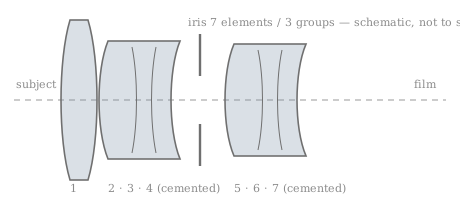
- 7 elements / 3 groups
- Aperture range
- f/1.4
- Min. focus
- 0.91 m
- Filter
- 43 mm (0.5 mm pitch) (Nikon S (1950 baseline), Leica screw mount, "Olympic" (1964)) · 43 mm (0.75 mm pitch) ("Millennium" (2000))
- Years manufactured
- 1950
- Country
- Japan
What reviewers say
- BastianK (phillipreeve.net) (blog) — An exceptionally built chrome-and-brass character lens — low contrast wide open, roughly 3 EV of vignetting at f/1.4, and the worst flare resistance he has ever tested — worth owning for its build and vintage rendering, though he points most buyers to a modern Voigtländer Nokton 50/1.5 first.
- Richard Haw (blog) — Spherical aberration is its defining trait wide open — a delicate, old-Hollywood glow — and it was recalculated to perform better at close distances than the prewar Zeiss original it derives from; the kind of Nikkor some Leica shooters buy instead of native glass, spending the savings elsewhere.
- Koichi Ito (伊藤浩一) (blog) — Wide open on a Nikon Z fc it renders delicately and softly, but stopped down to f/2 it snaps into the refined drawing characteristic of a Sonnar. via machine translation — corrections welcome
- aremo-koremo (カメラが欲しい、レンズが欲しい、あれもこれも欲しい) (blog) — Flare-prone and impressionistic wide open with very solid construction — quintessential old-lens character that the author suspects will become a favorite. via machine translation — corrections welcome
- Gigantoptik (기간트옵틱) (blog) — "The body cap of the Nikon RF" — the archetypal starter lens he reserves for portraits and pastel old-lens moods, since bright highlights bleed softly at f/1.4; edge field curvature never fully clears even stopped down. via machine translation — corrections welcome
Optical formula — Sonnar
History
Nippon Kogaku’s official chronicle dates the completion of the 5cm f/1.4 to July 1950 — the first serial batch carries the code 5005, which the early-serial decoder reads as May 1950, and the 1951 date found on Japanese Wikipedia reflects market availability rather than design. Whichever month you prefer, the lens moved fast: by December 1950 it had superseded the Nikkor-S·C 5cm f/1.5, itself on sale for under a year, as the system’s fastest standard lens. Optically it was a Sonnar type, seven elements in three groups, in the lineage that ran back through the f/1.5 to the prewar Zeiss original — stretched roughly a fifth of a stop faster.
It became the workhorse of the entire rangefinder era. Production ran from the heavy chrome-over-brass first batches through later, lighter barrels, with the beauty ring changing from “Tokyo” to “Japan” along the way — around 100,000 in total by Pacific Rim Camera’s estimate, spread across serial blocks from 5005001 into the 417xxx range. The S·C engraving gave way to plain S in late 1958 or early 1959, at around serial 396000 per Rotoloni (p.106): the C stood for “coated,” and Nikon dropped it as redundant once coating was universal on every Nikkor regardless of marking. A Leica-screw-mount version is confirmed — surviving examples are documented complete with box and bakelite keeper can — and collector notes record black-barrel examples and a silver-aluminum batch among the serial-range quirks.
In 1964 the name was handed to an entirely different lens. The “Olympic” Nikkor-S 50mm f/1.4 — the collector nickname; no Olympic symbol appears anywhere on the lens — was designed by Yoshiyuki Shimizu (清水義之), and it was his first lens. Nikon’s own account has him polishing lenses when Wakimoto Zenji picked him out, and dates the optical design report to November 1962 and the mass-production drawing to April 1964; the Nikkor Auto lenses for the F, and the 6mm f/2.8 fisheye, came after. It abandoned the Sonnar for a seven-element, five-group Double Gauss design (Nikon’s own essay calls it an orthodox Gauss; a four-group figure circulating from Japanese Wikipedia is the outlier), with new lanthanum glass in four of its seven elements, and it is the only vintage variant engraved 50mm rather than 5cm — the 2000 Millennium reissue also reads 50mm. How many were made is genuinely unsettled: Mikio Kuno’s 1990 book gives about 2,000, while the observed serial span (140027–141651) accounts for roughly 1,651 — and no factory figure survives, Rotoloni noting that Nippon Kogaku simply didn’t keep very good records.
The story got one more chapter. In 2000, for the S3-2000 reissue sets, Nikon put the 50mm f/1.4 back into production as the “Millennium” — the camera work went to Sendai Nikon and the lens to Tochigi Nikon — with the same seven-in-five Olympic formula, now with updated glass and multi-coating, nine aperture blades, and a 43mm filter thread. More than 8,000 chrome sets were built, followed by 2,000 black sets in June 2002: a fifty-year arc, from the fastest ambitions of 1950 to a deliberate act of remembrance.
This history is AI-written, from the sources listed at the foot of the page. Where the record is silent it says so rather than filling the gap — but no human wrote these sentences.
Example photos


More sample photos elsewhere
These photographers keep all rights to their work — enjoy it at the source.
Sample photo wanted — shot with a Nikkor-S(·C) 5cm f/1.4? We'd love to feature it (with credit).
Live listings
Asking price, USD: a median of $200 across 54 fixed-price listings on 2026-10-19 (middle half $180–$300). Tracked since 2026-09-06, 10 days: down 6% from $210.
By day
| Date | Median | Middle half | Listings |
|---|---|---|---|
| 2026-10-19 | $200 | $180–$300 | 54 |
| 2026-10-18 | $200 | $180–$330 | 55 |
| 2026-10-17 | $200 | $180–$330 | 55 |
| 2026-10-16 | $200 | $180–$330 | 52 |
| 2026-10-15 | $200 | $170–$350 | 49 |
| 2026-09-21 | $200 | $170–$240 | 55 |
| 2026-09-19 | $200 | $180–$290 | 54 |
| 2026-09-18 | $200 | $180–$290 | 54 |
| 2026-09-11 | $210 | $180–$420 | 53 |
| 2026-09-06 | $210 | $180–$430 | 55 |
Asking prices from the listings scanned, not sales; junk-flagged rows and auction lots excluded; other currencies are not converted.
- 【Problem】Nikon Nippon Kogaku Nikkor S 50mm 5cm F1.4 Lens S Mount JAPAN #969
- NIKON Nikkor-S MF 50mm f/1,4 - SNr: 1150301
- Nikon Nikkor-S 50mm F/1.4 – very good condition
- EXC Nikon Nikkor-S C 50mm f/1.4 Historic lens for F Original lens caps
- 【Problem】Nikon Nippon Kogaku Nikkor S 50mm 5cm F1.4 Objektiv S Mount JAPAN #969
- NIKKOR-S 50mm f.1.4 n.549204
- Nikon Nikkor S C 5cm 50mm f1.4 Nippon Kogaku Rangefinder Lens Black
- Nikon Nikkor S 5cm 50mm f1.4 Nippon Kogaku Rangefinder Lens Black
- 🔥 Nikon Nikkor S-C 50mm F/1.4 pre Ai 🔥 ***One Month warranty***
- Nikkor-S f1.4 5cm Lens for Nikon / Contax Rangefinder Cameras * Ex. Condition *
- Nikkor-S.C 5cm f/1.4, Poor — SN 345707
- Nikon Nippon Kogaku Nikkor-S 5cm 50mm f/1.4 Lens S Mount From JAPAN #1274
- Nikon Nikkor S.C SC 5cm F1.4 MF Lens for S, S2, S3, S4, SP [ Exc+5 ] JAPAN C953
- Seltener Nippon Kogaku Tokyo Nikkor Objektiv Metalldeckel für Nikkor S C 5cm F1.4 F
- [Near MINT] Nikon NIKKOR-S 5cm 50mm f/1.4 Lens S Mount Rangefinder MF From JAPAN
- [Near MINT+++] Nikon Nippon Kogaku Nikkor-S 5cm 50mm f1.4 Lens for S Mount JAPAN
- [Near Mint] Nikon Nippon Kogaku Nikkor-S 50mm F1.4 S Mount black From JAPAN
- Video*[N MINT] Nippon Kogaku Nikkor S.C 5cm F1.4 50mm S mount JAPAN1 #1 day ship
- Nippon Kogaku Nikkor-S.C 5cm f/1.4 Vintage Rangefinder Lens — Nikon S Mount
- [Exc+5] Nikon Nippon Kogaku Nikkor-S 5cm 50mm f/1.4 Lens For S Mount From JAPAN
Show 95 more listings
- [Fast neuwertig] Nikon NIKKOR-S 5cm 50mm f/1.4 Objektiv S Mount...
- [MINT] Nippon Kogaku Nikkor S C 5cm 50mm f/1.4 Lens For Nikon S Mount From JAPAN
- 【 Near MINT 】Nikon Nikkor-S 5cm 50mm f/1.4 Nippon Kogaku Lens S Mount From JAPAN
- Nikon Nikkor 5cm 50mm f1.4 S C Nippon Kogaku Rangefinder Lens #761
- Nippon Kogaku Nikkor S C 5cm f/1.4 Nikon 50mm Exc+5 Z3064
- [Exc+5] Nikon NIKKOR-S.C 5cm f/1.4 MF Lens For Nikon S Mount #9422
- Nippon Kogaku Nikkor S C 5cm f/1.4 Nikon 50mm Exc+5 Z3064
- [Almost MINT] Nikon Nippon Kogaku Nikkor S 50mm f/1.4 RF Lens S Mount Japan 3177
- Video*[Exc+5] Nippon Kogaku Nikkor S.C 5cm F1.4 50mm S mount JAPAN 2 #1 day ship
- Nikon Nippon Kogaku Nikkor-S.C 5cm f/1.4 Rangefinder Lens 50mm
- [MINT] Nikon Nikkor-S.C 50mm f/1.4 MF Lens S Mount S S2 S3 SP CLA'D From JAPAN
- [Exc+4] Nikon Nippon Kogaku Nikkor-S.C 5cm 50mm f/1.4 MF Lens For Nikon S-mount
- [Fast neuwertig+++] Nikon Nippon Kogaku Nikkor-S 5 cm 50 mm f1,4 Objektiv für...
- Nikon Nippon Kogaku Nikkor-S 5cm 50mm f/1.4 Objektiv S Mount aus JAPAN #1274
- NIKKOR-S.C 5cm 50mm f1.4 Nippon Kogaku Lens NIKON S mount f/1.4 #341939
- [Near MINT] Nikon Nippon Kogaku Nikkor S.C 5cm F1.4 50mm Black Lens S From JAPAN
- Nikon Nikkor S.C 5cm 50mm f/1.4 Lens S Rangefinder
- [MINT+++] Nikon Nippon Kogaku Nikkor-S 5cm 50mm f/1.4 MF Lens S Moun From JAPAN
- [Vintage MINT] Nikon Nippon Kogaku Nikkor-S.C 50mm F/1.4 Lens For Nikon S JAPAN
- Near Mint Nikon Nippon Kogaku Nikkor S.C 5cm F1.4 50mm Lens S mount from Japan
- [N NEUWERTIG] Nikon Nippon Kogaku Nikkor-S.C 5cm 50mm f1.4 schwarz S Mount...
- Nikkor-S.C 5cm f/1.4, Fair — SN 353553
- Nikkor-S.C 5cm f/1.4, Good — SN 345761
- [Almost MINT] NIKON NIKKOR S.C 5cm 50mm F/1.4 MF Prime Lens For S Mount JAPAN
- [Top MINT] Nikon Nippon Kogaku Nikkor-S 5cm 50mm f/1.4 MF Lens S Mount JAPAN
- [Exc+4] Nikon Nikkor-S.C 5 cm 50 mm f/1.4 MF S Mount Objektiv: aus JAPAN
- Nikon Nippon Kogaku Nikkor-S.C 5 cm 50 mm f/1.4 MF Objektiv S Mount aus JAPAN...
- [MINT] Nippon Kogaku Nikkor S.C 5cm 50mm f1.4 Nikon S Mount MF Lens From JAPAN
- [Mint] Nikon Nikkor-S 50mm 5cm f/1.4 Black S mount MF Prime Lens From JAPAN
- [Vintage NEUWERTIG mit Haube] Nikon NIKKOR-S.C 5cm 50mm f/1.4 schwarz S...
- Nikon Nippon Kogaku Nikkor-S 50mm f1,4 obiettivo per fotocamere reflex F pre AI
- [Near MINT] Nikon Nippon Kogaku Nikkor-S 5cm 50mm f/1.4 Lens S Mount From JAPAN
- [Fast NEUWERTIG] NIKON NIKKOR S.C 5 cm 50 mm F/1.4 MF Prime Objektiv für S...
- [MINT] Nikon Nippon Kogaku Nikkor S.C SC 5cm 50mm F/1.4 Black S Mount From JAPAN
- Nikon Nippon Kogaku Nikkor-S.C 5cm 50mm f/1.4 MF Lens S Mount JAPAN [Exc+4]
- Nippon Kogaku Nikkor-S C 50mm f/1.4 S mount
- [Exc+4] Nikon Nippon Kogaku Nikkor-S.C 5 cm 50 mm f/1.4 MF Objektiv S Mount a...
- [Fast NEUWERTIG] Nikon Nippon Kogaku Nikkor S.C 5cm 50mm f/1.4 Objektiv S Mou...
- [Vintage NEUWERTIG] Nikon Nikkor-SC 5cm 50mm f1.4 schwarz Objektivfass aus JAPAN
- *Near MINT* Nikon Nikkor-S C 5cm 50mm F1.4 S Mount Lens Silver From JAPAN
- ^^ Nikon Nikkor S.C 5cm 50mm F/1.4 - (HTY82)
- [ MINT ] Nikon Nikkor-S.C 5cm f1.4 50mm S mount Standard Lens From JAPAN
- Nikon 50mm f1.4 Nikkor
- Nikon Nikkor S.C 5Cm 50Mm F/1.4 - (HTY82)
- [TOP MINT] Nikon Nippon Kogaku NIKKOR-S 50mm 5cm F1.4 Lens S Mount JAPAN
- Haube [fast neuwertig] Nikon Nippon Kogaku Nikkor-S.C 5cm 50mm F1.4 Objektiv ...
- [ MINT ] Nikon Nikkor-S.C 5cm f1.4 50mm S mount Standard Lens From JAPAN
- **MINT** Nikon Nikkor-S 5cm 50mm F1.4 S Mount Lens Black From JAPAN
- [Near MINT] Nikon NIKKOR S.C SC 5cm F1.4 50mm Black For S S2 S3 Lens From JAPAN
- [NEUWERTIG] Nikon Nikkor-S.C 5cm f1.4 50mm S mount Standardobjektiv aus JAPAN
- Nippon Kogaku Japan Nikkor-S 5cm f/1.4 - Nikon S, contax RF mount rare version
- Vintage Nikon S Rangefinder 35mm Film Camera + Nikkor-S.C f/1.4 50mm Lens & Case
- Nikkor-S.C 5cm f1.4 Lens / For Nikon S / Serial No. 368679 / Case /
- NIKON S RANGEFINDER WITH 5CM F/1.4 NIKKOR-S-C CLEAN GLASS NEEDS SHUTTER SERVICE
- NIKON NIKKOR-S 5CM F1.4 Schwarz Objektiv
- [Near MINT] Nikon S + Nikkor-S.C 50mm F/1.4
- Nikon Nippon obiettivo Nikkor S C 5 cm 50 mm f1.4 silver telemetro garanzia.
- NIKON Single-focus Lens NIKKOR-S 5CM F1.4 Black Used
- Nikon Nikkor-S 5cm F1.4 Standard Prime Objektiv für Nikon S Nippon Kogaku Japan
- Nikon S #6127121, chrome, Nikkor-H 5cm/1.4 chrome #348546, CLA'd 2024, Ex+
- Nikon S2 #6150236, chrome dial, Nikkor-SC 5cm/1.4 #321639, CLA'd 2025, Ex-
- Nikon Nikkor-S C 5cm 50mm f/1.4 MF Standard Lens L39 Leica Screw Mount 8137
- READ! [Rare Black Lens / Near MINT] Nikon S2 + Nikkor-S.C 5cm f/1.4 Black JAPAN
- Nikon Nippon Nikkor S C 5 cm 50mm f1.4 Silver Rangefinder Lens Warranty
- [Near Mint] Nippon Kogaku Nikon NIKKOR-S C 5cm 50mm f/1.4 L39 LTM aus JAPAN
- [Near MINT] Nikon S2 Black Dial Camera Nikkor S.C 50mm 5cm F1.4 JAPAN #1295
- [NEUWERTIG] Nikon S2 Late Black Dial Rangefinder + Nikkor-S.C 5cm f/1.4...
- Late Black Dial Nikon S2 Film Camera Nikkor S.C 5cm 50mm f/1.4 Lens JAPAN MINT
- Nikon S2 Rangefinder E.P Mark Nippon Kogaku NIKKOR-S C 5cm 50mm f1.4...
- Nikon NIKKOR-S.C 5cm 50mm f/1.4 S Mount Lens Tested Used Caps
- *Rare " Nippon Kogaku Tokyo " Exc+5* Nikon Nikkor S C 5cm F1.4 for S mount Japan
- CLA'd, Nippon Kogaku Nikkor S C 5 cm F 1.4 Leica L39 "Near MINT" From JP#3403
- Obiettivo Nikkor Z 50mm f/1.4
- Nikon Nikkor-S C 5cm 50mm f/1.4 L39 8137
- Nikkor S C 5cm F/1.4 Leica L39 Objektiv Serviced
- Nikon S Nippon Kogaku + Nikkor-S.C 5cm f/1.4 Lens + Nikon Case, 35mm Film Camera
- Nikon EP Black Rim NIKKOR SC S.C 5cm 50mm f1.4 Nippon Kogaku Japan Ltm
- Nikon NIKKOR-S C 5cm F1.4 Rare Tokyo Model Vintage Camera Lens
- Nippon Kogaku Nikkor-S•C 5cm f/1.4 Lens for M39/LTM Mount #Z-16072
- Nikon S2 Messsucherkamera + Nikkor-S.C 50mm f/1.4 – Voll funktionsfähig
- Nikkor-S 50mm F1.4 LTM M39 Leica Lens Black Belt
- ⏯️ [Vintage NEUWERTIG++] Nikon SP Nikkor-S 50mm 5cm f/1.4 Range Finder aus JA...
- Nikon S3 Rangefinder Camera REPAINT Green W/ Nikkor-S 5cm 50mm f/1.4 lens CLAD
- Late 622xxxx [Near MINT] Nikon SP Film Camera Nikkor-S 5cm 80mm f/1.4 From JAPAN
- Bemalt【N NEUWERTIG】 Nikon S Messsucherkamera Nikkor S C 50mm 5cm f/1.4 Objekt...
- Nippon Kogaku Nikkor S.C 50mm 5cm f1.4 LTM Black Rim/Black Band S#: 392xxx
- Nippon Kogaku Nikkor-S·C 5cm f/1.4 in Rare Bakelite Case Leica LTM
- 【NEUWERTIG】 Voigtländer BESSA R2S Schwarz 35mm RF mit NIKKOR S 5cm F/1.4 Obje...
- Nikon S4 + Nikkor-S 5cm f/1,4, TESTED ✅, Produced 1959
- Nikon M sync M/S rangefinder camera Nikkor-S 5cm f/1.4 lens 5005XX Nippon Kogaku
- 【Exc+5】 Nikon SP Black 35mm Rangefinder Film Camera Nikkor-S.C 5cm f/1.4...
- Nippon Kogaku Nikkor-S.C 50mm F1.4 - Black Paint / Nikon S Mount — SN 331284
- Nippon Kogaku Nikkor-S.C 50mm F1.4 - Aluminium / Nikon S Mount — SN 358142
- Very Rare Nikon S2 Black Paint Black Dial & First Batch Nikkor-S 5cm f/1.4 Black
- Nikon nikkor 50mm f1.4
Buying from Yahoo! Auctions outside Japan. It is a domestic marketplace: sellers ship within Japan, and most will not register an overseas buyer. A proxy service bids on your behalf, receives the item and forwards it, for a fee and a wait. Buyee, Jauce and ZenMarket each accept a Yahoo auction number directly. Listed alphabetically for information — none is recommended over another, and none of these is an affiliate link.
Listings updated 2026-10-19. Links go to the shop or marketplace that carries the item.