Zunow 5cm f/1.1
Zunow (Teikoku Kogaku) · Nikon S + Contax RF + LTM · 1953 · Sonnar type
Also known as: Zunow 5cm f/1.1 · Zunow 50mm f/1.1 · Zunow 5cm F1.1 · Zunow 50/1.1 · Zunow 1.1 · Teikoku Kogaku Zunow 5cm f/1.1 · Zunow Opt. 50mm f/1.1 · 帝国光学 Zunow 5cm F1.1 · ズノー 5cm F1.1
Variants & identification
| Variant | Mount | Years | Serial ranges | Production |
|---|---|---|---|---|
| Type I · Nikon S · Sonnar type, 9 elements in 5 groups | Nikon S | 1953 | Below ~5,400¹ | Total "said to be 800 or 1000" across all types — no factory figures¹; Type I survivors believed <50²; reputedly the smallest of the three mounts³ |
| Type I · Contax RF · Sonnar type, 9 elements in 5 groups | Contax RF | 1953 | Below ~5,400¹ | Total "said to be 800 or 1000" across all types — no factory figures¹; Type I survivors believed <50² |
| Type I · Leica screw mount · Sonnar type, 9 elements in 5 groups | LTM | 1953 | Below ~5,400¹ | Total "said to be 800 or 1000" across all types — no factory figures¹; Type I survivors believed <50² |
| Type II · Nikon S · Sonnar type, 8 elements in 5 groups (flat rear group, new glass, hard coating) | Nikon S | 1955 | ~5,400 onward¹ | Total "said to be 800 or 1000" across all types — no factory figures¹; reputedly the smallest of the three mounts³ |
| Type II · Contax RF · Sonnar type, 8 elements in 5 groups (flat rear group, new glass, hard coating) | Contax RF | 1955 | ~5,400 onward¹ | Total "said to be 800 or 1000" across all types — no factory figures¹ |
| Type II · Leica screw mount · Sonnar type, 8 elements in 5 groups (flat rear group, new glass, hard coating) | LTM | 1955 | ~5,400 onward¹ | Total "said to be 800 or 1000" across all types — no factory figures¹ |
- From MAP Camera's collection piece on a Nikon-S example (a PDF read 2026-09-10): the wartime products and records all burned, so the postwar lens began from memory; the 1950 twelve-element prototype was 'hard to mass-produce'; the 1953 lens was launched under the slogan 'the brightest lens in the world' with its rear element protruding about 1 cm; the 1955 improved type used three elements of the new glass; the list price of ¥95,000 stood against a monthly salary of about ¥10,000. The price year is taken as 1955, MAP's example being a Type II — the original 1953 price is not given. Nikon-S-mount lenses are scarcer than the thread ones because the S mount was then a far smaller market.
- Serial break and circulating totals per Old Lens Junkies; no factory production records survive.
- Survivor estimate is a single expert opinion relayed by Old Lens Junkies.
- MAP Camera dealer claim — their own phrasing is "it is said."
How to tell them apart
- Nikon S: Mounts physically on Contax bodies as well but focuses correctly only on Nikon S — a persistent listing misidentification trap.
- Contax RF: Mounts physically on Nikon bodies as well but focuses correctly only on Contax — a persistent listing misidentification trap.
Type I · Nikon S:
- Protruding "ping-pong ball" rear element
- 55mm filter (Type II is 54.5mm)
- Red "N" on the bayonet mount — an unmarked bayonet version is Contax
Type I · Contax RF:
- Protruding "ping-pong ball" rear element
- 55mm filter (Type II is 54.5mm)
- No mount marking — the unmarked bayonet version is Contax; Nikon versions carry a red "N"
Type I · Leica screw mount:
- Protruding "ping-pong ball" rear element
- 55mm filter (Type II is 54.5mm)
Type II · Nikon S:
- Flat rear group — no protruding rear element
- 54.5mm filter (Type I is 55mm)
- Aperture ring turns the opposite direction from Type I
- Red "N" on the bayonet mount — an unmarked bayonet version is Contax
Type II · Contax RF:
- Flat rear group — no protruding rear element
- 54.5mm filter (Type I is 55mm)
- Aperture ring turns the opposite direction from Type I
- No mount marking — the unmarked bayonet version is Contax; Nikon versions carry a red "N"
Type II · Leica screw mount:
- Flat rear group — no protruding rear element
- 54.5mm filter (Type I is 55mm)
- Aperture ring turns the opposite direction from Type I
Serial-range notes
- 3000 series
- Early Type I; blue coating observed .
- 5000 series
- Later Type I running up to the type break; purple coating observed.
- ~5,400
- Approximate Type I → Type II changeover point.
Specifications
- Formula
- Sonnar type
- Construction
- 9 elements / 5 groups
- Aperture range
- f/1.1
- Min. focus
- 0.91 m
- Weight
- 415 g
- Years manufactured
- 1953
- Country
- Japan
- Original price
- ¥95,000 (MAP Camera; against a salaried man's monthly pay of about ¥10,000 — the better part of a year's wages) (today ¥614,000)
What reviewers say
- Kenneth Min Zee (Old Lens Junkies) (blog) — The definitive Type I vs Type II reference: residual spherical aberration keeps things soft until f/2.8, but coma stays minimal and the bokeh sparkles "with the brilliance of fireworks" — a remarkably compact package for f/1.1.
- MAP Camera staff (Kasyapa for LEICA) (blog) — Shooting an early blue-coated 3000-series Type I on a Leica M11: a soft-filter glow wide open with rainbow flare as capricious "as a cat," sharpening fast by f/2.8 with f/4 the sweet spot — though the corners stay dark stopped down, perhaps a relic of the 24×32mm "Nihon" format. via machine translation — corrections welcome
- Masahiko Inagaki (僕とライカとコダクローム) (blog) — Zunow's "hazy lens" reputation belongs mostly to the flare-prone early type; he deliberately hunted down a late model for its cleaner bokeh and the markedly improved rendering of the new-glass redesign. via machine translation — corrections welcome
- Anson (Tahusa) (blog) — "Glow and soft" are his two words for it: vaseline-soft at f/1.1, most attractive by f/2.8, edges never fully crisp even at f/8 thanks to field curvature, and firework-like Sonnar bokeh that turns busy against cluttered backgrounds.
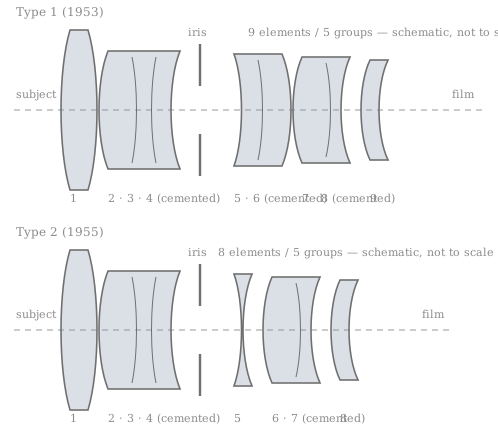
Optical formula — Sonnar type
History
Every telling of the Zunow story starts in wartime. As both MAP Camera and Old Lens Junkies recount it, the Imperial Japanese Navy asked for “a brighter lens” for aviation search and reconnaissance work at a time when f/1.5 defined the state of the art. Old Lens Junkies traces the conception to Michisaburo Hamano (浜野道三郎) in 1943; MAP Camera credits the founder of the Teikoku Optical Research Institute (帝国光学研究所), Sakuta Suzuki (鈴木作太), with carrying an experimental f/1.2 forward into the postwar project. However the credit divides, the outcome is not in dispute: a 12-element prototype was working by 1950, and in 1953 it was refined into a 9-element, 5-group Sonnar-type design and sold as the Zunow 5cm f/1.1 — the fastest lens yet offered for a 35mm camera, and the opening shot of the decade’s ultra-fast-lens race.
The first version wears its ambition on the wrong end: the rear element bulges out of the barrel, earning the collector nickname “ping-pong ball.” Wide open it flares seriously and renders as if through a soft filter — MAP Camera’s staff, shooting an early blue-coated 3000-series example, describe rainbow ghosts that come and go “as capriciously as a cat,” and even speculate that many Type I lenses were computed for the smaller 24×32mm “Nihon” format, which would explain corners that stay dark well after stopping down. When Fuji Photo Film answered in 1954 with an f/1.2 built on newly developed rare-earth glass, the marketing panic pushed Zunow into a full redesign. The 1955 Type II — credited to Kenji Kunitomo, recruited from Nippon Kogaku, and Yoshitatsu Fujioka (romanizations of both names vary across sources) — flattened the rear group into an 8-element, 5-group formula with new glass and a hard coating. The filter shrank from 55mm to 54.5mm, the aperture ring reversed direction, and the changeover falls at roughly serial 5,400.
The lens was sold in Nikon S, Contax RF and Leica screw mounts, with a trap for the unwary that persists in marketplace listings today: the Nikon bayonet version carries a small red “N,” the Contax version is entirely unmarked, and the two mount physically on either body while focusing correctly only on their own. Production numbers are lore rather than record — the total is “said to be 800 or 1000,” no factory figures survive, and surviving Type I examples are believed to number under fifty, an expert opinion passed along by Old Lens Junkies and best treated as exactly that. The S mount is, “it is said,” the smallest production of the three — a dealer’s claim from MAP Camera, offered in their own hedged words.
Teikoku Kogaku renamed itself Zunow Kōgaku Kōgyō (ズノー光学工業) in December 1956 and moved on to a 35mm f/1.7, a 100mm f/2, 8mm cine lenses and the Zunow camera before closing for good on 1 January 1961; no other Zunow focal length has ever been documented in S mount. Survivors trade at $5,000–10,000 today, with exceptional examples reaching $20,000 — steep tribute for a lens whose most loved trait, the veiling glow its designers fought to eliminate, is exactly what the Type II was built to fix.
This history is AI-written, from the sources listed at the foot of the page. Where the record is silent it says so rather than filling the gap — but no human wrote these sentences.
Example photos
More sample photos elsewhere
- bob camera's 131-photo album — Zunow 50mm f/1.1 (L) Black (Flickr)
- RangefinderNotDead's 19-photo Zunow 50mm f/1.1 LTM album (Flickr)
These photographers keep all rights to their work — enjoy it at the source.
Sample photo wanted — shot with a Zunow 5cm f/1.1? We'd love to feature it (with credit).
Live listings
Asking price, USD: a median of $9,900 across 6 fixed-price listings on 2026-10-19 (middle half $8,100–$12,700). Tracked since 2026-09-06, 10 days: down 22% from $12,700.
By day
| Date | Median | Middle half | Listings |
|---|---|---|---|
| 2026-10-19 | $9,900 | $8,100–$12,700 | 6 |
| 2026-10-18 | $9,900 | $8,100–$12,700 | 6 |
| 2026-10-17 | $9,900 | $8,100–$12,700 | 6 |
| 2026-10-16 | $9,900 | $750–$12,700 | 7 |
| 2026-10-15 | $9,900 | $750–$12,700 | 7 |
| 2026-09-21 | $12,700 | $9,900–$13,400 | 5 |
| 2026-09-19 | $12,700 | $9,900–$13,400 | 5 |
| 2026-09-18 | $12,700 | $9,900–$13,400 | 5 |
| 2026-09-11 | $12,700 | $9,900–$13,400 | 5 |
| 2026-09-06 | $12,700 | $9,900–$13,400 | 5 |
Asking prices from the listings scanned, not sales; junk-flagged rows and auction lots excluded; other currencies are not converted.
- SHOTEN TRIBUTE 01 lens 50mm F1.1 LTM Zunow Black For Leica M M39 M240 M3 M6 M9
- Zunow 5cm f1.1 version 2 LTM
- ZUNOW 5cm f/1.1 Lens L39 LTM Mount 50mm Japanese Navy RARE vintage #Z-5770
- Zunow 50mm F1.1 - LTM — SN 5776
- Zunow 50mm F1.1 - LTM; L39 Screw mount lens (94-96%new)
- ZUNOW (L) 50mm F1.1 Silver -Near Mint- 6822
- ZUNOW (L) 50mm F1.1 Silver -EXC- 1387
- ZUNOW (L) 50mm F1.1 Silver -Near Mint- 2336
Listings updated 2026-10-19. Links go to the shop or marketplace that carries the item.