S Heliar 50mm f/3.5
Cosina Voigtländer · Nikon S · 2005 · Heliar
Also known as: Voigtländer S Heliar 50mm f/3.5 · Voigtlander S Heliar 50mm f3.5 · Voigtlander S-Heliar 50mm f/3.5 · S-Heliar 50mm f/3.5 · Heliar S 50mm f/3.5 · Heliar S 50/3.5 · Voigtlander 50/3.5 S Heliar · Cosina Voigtländer Heliar 50mm f/3.5 Nikon S · NHS R2S Heliar 50mm f/3.5
Variants & identification
| Variant | Mount | Years | Serial ranges | Production |
|---|---|---|---|---|
| Nikon S (NHS set, 2005) | Nikon S | 2005–2005 | — | 500 in a single production run; the standalone lenses that reached the market from 2005 on were set-separated stock from that batch, not a second run |
How to tell them apart
- Rigid barrel with no helical of its own — it seats on the body's inner bayonet and is driven by the camera's focusing wheel, or by twisting the lens itself, where the 2001 Leica-screw Heliar it was drawn from collapses into the body and focuses itself
- Clickless diaphragm running f/3.5 to f/22, its markings crowding closer together as you stop down, with a second scale on the opposite side of the barrel because the barrel turns as the body focuses
- 27mm filter thread; the hood feels like solid brass under a satin-chrome exterior, and the push-on front cap seats over it and interchanges with the Leica-screw 101st Anniversary and Nickel Heliars
- A 600-unit Nickel Heliar followed in 2009 in Leica screw mount — the "600 made in S mount" figure in circulation is that lens's number, not this one's
- Nikon S (NHS set, 2005): Distributed inside the Bessa R2S Special Set for the Nikon Historical Society at $999: body, lens, a box marked "Special Set for NHS," and a letter of authentication from NHS founder Robert Rotoloni tying the serial number to the series. The set body wears a piano-black front plate in place of the standard speckled paint, but carries no NHS engraving and no serial prefix, so the lens is the set's only visible identifier. Sales ran through a single US importer. Sets broken up afterwards put loose lenses on the market at $399 in 2005, drifting to about $499 for the last of the stock into the mid-2010s.
Specifications
- Formula
- Heliar
- Construction
- 5 elements
- Aperture range
- f/3.5–f/22
- Min. focus
- 0.9 m
- Filter
- 27 mm
- Years manufactured
- 2005–2005
- Country
- Japan
- Coating
- Multi-coated
- Original price
- $399 standalone in 2005 (today $641); $999 for the NHS R2S Special Set with body, about $499 by the mid-2010s
What reviewers say
- Stephen Gandy (CameraQuest) (blog) — Probably the sharpest lens ever made in Nikon rangefinder mount — the same optics as the Leica-screw original, rebuilt rigid — and a deliberate saving of the best for last as Cosina closed its S line.
- Roger W. Hicks (Shutterbug) (blog) — One of the sharpest 50s ever made and almost reason enough on its own to buy the camera — though the clickless diaphragm makes you realise why click stops are so widely used, and he expects the lens to end up the more collectible half of the set, being the more recognisable of the two.
- Bryan Garris (Valdosta in Film) (blog) — A fantastic lens on the R2S — sharp, contrasty, with an excellent out-of-focus area — held back only by being slow, which put him on a tripod in dark overcast woodland.
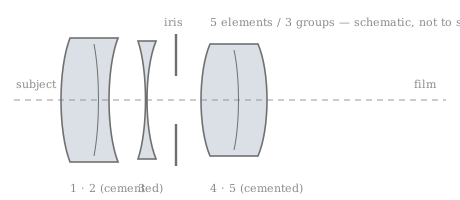
Optical formula — Heliar
History
Cosina announced the S Heliar 50mm f/3.5 in March 2005 and began shipping around the first of May, and that was the end of the line — the last lens of the Voigtländer S series, four years after the first SC Skopars arrived for a mount nobody had built for since the 1960s. All 500 were made in a single run, and all 500 went out inside a camera set: the Bessa R2S Special Set for the Nikon Historical Society, $999, sold in a box marked exactly that, with a piano-black front plate in place of the R2S’s usual speckled paint and a letter of authentication from NHS founder Robert Rotoloni matching the serial number to the series. Nothing on the camera says NHS. The lens is the giveaway.
The two badges Cosina used meant different things. The SC wides — 21, 25, 28, 35 — carry a single external bayonet that serves Nikon S and the Zeiss Contax rangefinders alike, because Nikon copied the Contax mount but not its exact angle of rotation between infinity and close focus, and at wide-angle depths of field that discrepancy disappears. S without the C meant Nikon only: the 50s and the 85, where the divergence bites. The Heliar is an S lens twice over, because a standard lens on a Nikon rangefinder carries no focusing mount at all. The helical lives in the body, running 0.9m to infinity, and the lens seats on the inner bayonet to be turned by the finger wheel beside the shutter release, or by twisting the lens itself. So where the Leica-screw Heliar collapses into the camera and focuses itself, the S Heliar is rigid and rotates as you focus — hence the two aperture scales on opposite sides of the barrel, and a diaphragm running f/3.5 to f/22 with no click stops at all, its markings crowding closer together the further down you go.
The glass was not new. In 2001 Cosina had put a 50mm f/3.5 Heliar into Leica screw mount for the Bessa-T 101 Years sets — the Voigtländer design of 1900, five elements, the anniversary body engraved Heliar 1900–2001 across its back plate — and sold 2,000 of them in one run, the lens available only with the sets. Popular Photography tested it in March 2002 and came back with a verdict that reads like a valediction: SQF results on a par with the best lenses the magazine had ever tested, and a flat doubt that any other commercially made lens would produce superior results. The S version keeps that formula, the 27mm filter thread, and a hood that feels like solid brass under its satin chrome, with a push-on cap that drops over the hood and fits the Leica-screw Heliars too.
Stephen Gandy, who imported the sets and was their only channel, called it probably the sharpest lens ever made in Nikon rangefinder mount, and the people who used one did not much argue. Roger Hicks, writing the set up for Shutterbug in 2008, thought the lens alone almost reason enough to buy the camera, and guessed it would end up the more collectible half of the pair simply because it is the more recognisable object; the clickless diaphragm he found instructive mainly as a demonstration of why click stops are so widely used. Bryan Garris, shooting one on an R2S at Reed Bingham State Park in south Georgia in 2013, called it fantastic — sharp, contrasty, lovely out of focus — and slow enough that a dark overcast day in the woods put him on a tripod.
The counting is where the record knots, and it is worth untying carefully. Five hundred is the distributor’s figure and it covers one run. The loose lenses that surfaced afterwards — $399 in 2005, creeping toward $499 for the last of the stock a decade later, sold with hood and cap but no box — were sets taken apart rather than a second batch, which is why some databases list the lens twice. The other number in circulation, 600, belongs to a different lens: the Nickel Heliar of 2009, a limited reissue in Leica screw mount. It has been repeated on enough forum threads about the S version to have acquired the texture of a fact, and it is not one. A third figure, around a thousand, turns up in passing in shooters’ accounts with nothing at all standing behind it.
This history is AI-written, from the sources listed at the foot of the page. Where the record is silent it says so rather than filling the gap — but no human wrote these sentences.
Example photos
More sample photos elsewhere
- Clay Kippen — "SP / Heliar" film rolls (Nikon SP + Voigtländer 50mm f/3.5 Heliar, Fomapan 400 & Kodak, 2026) on Flickr
- T&T and Mr B Abrahamsson — "G 757" / "H 234" / "F918" roll scans, Bessa R2S + VC Heliar 50mm f3.5 S-mount, on Flickr
- Tveljus — Nikon S2 (EP) and Bessa R2S NHS edition with the s-mount Heliar 50/3.5, on Flickr
These photographers keep all rights to their work — enjoy it at the source.
Sample photo wanted — shot with a S Heliar 50mm f/3.5? We'd love to feature it (with credit).
Live listings
- Beautiful Voigtlander 50mm f3.5 Heliar Lens , Excellent Condition.
- Voigtlaner S Heliar 50mm F3.5 - Nikon S Mount — SN 9520035
- [Top MINT] Voigtlander BESSA R2S 35mm Film Camera + S Heliar 50mm f/3.5 NIKON S
- 【極上品】Voigtlander BESSA R2S Special Set for NHS HELIAR 50mm F3.5 世界500台 #3671
Buying from Yahoo! Auctions outside Japan. It is a domestic marketplace: sellers ship within Japan, and most will not register an overseas buyer. A proxy service bids on your behalf, receives the item and forwards it, for a fee and a wait. Buyee, Jauce and ZenMarket each accept a Yahoo auction number directly. Listed alphabetically for information — none is recommended over another, and none of these is an affiliate link.
Listings updated 2026-10-19. Links go to the shop or marketplace that carries the item.