S Skopar 50mm f/2.5
Cosina Voigtländer · Nikon S · 2003
Also known as: Voigtländer S Skopar 50mm f/2.5 · Voigtlander S-Skopar 50mm F2.5 · S SKOPAR 50mm F2.5 · Color-Skopar 50mm f/2.5 S mount · Color Skopar S 50/2.5 · Cosina Voigtlander 50/2.5 S · Sスコパー 50mm F2.5 · S SKOPAR 50mm F2.5 Sマウント
Variants & identification
| Variant | Mount | Years | Serial ranges | Production |
|---|---|---|---|---|
| Nikon S (2003–2005) | Nikon S | 2003–2005 | — | 600 |
How to tell them apart
- Catalogued as S Skopar; the Leica-screw lens built on the same optics is the Color-Skopar 50mm f/2.5 L. A bare S prefix means Nikon S only, while the SC prefix on the line's wide-angles means Nikon S and the classic Zeiss Contax rangefinders both
- 43mm filter thread and 0.9m close focus; the Leica-screw Color-Skopar built on the same optics takes 39mm filters and reaches 0.75m
- 149g, against 208g for the brass-barrelled Leica-screw lens
- Sits on the body's outer bayonet and carries its own focusing helicoid, where most vintage Nikkor fifties sit on the inner mount and are driven by the camera's; the body's finger wheel turns it either way, and here it rotates the barrel and the aperture ring with it
- Circular cut-out hood, a design later reused on the SL II 40mm f/2 Ultron for SLRs
- Aperture clicks at half-stop detents between the marked numbers; the S Heliar 50mm f/3.5 in the same line has no click stops at all
- Nikon S (2003–2005): Dimensions of φ55.8 × 39.2mm are measured with the hood fitted. Rangefinder coupling runs ∞–0.9m. Supplied with a felt-lined hood that mounts inverted, a focusing handle that clamps over the focusing ring, and the 50mm push-on metal front cap shared with the line's wide-angles and the S APO-Lanthar 85mm f/3.5. Focus turns the opposite way to Cosina's Leica-mount lenses.
Specifications
- Construction
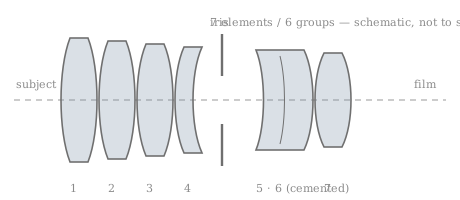
- 7 elements / 6 groups
- Aperture range
- f/2.5–f/22
- Diaphragm blades
- 10
- Min. focus
- 0.9 m
- Weight
- 149 g
- Filter
- 43 mm
- Years manufactured
- 2003–2005
- Country
- Japan
- Coating
- Multi-coated
- Original price
- ¥55,000 ex-tax at the January 2003 Japanese release (today ¥62,000); $319 in the US
What reviewers say
- Richard Haw (blog) — Bought in S mount and shot on a Nikon S2: a sharpness lens, very sharp even wide open with little to gain from stopping down, bold contrast and saturated colour, but heavy vignetting and colour fringing at f/2.5 that clear by f/5.6, poor bokeh against foliage and twigs, pincushion distortion he expected a modern design to beat, and ghosts off bright bulbs despite the modern coatings — he recommends it warmly while admitting he prefers the gentler drawing of a real classic.
- mynakedsoda (DPReview forums) (blog) — After a month of daily use adapted to a NEX-3, still a true jewel optically and in build — so good wide open that the modest f/2.5 stops mattering, and he can think of no more compact solution; overpriced at list, he thought, but a bargain at the closeout price.
- Alupang (DPReview forums) (blog) — His everyday carry-everywhere lens on a NEX: smooth rendering with the colour and contrast he calls the Skopar look, no corner smearing or colour shift, all-metal and tiny, and at $199 an easy recommendation — better built than his Leica-mount Color-Skopar 35mm f/2.5, and worth the quirks to save $400 over the screw-mount version.
Optical formula
History
About six hundred were made, and that was the end of it. The S Skopar 50mm f/2.5, launched in 2003, was a brand-new standard lens for the Nikon rangefinder mount some four decades after Nikon stopped making lenses for it — the plainest item in the short Voigtländer line Cosina built for classic rangefinder bodies, and the one whose name is most exact about who it was for. A bare S in that line means Nikon S and nothing else. The prefix SC, worn by the line’s wide-angles, means the Nikon S bodies and the classic Zeiss Contax rangefinders alike, Kiev copies included: one lens, two systems, because a wide lens’s depth of field papers over the fact that Nikon copied Contax’s bayonet and back focus without copying its focusing rotation. From 50mm up that divergence starts to bite, so the longer lenses were Nikon-only and got the bare S.
It arrived with a body to put it on. Cosina had shown the Bessa R2S at Photokina in 2002 — the first and only production rangefinder with TTL metering in the classic Nikon mount — and built it until 2005; the S lenses were for that camera and for the S2s and SPs already in collectors’ hands. Optically the Skopar is the Leica-screw Color-Skopar 50mm f/2.5 of April 2002 carried over unchanged: seven elements in six groups, a count Cosina itself called unusual for the 50mm f/2.5 class, with ten blades, f/2.5 to f/22 and a 46-degree field. The name is borrowed and nothing more — the original Voigtländer Skopar was a four-element Tessar type, and this shares nothing with it but the word.
Everything around the glass was rebuilt for the mount. The barrel takes 43mm filters — the size a long string of classic Nikkor rangefinder lenses use, the 50mm f/1.4 among them — where the screw-mount lens takes 39mm. It sits on the body’s outer bayonet rather than the inner mount most vintage Nikkor fifties use, and is focused from the camera’s finger wheel, which turns the whole barrel and the aperture ring with it; a focusing handle came in the box for anyone who would rather grip the lens. Rangefinder coupling stops at 0.9m where the screw-mount lens reaches 0.75m. It is also much lighter, 149g against 208g, the screw-mount lens having a brass barrel. The hood is an odd circular cut-out design Cosina liked enough to reuse years later on an SLR lens, the SL II 40mm f/2 Ultron. List was ¥55,000 before tax in Japan and $319 in the United States — ¥7,000 to ¥10,000 more than the screw-mount lens, catalogued at ¥45,000 in silver and ¥48,000 in black paint. Stephen Gandy, who imported the line, put the difference down to the S bayonet needing considerably more machining than a thread.
The dates do not quite agree. Cosina’s own catalogue records a January 2003 release and gives April 2005 as the end of production; CameraQuest, the US distributor, put availability at September 2003. How many were made is a single-source fact: CameraQuest states 600, as it states a figure for every lens in the line, and no Japanese source publishes a count at all — the numbers presumably went from Cosina to its distributor and no further. What is not in doubt is that the line sold badly. It had been scheduled as limited runs from the outset, sales never justified a second one, and the S and SC lenses were formally discontinued and put on closeout in March 2007; by late 2011 a $319 lens was going out the door at $199, with Gandy telling customers to buy now because the only modern glass ever made for these bodies would end up collectible. He was right.
On the evidence of people who have actually shot it, this is a sharpness lens. Richard Haw, who bought his in S mount and put it on a Nikon S2, found it very sharp wide open with little to gain from stopping down, with bold contrast, saturated colour and a flat focus transition he calls a “wall-of-focus” — the price being heavy vignetting and visible fringing at f/2.5 that clear by f/5.6, poor bokeh whenever foliage and twigs sit in the background, pincushion distortion he expected a modern design to beat, and ghosting off bright bulbs despite the modern coatings. His verdict is that it renders like exactly what it is, a modern lens: clean, a little generic, which is either the point or the problem depending on why you picked up a 1950s camera in the first place. Owners who adapted it to the early Sony NEX bodies in 2011 were more straightforwardly enthusiastic — a jewel optically and in build, good enough wide open that f/2.5 stops feeling slow, all-metal, and about as small as a rangefinder fifty gets.
This history is AI-written, from the sources listed at the foot of the page. Where the record is silent it says so rather than filling the gap — but no human wrote these sentences.
Example photos


More sample photos elsewhere
- Leo Roos — "Voigtlander S Skopar 50mm F2.5 (Nikon S-mount)" on Sony A7R II, Zeeland / Scheldt series (4 photos)
- Steve / PositiveAboutNegatives — Nikon S2 + CV 50mm f/2.5, Florida black-and-white film set (12 photos)
- Flickr tag "voigtlandersskopar50mmf25" — cross-photographer S-Skopar pool incl. B. Abrahamsson's Nikon SP "Nikon RF Month" frames and Kittisuk S's Fruit series (40 photos)
These photographers keep all rights to their work — enjoy it at the source.
Sample photo wanted — shot with a S Skopar 50mm f/2.5? We'd love to feature it (with credit).
Live listings
- [Top Mint] Voigtlander S Skopar 50mm f/2.5 Nikon S Lens from Japan 464
- 【Unused】 Voigtlander Bessa R2S Rangefinder black S Skopar 50mm f/2.5 Lens JAPAN
Listings updated 2026-10-17. Links go to the shop or marketplace that carries the item.