SC-Skopar 21mm f/4
Cosina Voigtländer · Nikon S + Contax RF · 2001 · Symmetrical
Also known as: Voigtländer SC-Skopar 21mm f/4 · Voigtlander SC Skopar 21mm F4 · Voigtlander SC-Skopar 21/4 · SC-SKOPAR 21mm/4 · Cosina Voigtländer SC Skopar 21mm f/4 · Voigtlander SC 21mm f4 Nikon S
Variants & identification
| Variant | Mount | Years | Serial ranges | Production |
|---|---|---|---|---|
| Nikon S / Contax RF (one shared version) | Nikon S | 2001 | — | 900 — a single planned run, never repeated after slow sales |
How to tell them apart
- Engraved SC-SKOPAR: the Leica-mount namesake is a COLOR-SKOPAR, and only the SC version carries the external Nikon/Contax bayonet
- Black barrel with a white-chrome aperture ring, styled after the classic Nikkor rangefinder wides; the SC 21, 25 and 28 share one barrel and differ only in the lettering
- Focal length engraved on the barrel in small red type
- Aperture ring rides outboard, next to the hood — the vintage Nikkor wides it imitates turn their aperture ring inside the filter ring instead
- 43mm filter screws into a recessed inner thread inside the aperture ring and the slim hood onto the outer thread, so a fitted filter vanishes under the hood; this hood extends 4mm against 6mm for the SC 25 and 35
- Complete examples include a 21mm brightline finder, screw-in hood, slip-over focusing-wheel grip and the 50mm push-on front cap shared across the SC line
- Nikon S / Contax RF (one shared version): One external-bayonet version serves Nikon S bodies, the classic Zeiss Contax rangefinders and the Soviet Kiev copies alike — the Nikon/Contax helical divergence that spoils telephoto focus is masked by a 21mm's depth of field. Focus runs through the body's internal helical and focusing wheel.
Specifications
- Formula
- Symmetrical
- Construction
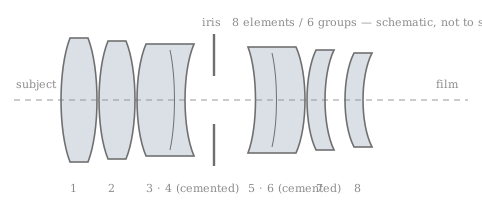
- 8 elements / 6 groups
- Aperture range
- f/4–f/22
- Min. focus
- 0.9 m
- Weight
- 140 g
- Filter
- 43 mm
- Years manufactured
- 2001
- Country
- Japan
- Coating
- Multi-coated
- Original price
- $459 (today $813) — brightline finder included
What reviewers say
- Gigantoptik (기간트옵틱) (blog) — A light, modern S-mount 21 he rates nearly equal to the legendary Biogon 21/4.5 in resolution and better against flare — held back only by barrel distortion it "cannot completely control." via machine translation — corrections welcome
- Stephen Gandy (CameraQuest) (blog) — Sharp multi-coated optics identical to the Leica-mount version, in a barrel whose machining and finish he rates far above the plastic norm — and the included brightline finder is a joy to use; his one complaint is focal length marked in small red type he wishes were larger and white.
Optical formula — Symmetrical
History
Cosina announced the SC-Skopar 21mm f/4 in February 2001 and delivered it that October: the first new wide-angle lens for the Nikon S and classic Zeiss Contax rangefinders in some thirty-seven years, and the widest of the three that launched together. The S-C is literal — S for Nikon’s S series, C for the classic Zeiss Contax rangefinders of the thirties to the fifties, whose bayonet Nikon had copied — and there is only one version of the lens, a single external-bayonet barrel that mounts on both systems and on the Soviet Kiev copies as well. That trick works because Nikon copied the Contax mount and back focus but not its helical rotation, a divergence that wrecks focus on telephotos and is simply swallowed by the depth of field of a 21mm. Cosina scheduled one run of nine hundred, and slow sales meant it was never repeated.
Before it arrived, a 21 on a Nikon rangefinder was mostly theoretical. Nippon Kogaku’s own Nikkor-O 2.1cm f/4 ran to roughly three hundred units by Stephen Gandy’s count and came with a mediocre finder; Zeiss’s 21mm f/4.5 Biogon was more plentiful, and fits the Nikon bodies too, but it was still hard to find, heavy, expensive and no better served for framing. Gandy, who imported the SC line into the United States, made the obvious argument: nobody shoots a lens they can neither find nor afford. At $459 with a brightline finder in the box, the Skopar answered both halves. Cosina’s president Hirofumi Kobayashi (小林博文) was himself a Nikon rangefinder enthusiast, and the Korean reviewer at Gigantoptik ties the timing directly to Nikon’s S3-2000 reissue, which put working S-mount bodies back on dealers’ shelves and made converting the existing Leica-screw designs to the old bayonet worth the machining. Whatever prompted it, the result was the first multi-coated wide angle ever made for either mount — a black barrel with a white-chrome aperture ring, deliberately styled after the classic Nikkor wides and sharing their 43mm filter thread.
The comparison everyone reached for was the Biogon. Gigantoptik, shooting it on a Nikon SP and an S3, found the Skopar essentially the Biogon’s equal in resolution, color and corner falloff, and its superior against flare and ghosting thanks to the modern coating — but its inferior in distortion, and did not hide that this was the one thing keeping the older lens from being made redundant. The cause is structural: where the Biogon buries an enormous rear element almost against the film plane, the Skopar’s rear group is of ordinary length, which buys the compact barrel and a standard rear cap at the cost of straight lines that bow gently near the edges. Handling was the quieter win. Vintage Zeiss and Nikkor wides are stiff enough that driving them from the body’s focusing wheel is bad practice — lean on it and you can strain the focusing gear — while the SC lenses turn lightly enough to make the wheel genuinely usable, and a slip-over grip came in the box for anyone who preferred to focus at the lens instead. The one complaint that survives the praise is that the half-stop aperture ring sits so close to the focusing ring that a careless grip drags the aperture along with it.
Commercially it went nowhere, and the 21 was not alone: the eight hundred 25mm f/4s and seven hundred 35mm f/2.5s announced beside it each got exactly one run as well. Those figures come from CameraQuest alone, the American distributor; no Japanese source publishes counts for the line. The Bessa R2S and R2C bodies that finally gave these lenses a modern home appeared at Photokina 2002 and ran to 2005, a planned SC 35mm f/1.2 Nokton got three prototypes before being cancelled outright, and the last of the S and SC lenses were built that same year — though the range was not formally declared discontinued and on closeout until March 2007, two years of distributor stock later. What is left is a small, strange artifact: nine hundred modern multi-coated 21mm lenses built for a camera system its own maker had walked away from four decades earlier.
This history is AI-written, from the sources listed at the foot of the page. Where the record is silent it says so rather than filling the gap — but no human wrote these sentences.
Example photos
More sample photos elsewhere
- Jeff Ducksler — "Voigtländer SC-Skopar 21mm f4 Nikon S-Mount" album (22 frames, Nikon S2 on Fujicolor 100)
- Man with Red Eyes — 23 frames tagged "SC Skopar 21mm f4", shot on Nikon S3 Olympic and Nikon S2 (mostly B&W film)
- komehachi888 (8 Kome) — 19 frames tagged "SC Skopar 21mm F4", shot on a Voigtländer Bessa R2S
These photographers keep all rights to their work — enjoy it at the source.
Sample photo wanted — shot with a SC-Skopar 21mm f/4? We'd love to feature it (with credit).
Live listings
Listings updated 2026-10-17. Links go to the shop or marketplace that carries the item.