Nikkor-O 2.1cm f/4
Nippon Kogaku · Nikon S + Nikon F · 1959 · Symmetrical (Wakimoto type)
Also known as: Nikkor 2.1cm f/4 · Nikkor 21mm f/4 · Nikkor-O 21mm f/4 · Nikkor-O 2.1cm F4 · Nikkor O 2.1cm f4 · NIKKOR-O 1:4 f=2.1cm · Nippon Kogaku 2.1cm f/4 · Nippon Kogaku 21mm f/4 · 2.1cm/4 · Nikkor-O 2,1cm f/4 · Nikon 21mm f/4 mirror-up
Variants & identification
| Variant | Mount | Years | Serial ranges | Production |
|---|---|---|---|---|
| Nikon S | Nikon S | 1959–1960 | 621001–621330 | Disputed — 298 per gigantoptik.com's claimed factory-records figure (a single hobby site, which itself notes ~330 examples reported from serial listings) vs ~300 per Kuno vs ~330 by serial span vs up to ~600 per NHS/Pacific Rim estimates; no authoritative figure |
| Nikon F (mirror-up) | Nikon F | 1959–1967 | 220101–220102 (prototypes) 220111–220301 (first series, from Oct 1959; large 360° rear collar) 220347–220511 ('Pat. Pend.' engraving) 220578–221943 ('Pat. Pend.'; modified rear) 221946–223906 225001–227158 (revised mount also fits Nikkormats; run ended Sep 1967) | ~5,956 by serial-span arithmetic across prototypes, first series, and the Nikkormat-fit series vs 7,163 per cameraquest.com — no factory total published |
How to tell them apart
Nikon S:
- 43mm attachment size (the F-mount version takes 52mm)
- Compact W-Nikkor-style barrel; the deeply protruding rear group with its protective claw guard is the giveaway from the rear
- Dedicated 2.1cm finder mounts on an accessory shoe molded into the deep rear cap
Nikon F (mirror-up):
- Rear group reaches to within ~7mm of the film plane — usable only with the mirror locked up, on the Nikon F and F2
- 52mm filter thread; all-manual aperture
- Late examples (serials 225001 up) have a revised mount with a thinner overlap that also fits Nikkormat FT-series bodies
- Nikon S: Serial dating brackets the run May 1959 – June 1960, consistent with a sales window of about a year before the F system swept the rangefinder era away. Market values run $3,000–6,000 against under $500 for the optically near-identical F-mount version.
- Nikon F (mirror-up): Optically identical to the S-mount lens except a small modification to the rear element. On sale December 1959 through September 1967 — well past the end of the rangefinder system itself.
Serial-range notes
- 221542–221735
- Within the F-mount 'Pat. Pend.' block, some examples carry a dot engraved after the serial number.
- 621526
- A reported example above the 621001–621330 span — the highest S-mount serial on record.
- 600001–601656
- The dedicated 2.1cm optical finder ran its own serial sequence, roughly 1,600 made — F-mount users needed the finder too, since the mirror stays locked up and the prism shows nothing.
Specifications
- Formula
- Symmetrical (Wakimoto type)
- Construction
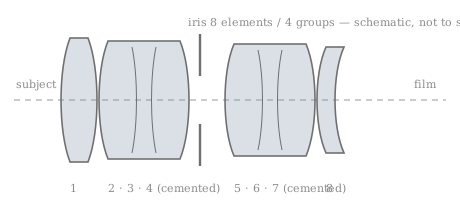
- 8 elements / 4 groups
- Aperture range
- f/4
- Min. focus
- 0.9 m
- Weight
- 150 g
- Filter
- 43 mm (Nikon S) · 52 mm (Nikon F (mirror-up))
- Years manufactured
- 1959–1967
- Country
- Japan
What reviewers say
- Richard Haw (blog) — Good central sharpness from f/5.6 and simpler, less-complicated distortion than the retrofocus wides (though more of it than the near-zero folklore claims), but subdued contrast and visible chromatic and spherical aberration wide open — and it performs terribly on digital sensors, so he calls it a film-only lens to shoot for fun, pointing practical buyers to the retrofocus 20mm Nikkors instead.
- Richard Haw (blog) — On a Nikon SP the S-mount version is compact, nimble, and enormous fun — the widest Nikkor of the rangefinder system — but at collector prices he wouldn't recommend it over a Voigtländer 21mm, which is better optically and far more practical.
- Jake Horn (blog) — Resolution is a touch soft but color has a cool yet vibrant feel; uneven sky exposure at shutter speeds beyond 1/500 traced to the 7mm rear-element clearance, and best results at f/8–f/16 — recommended to anyone still shooting an original F, though he wouldn't urge others to seek one out when a 20mm f/3.5 AI performs better for less.
- airこん (rd1digital.exblog.jp) (blog) — None of the hazy, sluggish rendering of early retrofocus wides — giving up reflex viewing for the mirror-up symmetrical design bought image quality clearly better than its F-mount contemporaries, and that plus the charm of external-finder shooting kept it a cult item of the used-camera boom. via machine translation — corrections welcome
- Gigantoptik (기간트옵틱) (blog) — Delicate, low-contrast but sharp-lined Topogon-style rendering — softer edges wide open for Super-Angulon-style emotive shots, needing f/11–16 to approach the Biogon's corner-to-corner bite — prized above all as the rarest practically usable S-mount collectible. via machine translation — corrections welcome
Optical formula — Symmetrical (Wakimoto type)
History
When Nikon began telling the stories of its own lenses in the long-running “NIKKOR — The Thousand and One Nights” essay series, it chose this one to open with: installment No.1 is the Nikkor-O 2.1cm f/4. Announced in both mounts together at the June 1959 IPEX show, it was the widest lens ever offered for the Nikon rangefinder system — and, in its mirror-up F-mount form, the widest Japanese lens for SLR photography at its debut. Designer Zenji Wakimoto (脇本善司, 1924–1996) gave it a fully symmetrical eight-element, four-group construction that Nikon calls the “Wakimoto type”; Japanese Wikipedia instead files it as a Rusinov type, designed around Bertele’s Biogon patent — the essay itself takes care to distinguish it from the Biogon’s structure.
The design’s refusal of the retrofocus compromise is the whole story. Nikon’s essay — written by Haruo Sato (佐藤治夫) — locates the invention in the two cemented three-element groups flanking the aperture, and the price of that symmetry is a rear group reaching to within about 7mm of the film plane. On the Nikon F that meant locking the mirror up, focusing by the distance scale, and framing through an external finder riding the camera’s accessory shoe; the finder also mounts on a shoe molded into the lens’s deep rear cap, a detail collectors still check for. Sato’s essay also preserves a memorable portrait of the designer: Wakimoto was known for dangling his legs off the edge of the unfenced Ohi plant roof — and later walking along it — antics that reportedly prompted the installation of safety fencing.
The two mounts had opposite fates. The S-mount version, serials 621001 up, arrived just as the F was ending the rangefinder era: serial dating brackets its run at May 1959 to June 1960, and the confirmed span reaches only 621330 (one reported example runs as high as 621526). How many were made is genuinely unsettled, and the estimates are worth keeping side by side: 298 per a claimed factory-records figure on gigantoptik.com — a single hobby site, which itself notes ~330 examples reported from serial listings — against roughly 300 per Mikio Kuno (久野幹雄), ~330 by the serial span, and up to ~600 per NHS and Pacific Rim Camera estimates. The F-mount version, on sale from December 1959, ran nearly a decade to September 1967 across prototypes, a first series, and a late Nikkormat-fit mount revision — roughly 5,956 by serial-span arithmetic (a 7,163 figure also circulates), plus about 1,600 separately serialized finders. Per Rotoloni and the NHS, the two are optically identical except for a small modification to the rear element.
That near-identity is what makes the family the poster child for the undervalued sibling: S-mount examples trade at $3,000–6,000 while the same glass in F mount changes hands for under $500. Reviewers past and present land in roughly the same place — simple, honest distortion and real sharpness stopped down, genuine charm on film, real hazards anywhere near a digital sensor — and the cheap version delivers all of it. The expensive one delivers something else: the final, widest statement of the Nikon rangefinder system, made in its last year of life.
This history is AI-written, from the sources listed at the foot of the page. Where the record is silent it says so rather than filling the gap — but no human wrote these sentences.
Example photos
More sample photos elsewhere
- Hubert Chunghao Chao — Flickr album "Nikkor-O 2.1cm F4": street scenes shot with the 1959 lens, which he notes performs beautifully in direct sunlight (CC BY-NC-ND, so link only)
- masaki-yamamoto — Flickr photos tagged nikkoro21cmf4: three film samples including "Old Town Foxes", shot on a Nikon F with the Nikkor-O 2.1cm f/4, YA3 filter and Neopan Presto 400 (all rights reserved)
- Jake Horn Photography — Nikkor-O 2.1cm f/4 review with sample photographs (USS Midway and others) shot on a Nikon F with Ektar 100
These photographers keep all rights to their work — enjoy it at the source.
Sample photo wanted — shot with a Nikkor-O 2.1cm f/4? We'd love to feature it (with credit).
Live listings
Asking price, USD: a median of $600 across 12 fixed-price listings on 2026-10-19 (middle half $520–$820). Tracked since 2026-09-06, 8 days: up 9% from $550.
By day
| Date | Median | Middle half | Listings |
|---|---|---|---|
| 2026-10-19 | $600 | $520–$820 | 12 |
| 2026-10-18 | $600 | $520–$820 | 12 |
| 2026-10-17 | $600 | $520–$820 | 12 |
| 2026-10-16 | $600 | $520–$820 | 12 |
| 2026-10-15 | $600 | $500–$670 | 9 |
| 2026-09-21 | $550 | $500–$600 | 10 |
| 2026-09-18 | $500 | $400–$600 | 8 |
| 2026-09-06 | $550 | $500–$680 | 10 |
Asking prices from the listings scanned, not sales; junk-flagged rows and auction lots excluded; other currencies are not converted.
- Nikon Nikkor-O 2.1cm 21mm f4 Nippon Kogaku Lens w/Finder #119
- Nikon Nikkor 2.1 CM F4 with viewfinder
- NIKON NIKKOR-O 2.1CM F4 Lens Vintage Camera Accessory
- Nikon Nippon Kogaku Japan Nikkor-O 1:4 f=2,1cm für Nikon F
- Nikon Nikkor-O 2.1cm f/4 Lens with View Finder Made in Japan
- [Mint in Box w/ Case] Nikon Nikkor-O 2.1cm 21mm f/4 F-Mount MF Lens from Japan
- Nikon 2.1cm F/4 Nikkor-O Vintage Nikon F 21mm Wide Angle Lens w/ Finder
- NIKON LENS NIKKOR-O 2.1CM F4 Used
- NIKON OBJEKTIV NIKKOR-O 2,1CM F4 gebraucht
- NIKON LENS NIKKOR-O 2.1CM F4 Used
- Nikon NIKKOR-O 21mm f/4 Wide Angle F Mount with Viewfinder Set From Japan M0928
- Nikon Nikkor-O Nippon Kogaku 21mm F4.0 Objektiv
- [Used] Average Condition Nikon Nikkor 21mm F4 [ Lens | ]
- 【Condition】《》 Nikon Nikkor 21mm F4 [Lens | ]
- Nikon F - Black Paint with Nikkor-O 21mm F4 F Mount & extra (88-89%new)
- Nikon Lens and Finder NIKKOR-O 2.1CM F4 Used
- Nikon Lens and Finder NIKKOR-O 2.1CM F4 Used
- @RARE@ Nikon Nippon Kogaku Nikkor-o 21mm f/4 for Nikon F F2 Full Set in Box
- ※ 美品 希少 Nikon ニコン ファインダー付 単焦点レンズ F Nikkor-O 21mm 2.1cm f4 前後キャップ 3898
Buying from Yahoo! Auctions outside Japan. It is a domestic marketplace: sellers ship within Japan, and most will not register an overseas buyer. A proxy service bids on your behalf, receives the item and forwards it, for a fee and a wait. Buyee, Jauce and ZenMarket each accept a Yahoo auction number directly. Listed alphabetically for information — none is recommended over another, and none of these is an affiliate link.
Listings updated 2026-10-19. Links go to the shop or marketplace that carries the item.