SC-Skopar 35mm f/2.5
Cosina Voigtländer · Nikon S + Contax RF · 2001
single source, unconfirmedAlso known as: Voigtländer SC-Skopar 35mm f/2.5 · Voigtlander SC Skopar 35mm f/2.5 · SC SKOPAR 35mm F2.5 · SC-Skopar 35/2.5 · Cosina Voigtländer SC Skopar 35mm F/2.5 · Voigtlander SC 35/2.5 · Voigtlander 35/2.5 SC
Variants & identification
| Variant | Mount | Years | Serial ranges | Production |
|---|---|---|---|---|
| Nikon S / Contax RF (one shared version) | Nikon S | 2001 | — | 700, the one scheduled run — slow sales cancelled any second |
How to tell them apart
- Engraved SC-Skopar and mounts on the body's outer three-claw bayonet; the same optics in Leica mount are engraved Color-Skopar
- Aperture ring sits outside the barrel next to the screw-in hood — the vintage 25mm, 35mm f/2.5 and 35mm f/3.5 Nikkors change stops on a ring inside the filter ring
- Focal length engraved on the barrel in small red figures
- Two aperture scales, so one stays readable as the whole lens rotates while focusing
- 43mm filter thread, shared with the classic Nikon rangefinder 21mm f/4, 28mm f/3.5, 35mm f/3.5, 35mm f/2.5, 35mm f/1.8, 50mm f/1.4 and 135mm f/3.5
- Chrome screw-in hood appears only on the prototypes, never on production lenses
- Hood interchanges with the 25mm f/4; both extend 6mm, against 4mm for the 21mm f/4
- Slip-over focusing collar included with production lenses, for turning the barrel instead of the body wheel
- Nikon S / Contax RF (one shared version): Announced February 2001 alongside the 21mm f/4 and 25mm f/4 as the original SC trio; pre-production samples circulated in June 2001 and deliveries began that October.
Specifications
- Construction
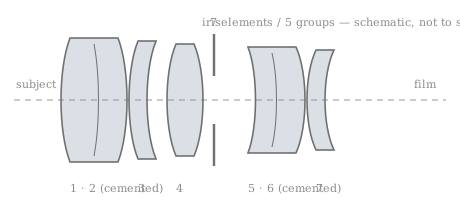
- 7 elements / 5 groups
- Aperture range
- f/2.5–f/22
- Min. focus
- 0.9 m
- Weight
- 141 g
- Filter
- 43 mm
- Years manufactured
- 2001
- Country
- Japan
- Coating
- Multi-coated
- Original price
- $319 (today $565)
What reviewers say
- Stephen Gandy (CameraQuest) (blog) — What strikes him first is the build: a startlingly solid lens, made like the classic Nikon rangefinder wides, with mechanical fit and finish he rates "quite high in today's age of plastic" and a mount needing considerably more machining than the Leica screw-mount equivalents; focusing, aperture ring and mounting all work smoothly. His one grumble is the focal length marked in small red figures he wishes were bigger and white.
- Roger W. Hicks (Shutterbug) (blog) — Testing it on the new Bessa R2S he found little to say about the optics — the system exploits any modern film to the limits of its resolution at all but the widest and smallest apertures — and, against the traditional practice of focusing everything but a 50 on the lens collar, found the body's finger wheel more convenient than either the collar or the extension ruffs. Of everything on offer, this and the 50mm f/1.5 Nokton are the two he would leave on an R2S.
- davidde (davidde.com) (blog) — Weighing every 35mm a Nikon rangefinder owner can buy — the three vintage W-Nikkors, the Contax Biogons, the third-party options — he calls the S-mount Voigtländer "an excellent lens and probably the best overall S-mount 35mm."
Optical formula
History
In February 2001 Cosina did what no manufacturer had done in thirty-seven years: it announced brand-new wide-angle lenses for the Nikon S and classic Zeiss Contax rangefinders, mounts that had gone out of production in 1963 and 1961 respectively. The 35mm f/2.5 was the longest of the original SC-Skopar trio — 21mm f/4, 25mm f/4, 35mm f/2.5, with the 28mm f/3.5 following only in September 2003 — and the hyphen in S-C carries the whole idea: S for the Nikon S series, C for the classic Contax, a single lens that fits both, and the Soviet Kiev copies besides. Nikon had copied the Contax bayonet and its back focus but not its rotation from close-up to infinity, a divergence Shutterbug put at 268 degrees on one mount against 277 on the other over the same travel to 0.9m. On a fast or long lens that gap shows up as missed focus. At 35mm and f/2.5 the depth of field simply swallows it — which is why the wides could be one shared lens while the 50mm and 85mm Voigtländers that came later had to be built Nikon-only.
Stephen Gandy, the US distributor, opened a box of pre-production 21s, 25s and 35s in early June 2001 and drove down to Long Beach to photograph the retired Queen Mary with them mounted on black motorised Nikon SPs; production lenses reached buyers that October at $319. Optically it is the Leica-mount Color-Skopar 35mm f/2.5 transplanted — seven elements in five groups, multi-coated, and one of the first three multi-coated wide angles ever sold for either mount. The physical lens is deliberately of a piece with the cameras it serves: 141 grams, a 43mm filter thread shared with Nikon’s own 21mm f/4, 28mm f/3.5, the three vintage 3.5cm lenses, the 50mm f/1.4 and the 135mm f/3.5, 0.9m close focus, a screw-in hood that interchanges with the 25mm. It rides the outer of the body’s two three-claw bayonets and focuses through the index-finger wheel, which turns the entire lens — hence the two aperture scales, one always facing you — and Cosina included a slip-over collar for anyone who preferred to grip the barrel. Gandy’s verdict on first handling was that the thing is astonishingly heavily built, of a piece with the classic Nikon rangefinder wides.
The lenses arrived before there was a new camera to put them on: the Bessa R2S and R2C, the first rangefinders ever made in these mounts with through-the-lens metering, only appeared at Photokina in 2002. For a year the SC-Skopars existed purely to be bolted onto forty-year-old Nikons, Contaxes and Kievs. Cosina scheduled a single run of 700 for the 35mm f/2.5 and, sales having disappointed, never ordered a second; a 35mm f/1.2 SC Nokton Aspherical got as far as three prototypes before Cosina cancelled it for the same reason, and the SC line was eventually discontinued and cleared at closeout. Every production figure for the whole SC family — 900, 800, 700, and the rest — comes from CameraQuest, and Gandy alone published them; no Japanese source puts a number to these lenses, so the counts stand on one distributor’s word.
Reception has been quietly consistent across two decades. Hicks, reviewing the R2S in 2003, dared to whisper that most or all of the new Voigtländers were better than the forty- and fifty-year-old Nikkors they joined, and named this lens and the 50mm f/1.5 Nokton as the two he would leave mounted on the camera. In 2021, surveying every 35mm a Nikon rangefinder owner can buy, davidde called it an excellent lens and probably the best overall S-mount 35mm. The reference databases have been less attentive — thelensdb’s S-mount list omits the lens entirely, which is part of why it is easy to miss. One warning for buyers: the same 35mm f/2.5 optics were sold in Leica mount under the Color-Skopar name, and that is the lens most listings mean. The SC is the one engraved SC-Skopar, on the three-claw external bayonet, coupled to the camera’s focusing wheel, and a listing that says only “Voigtländer 35mm f/2.5 Skopar” is almost certainly not it.
This history is AI-written, from the sources listed at the foot of the page. Where the record is silent it says so rather than filling the gap — but no human wrote these sentences.
Example photos
More sample photos elsewhere
- phlsphdr — "SC Skopar 35" 2010 test roll (12 frames, ISO 400, Contax rangefinder)
- Taomeister — SC Color Skopar 35mm f/2.5 on Nikon SP, Mercer Island WA 2018 (tagged set)
- Gordon Bell (Gordy Pops) — "Boxer", Voigtländer Bessa R2S + SC Skopar 35mm f/2.5, Kodak 400TX
These photographers keep all rights to their work — enjoy it at the source.
Sample photo wanted — shot with a SC-Skopar 35mm f/2.5? We'd love to feature it (with credit).
Live listings
Asking price, USD: a median of $370 across 3 fixed-price listings on 2026-09-21 (middle half $280–$370). Tracked since 2026-09-06, 3 days: down 4% from $390.
By day
| Date | Median | Middle half | Listings |
|---|---|---|---|
| 2026-09-21 | $370 | $280–$370 | 3 |
| 2026-09-18 | $400 | $280–$400 | 3 |
| 2026-09-06 | $390 | $280–$390 | 3 |
Asking prices from the listings scanned, not sales; junk-flagged rows and auction lots excluded; other currencies are not converted.
- [Near Mint] Voigtlander SC Skopar 35mm f/2.5 Nikon S w/Focus Tab From Japan
- CLA'd [fast neuwertig + Haube] Voigtländer SC SKOPAR 35mm F2.5 Objektiv...
- Voigtländer Cosina SC SKOPAR 35mm F2.5 S Mount Objektiv / mit Haube,...
Listings updated 2026-10-19. Links go to the shop or marketplace that carries the item.