Nikkor-S·C 5cm f/1.5
Nippon Kogaku · Nikon S + LTM · 1949 · Sonnar
Also known as: Nikkor 5cm f/1.5 · Nikkor 50mm f/1.5 · Nikkor-S.C 5cm f/1.5 · Nikkor-S·C 5cm f/1.5 · Nikkor-SC 5cm f1.5 · Nikkor-S 5cm f/1.5 · Nikkor-S 50mm f/1.5 · Nikkor-S.C 50mm f/1.5 · Nippon Kogaku 5cm f/1.5 · 5cm f1.5
Variants & identification
| Variant | Mount | Years | Serial ranges | Production |
|---|---|---|---|---|
| Nikon S bayonet | Nikon S | 1949–1950 | 9052xx–905520 (905 batch, serial-dated May 1949 — mounts interleaved, fewer pure-S survivors) 907163–907734 (907 batch, serial-dated July 1949 — higher proportion S-mount) | Family total ~800–1,100 across both mounts; per-mount split CONFLICTS between sources — CameraQuest estimates ≈500 Nikon S, while Sweeney's 2016 research says fewer than 800 total with about 400 in Leica mount and fewer in S, and a detailed source cited by Will gives ~389 in Nikon S bayonet with more in LTM |
| Leica screw mount | LTM | 1949–1950 | Interleaved within the same 905/907 batches — no separate LTM serial block; the 905 batch (May 1949) had more LTM mixed in | Per-mount split CONFLICTS: ≈300 (CameraQuest estimate) vs about 400 in Leica mount, more than the S-mount total (Sweeney 2016; a detailed source cited by Will similarly puts ~389 in Nikon S with more in LTM) |
How to tell them apart
Nikon S bayonet:
- Marked S·C, engraved 5cm; chrome only — no black version
- Stops down only to f/11, not f/16
- Aperture is set by the second, inner knurled ring — the outer knurled ring is fixed, unlike the later f/1.4
- 40.5mm accessory/filter size (shared with the 5cm f/2, not the f/1.4's 43mm); 12 aperture blades; no click stops
- Easily mistaken for the very similar-looking f/1.4 — read the f-stop engraving
Leica screw mount:
- Same chrome barrel and second-ring aperture control as the S-mount lens; Leica 51.6mm focal-length standard (Sweeney)
- Leica screw mount: The mount David Douglas Duncan used in Korea on his Leica IIIc — his lens was a 905-batch example (Sweeney, whose own #189 sits a few serials below it). Recent LTM examples have listed at $2,800–3,600+.
Serial-range notes
- 9052xx–905520
- 905 batch, serial-dated May 1949: the smaller batch, more LTM mixed in, fewer pure-S survivors (Will + NHS agree). Batch '906' was skipped — reason unknown.
- 907163–907734
- 907 batch, serial-dated July 1949: the larger batch, higher proportion S-mount.
- 907132, 907538
- Market sightings beyond the recorded 907 batch: 907132 (Leitz Auction, S-mount with chrome front cap, €1,800 incl. premium) sits just below the recorded 907163 start; 907538 (eBay, 2026) extends the recorded top of the batch.
- 90535x
- Early 905-batch example with ex-Rotoloni provenance — ~$2,200 private sale.
Specifications
- Formula
- Sonnar
- Construction
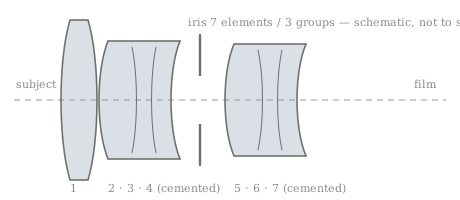
- 7 elements / 3 groups
- Aperture range
- f/1.5–f/11
- Diaphragm blades
- 12
- Min. focus
- 0.457 m
- Filter
- 40.5 mm
- Years manufactured
- 1949–1950
- Country
- Japan
- Coating
- Coated — the ·C marking; all optical surfaces hard-coated (Sweeney)
What reviewers say
- Brian Sweeney (Cameraderie) (blog) — Optimized, like all RF Nikkors, for wide-open use — Sonnar types carry a lot of spherical aberration and focus shift, and Nikon positioned the optics for full aperture: in his side-by-side at the Quantico Marine museum its center performance at f/1.5 equals a wartime Zeiss Sonnar T, with the Zeiss keeping a slight edge in contrast and edge-to-edge performance — and the history, from Duncan's Korea photographs to the December 1950 New York Times story, is why he calls it "the lens that got the attention of the World."
- Brian Sweeney (Cameraderie) (blog) — After a twenty-year search for his 905-batch copy, he rates it every bit as good as the early 5cm f/1.4 — "anyone saying the F1.5 lens is not as good is just trying to keep prices down" — and the most important lens a Nikon collector could own, one he would not trade or sell at any price.
Optical formula — Sonnar
History
For a lens that spent less than a year on the market, the Nikkor-S·C 5cm f/1.5 casts an extraordinarily long shadow. Nippon Kogaku’s first super-speed standard lens — a Sonnar type, seven elements in three groups, based on the prewar Carl Zeiss Jena Sonnar 5cm f/1.5 — came from just two serial batches dated May and July 1949 and reached the market in early 1950, which is why both “1949” and “1950” are defensible dates by convention. By December 1950 the new 5cm f/1.4 had superseded it, and only some 800–1,100 had been made across Nikon S bayonet and Leica screw mount. Yet this is the lens David Douglas Duncan carried into the Korean War on his Leica IIIc, and the one whose performance in his hands announced Japanese optics to the world.
The production story fits in two lines of a ledger. The “905” batch, serial-dated May 1949, was the smaller of the two, with more Leica-screw-mount lenses mixed in and fewer pure S-mount survivors; the “907” batch of July 1949 was larger, with a higher proportion of S-mount lenses — and batch “906” was skipped, for reasons unknown. The two mounts were interleaved within those batches rather than split into separate blocks, and the per-mount totals genuinely conflict across sources: CameraQuest estimates roughly 500 Nikon S and 300 LTM, Brian Sweeney’s 2016 research puts it at fewer than 800 total with about 400 in Leica mount and fewer in S, and another detailed source gives about 389 in Nikon S bayonet with more in LTM. Physically it is unmistakable once you know what to look for: chrome only, stopping down no further than f/11, with the aperture set by the second, inner knurled ring — the outer ring, unlike the later f/1.4’s, does not turn — plus twelve aperture blades, no click stops, and the 40.5mm accessory size it shared with the 5cm f/2 rather than the f/1.4’s 43mm.
The Korean War made it famous. Per Brian Sweeney’s research — the deepest published file on this lens — Duncan shot most of his Korea photographs, including the celebrated portrait of Capt. Ike Fenton, USMC, with the 5cm f/1.5 wide open alongside a Nikkor-Q·C 13.5cm f/4, and other photographers — Life’s Hank Walker among them — took note. On December 10, 1950 the New York Times broke the story that a Japanese camera and its lenses “had proven superior to the German cameras” the Life staff had been using — camera expert Mitch Bogdanovitch judged the Nikkors better at full aperture than Zeiss’s own — and an infuriated Carl Zeiss USA president threatened to pull advertising over it. The f/1.5 thus lit the fuse of the German–Japanese optics rivalry that defined the next two decades, even as its faster successor collected the glory.
Why build an f/1.5 and an f/1.4 barely a year apart? Peter Dechert’s Canon research (via Sweeney) traces the f/1.5 design back to 1937, intended for the Hansa Canon but never produced before the war — so when Nippon Kogaku needed a fast fifty on the market, the design was already on the shelf; Sweeney’s surmise is that it bridged the gap while the f/1.4 was still being designed. He also credits it as the first Nikkor with the 18-inch close-focus capability, ahead of the f/1.4 and rigid f/2 of 1950. Today it is among the rarest of all standard Nikkors — rarer, per CameraQuest, than even the 5cm f/1.1 — and market examples tell the story: an early 905-batch lens with ex-Rotoloni provenance changed hands privately around $2,200, a Leitz Auction S-mount example brought €1,800, and Leica-mount lenses have recently listed at $2,800–3,600 and up.
This history is AI-written, from the sources listed at the foot of the page. Where the record is silent it says so rather than filling the gap — but no human wrote these sentences.
Example photos
.jpg)
_(13893376151).jpg)
More sample photos elsewhere
- The NIKKOR (Sonnar) 50mm Rangefinder Lenses group pool — ~1,000 photos with the Sonnar-type 5cm f/1.4, f/1.5, and f/2 Nikkors in LTM and Nikon S mount; the group's rules explicitly accept the Nikkor S·C 5cm/1.5 (Flickr, 179 members)
- fiftyonepointsix's (Brian Sweeney, the lens's best-known chronicler) 'nikkor5cmf15' Flickr tag page — 3 all-rights-reserved photos OF the Nikkor-S·C 1:1.5 f=5cm itself (bezel legible, posed with David Douglas Duncan memorabilia), not sample images taken with it
These photographers keep all rights to their work — enjoy it at the source.
Sample photo wanted — shot with a Nikkor-S·C 5cm f/1.5? We'd love to feature it (with credit).
Live listings
- Rare Nikon Nikkor-S.C 50mm f/1.5 Screw Mount Silver 907xxx 1949 w/Caps
- Nikon LTM Nippon Kogaku 5cm f/1.5 L#907543
Listings updated 2026-10-19. Links go to the shop or marketplace that carries the item.