Komura 135mm f/2.8
Sankyo Koki · Nikon S + LTM · 1960
single source, unconfirmed our own findingAlso known as: Komura 135mm F2.8 · KOMURA- 135mm f/2.8 · Sankyo Koki Komura 135mm f/2.8 · Sankyo Kohki Komura 135mm F2.8 · コムラー 135mm F2.8 · 三協光機 コムラー 135mm F2.8
Variants & identification
| Variant | Mount | Years | Serial ranges | Production |
|---|---|---|---|---|
| Nikon S | Nikon S | — | — | — |
| Leica screw mount | LTM | 1960–1970 | — | — |
How to tell them apart
- Mount must be read off the lens, never inferred from the name: nearly every Komura 135mm f/2.8 in circulation is a single-lens-reflex lens, and the Uni-mount and Super-Komura Uni Auto versions are interchangeable-mount SLR lenses by definition
- Uni-mount examples come apart by hand into optics-and-diaphragm in front and a helicoid barrel behind, so the rear half can be swapped for another camera's mount; the detachable rear is the giveaway
- Five elements in four groups, 1.5 m minimum focus and a 55mm filter are shared with the SLR-mount lens, so neither the specification sheet nor the filter size separates a rangefinder example from an SLR one
- Blade count does not separate them either, and no count is published for the rangefinder lens in either mount: eighteen blades are recorded for the Uni-mount version and twelve for a photographed Nikon F example
- The bezel engraving dates it, as across the Komura line: earlier lenses read the bare focal length with the maker as Sankyo Kōki Tokyo, later ones prefix f= and read Sankyo Kōki Japan
- Nikon S: Not one of the initial four Nikon-mount Komuras but a later addition, alongside the 105mm f/2 and 200mm f/3.5. Undated: no document places it in the S mount in any year. The single photograph of an S-mount example shows it at the end of a row of six Komuras beside a Nikon S2 and a Bessa in S mount, identified by its owner's caption; the engravings are not legible at the published resolution. Whether it carries the 'N' barrel marking used on the 35mm and 80mm is unrecorded.
- Leica screw mount: Released in 1960 and sold until 1970 — a ten-year span, the longest recorded run of any Komura rangefinder telephoto. Five elements in four groups, 1.5 m minimum focus, 55mm screw-in filter. Introduced the same year as the screw-mount 105mm f/2 and 200mm f/4.5.
Specifications
- Construction
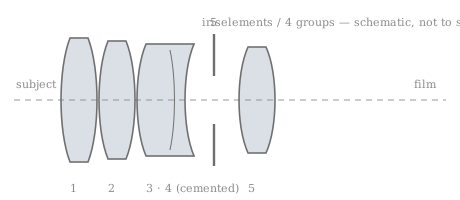
- 5 elements / 4 groups
- Aperture range
- f/2.8
- Min. focus
- 1.5 m
- Filter
- 55 mm
- Years manufactured
- 1960–1970
- Country
- Japan
What reviewers say
- くらら (くららのレンズ沼), the M42-mount version (blog) — The same optics in M42 mount rather than screw-mount rangefinder: 「普通によく写るレンズ」— a straightforwardly competent lens with a twelve-blade iris that draws pleasing highlights stopped down. Colour is shallow and flat, and her sample needed a teardown to clear fungus from the rear group. single source, unconfirmed via machine translation — corrections welcome
Optical formula
History
The Komura 135mm f/2.8 is the least-documented lens in Sankyo Koki’s Nikon rangefinder line, and its place in this catalogue rests on a single photograph. In December 2018 a Japanese collector, writing that Nikon S-mount Komuras had become scarce and dear, lined up six of them in front of a Nikon S2 and a Bessa in S mount and walked the row from left to right: the 35mm f/2.8, the zebra-striped 80mm f/1.8, the 105mm f/2.8, two 135mm f/3.5s, and — the largest, at the far right — the 135mm f/2.8, which he noted was brighter than the standard Nikkor 135mm f/3.5. A Komura multi-frame finder covering 50mm to 135mm sat in the group. That caption is the evidence. The engravings are not legible at the published resolution, so nothing in the picture independently confirms the mount; what confirms it is the owner saying so. One other first-hand Japanese account lists the lens among later additions to the Nikon line, and no reference work records it in that mount at all.
What the record does document is the Leica screw-mount version. Sankyo Koki (三協光機) was founded in July 1951, adopted the Komura brand in 1955, was renamed Komura Lens MFG. Ltd. in July 1969 and went bankrupt in 1980. Japanese Wikipedia’s list of Leica-mount lenses, citing Classic Camera Senka No.50, carries sixteen Komura coupled screw-mount lenses from 28mm to 200mm — with five longer teles sold separately for the company’s own Telebox and Pentabox reflex housings — and it dates the 135mm f/2.8 to 1960 and records it on sale until 1970, a ten-year span and the longest recorded run of any Komura rangefinder telephoto. The same entry gives five elements in four groups, a 1.5 m minimum focus and a 55mm screw-in filter. The lens arrived in 1960 alongside the screw-mount 105mm f/2 and 200mm f/4.5. The Japanese account of the Nikon line groups the 135mm f/2.8 with the 105mm f/2 and 200mm f/3.5 as later additions there too, and since the screw-mount 105mm f/2 is likewise dated to 1960, that is the closest thing to a date the Nikon version has.
Against that stands a good deal of silence in the Nikon mount. Camera-wiki’s Nikon rangefinder lens page lists three Komuras — the 35mm f/2.8 and the 80mm f/1.8, both with an N on the barrel, and the 135mm f/3.5 — and this is not one of them. Camera-wiki’s own Sankyō Kōki page lists three separate SLR-mount Komura 135mm f/2.8 lines and no Nikon rangefinder Komura at all. Rangefinderforum’s thread on the Nikon-mount 80mm does carry an English sentence naming the 135mm f/2.8 and 105mm f/2 as later Nikon RF additions, but it reproduces the same lineup in the same order as the Japanese account, so it cannot safely be counted as an independent second witness. No second S-mount example has been published, and the whole question would be settled by one clear photograph of a barrel.
Anyone hunting for one should treat the name as worthless on its own. The population sold under it is overwhelmingly reflex glass. Sankyo Koki’s Uni-mount system took Canon FL, Minolta MC, Nikon F and M42 adapters; the later Uni Auto mount took Canon FD, Nikon F and M42; and fixed-mount examples turn up in Nikon F, in M42 and in Komura’s own version of the T-mount. One forum lens advertised under the name proved to be a Uni Auto wearing a Petri bayonet adapter, and a second was the T-mount version in M42. Worse, the SLR lens shares the rangefinder lens’s headline numbers exactly: a Japanese collector’s page for the Uni-mount version gives five elements in four groups, 1.5 m and a 55mm filter — the same three figures Classic Camera Senka gives for the screw-mount lens. Blade counts do not rescue the comparison, since they scatter across the SLR versions and none is published for the rangefinder lens: eighteen for the Uni-mount lens, twelve on a photographed Nikon F example. The mount has to be read off the lens.
One check does not depend on the mount at all, and it is this catalogue’s own: comparing photographed Komuras side by side shows that the bezel engraving dates them — earlier lenses give the bare focal length with the maker as Sankyo Kōki Tokyo, later ones prefix f= and read Sankyo Kōki Japan. It holds on the 105mm f/2.8 and on the 135mm f/3.5, no published source consulted records source that records it, and it is offered as an observation rather than a citation. Applied here it is less decisive than it first looks: the changeover on the 105mm f/2.8 falls inside that lens’s 1958–1964 run, so a 135mm f/2.8 introduced in 1960 sits close to the switch and could plausibly wear either bezel. That makes a legible S-mount barrel worth more, not less — no serial number and no readable bezel has yet been photographed for this lens in either mount. Sankyo Koki published no production figures for it, and no S-mount price list survives.
This history is AI-written, from the sources listed at the foot of the page. Where the record is silent it says so rather than filling the gap — but no human wrote these sentences.
Example photos
Sample photo wanted — shot with a Komura 135mm f/2.8? We'd love to feature it (with credit).
Live listings
Asking price, USD: a median of $130 across 8 fixed-price listings on 2026-10-19 (middle half $29–$200). Tracked since 2026-09-06, 9 days: up 8% from $120.
By day
| Date | Median | Middle half | Listings |
|---|---|---|---|
| 2026-10-19 | $130 | $29–$200 | 8 |
| 2026-10-18 | $130 | $29–$200 | 8 |
| 2026-10-17 | $130 | $29–$200 | 8 |
| 2026-10-16 | $130 | $29–$200 | 8 |
| 2026-10-15 | $130 | $29–$200 | 8 |
| 2026-09-21 | $160 | $73–$180 | 9 |
| 2026-09-18 | $130 | $73–$160 | 11 |
| 2026-09-11 | $120 | $73–$200 | 8 |
| 2026-09-06 | $120 | $73–$200 | 8 |
Asking prices from the listings scanned, not sales; junk-flagged rows and auction lots excluded; other currencies are not converted.
- Sankyo Koki Komura 135mm f2.8 lens, with caps, stiff aperture
- Sankyo Kohki Komura 135mm f2.8 Leica LTM lens 133-134-4 #2241667 mtd 241016
- Komura 135mm F2.8 pre-set Sankyo Kohki Telephoto Lens Made in Japan - With Case
- Komura Kohki 135mm f2.8 Camera Lens with Case, Used, Vintage
- Komura Kohki 135mm f2.8 Kamera Objektiv mit Tasche, gebraucht, Vintage
- Leica M39 mount, Sankyo Kohki Komura S 135mm f/2.8 Lens MF 55mm (LTM)
- :[RARE] Sankyo Kohki KOMURA 135mm f/2.8 L39 LTM Leica Screw Mount Lens w/ Case
- SANKYO KOHKI KOMURA 135mm f/2.8 L39 LTM Leica Thread Mount Lens from Japan
- Sankyo Kohki Komura for Leica Screw Mount Komura 2.8/135mm lens
- Sankyo Kohki Komura for Leica Screw Mount Komura 2.8/135mm lens
Listings updated 2026-10-19. Links go to the shop or marketplace that carries the item.