Komura 105mm f/2
Sankyo Koki · Nikon S + LTM · 1960 · Ernostar
Also known as: Komura- 105mm f/2 · Komura 105mm F2 · Sankyo Koki Komura 105mm f/2 · Sankyo Kohki Komura 105mm F/2 · 三協光機 KOMURA 105mm F2 · コムラー 105mm F2
Variants & identification
| Variant | Mount | Years | Serial ranges | Production |
|---|---|---|---|---|
| Nikon S | Nikon S | — | 4350088 (photographed example) | — |
| Leica screw mount | LTM | 1960–1967 | — | — |
- Sankyo Koki published no production figures for any of its rangefinder lenses, and no S-mount price list survives.
How to tell them apart
- Tell apart from the 105mm f/2.8 sibling by filter size and blade count: the f/2 takes 58mm filters with 12 blades, the f/2.8 48mm with 16
- The later 105mm f/2.5 shares the optical design (1m close focus vs 1.5m) but exists only in SLR/Unidapter fittings — never in Nikon S mount
Nikon S:
- Nikon-mount Komuras carry an 'N' barrel marking, though some late lenses are unmarked
- Front bezel reads KOMURA- f=105mm 1:2 No.xxxxxxx Sankyo Koki Japan
- Nikon S: A later addition to Komura's Nikon-mount line, c.1960; ~440g.
- Leica screw mount: Sold 1960–1967; US list price $120 (1965).
Serial-range notes
- 4350088
- Photographed Nikon-mount example.
Specifications
- Formula
- Ernostar
- Construction
- 5 elements / 4 groups
- Aperture range
- f/2–f/16
- Diaphragm blades
- 12
- Min. focus
- 1.5 m
- Filter
- 58 mm
- Years manufactured
- 1960
- Country
- Japan
- Original price
- $120 (LTM) (today $1,200) — the 1965 EPOI list covers the screw-mount and SLR lines only; no S-mount Komura price list has ever surfaced
What reviewers say
- MAXY53, セカンド・ライフ・ヴィンテージ (oldlens.exblog.jp) (blog) — Shooting his own Nikon S example (~440g, dated c.1960), he finds it soft wide open, tightening into pleasant sharpness around f/2.8–4, with a slight blue lean to its colors. via machine translation — corrections welcome
- MAXY53, セカンド・ライフ・ヴィンテージ (oldlens.exblog.jp) (blog) — At f/2 the background bokeh of his Nikon S example goes distinctly swirly — a quirky streak he admits he had never registered before — while the later f/2.5, built on the same construction, strikes him as the better-balanced "best of the Komura 105s." via machine translation — corrections welcome
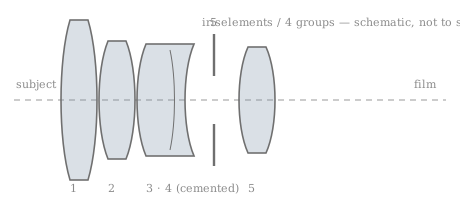
Optical formula — Ernostar
History
On Western message boards the Komura 105mm f/2 goes by the nickname “King of Ernostars” — a five-element, four-group telephoto in the lineage Ludwig Bertele laid down in the 1920s, and the fastest 105 ever offered for the Nikon rangefinder, out-speeding Nikon’s own celebrated Nikkor-P·C 10.5cm f/2.5. It arrived around 1960 as a late addition to Komura’s Nikon-mount line, and it is rare enough in S mount that its existence there rests on surviving examples rather than any catalog — anchored by a Japanese collector’s first-hand account of his own Nikon S example.
Sankyo Koki was founded in 1951 and sold lenses under the Komura brand from 1955; the company lasted until 1980. Its Nikon-mount line ran from the late 1950s into the early 1960s, following the same convention as Tanaka’s Tanar lenses: an “N” marking on the barrel identified the Nikon fit, though some late lenses went unmarked. The initial S-mount range consisted of four lenses — a 35mm f/2.8, an 80mm f/1.8, a 105mm f/2.8, and a 135mm f/3.5 — with the 105mm f/2 among a handful of later additions that arrived as the rangefinder era was already winding down.
The lens itself pairs its Ernostar formula with a preset 12-blade aperture, a 58mm filter thread, and a 1.5-metre minimum focus. Japanese literature dates the Leica-screw version to 1960, on sale until 1967, and the known Nikon S example dates to around the same year, weighing in near 440g. In use it behaves like the classic large-aperture Ernostar it is: soft wide open, tightening up between f/2.8 and f/4, with background bokeh that goes distinctly swirly at f/2 — the verdict of the collector whose example confirms the mount.
The paper trail is thin. No production quantities are documented anywhere for Sankyo Koki’s rangefinder lenses, and no S-mount price list survives; the only surviving original price is American — $120 for the Leica-screw version on the 1965 EPOI list. One caution for collectors: the later Komura 105mm f/2.5 shares this lens’s optical design and improves the close focus to 1 metre, but no source places it in S mount — it belongs to the SLR/Unidapter era — so the f/2 stands as the end of the line for the fast Komura 105 on the rangefinder.
This history is AI-written, from the sources listed at the foot of the page. Where the record is silent it says so rather than filling the gap — but no human wrote these sentences.
Example photos
More sample photos elsewhere
- Carl Berger Sr — "Komura 105mm f2.0" Flickr album (15 photos of and taken with his Komura 105/2, Leica screw-mount RF version, owned since the early 1970s)
- Tom Caldwell — "Samples: A7R Komura 105/2.0" DPReview Adapted Lens Talk thread (7 out-of-camera sample images, Komura 105mm f/2 LTM rangefinder version on Sony A7R)
These photographers keep all rights to their work — enjoy it at the source.
Sample photo wanted — shot with a Komura 105mm f/2? We'd love to feature it (with credit).
Live listings
Asking price, USD: a median of $330 across 12 fixed-price listings on 2026-10-19 (middle half $240–$410). Tracked since 2026-09-06, 8 days: down 6% from $350.
By day
| Date | Median | Middle half | Listings |
|---|---|---|---|
| 2026-10-19 | $330 | $240–$410 | 12 |
| 2026-10-18 | $330 | $240–$410 | 12 |
| 2026-10-17 | $330 | $240–$410 | 12 |
| 2026-10-16 | $330 | $240–$410 | 12 |
| 2026-10-15 | $330 | $240–$410 | 12 |
| 2026-09-21 | $330 | $240–$370 | 12 |
| 2026-09-18 | $330 | $250–$370 | 14 |
| 2026-09-06 | $350 | $250–$370 | 14 |
Asking prices from the listings scanned, not sales; junk-flagged rows and auction lots excluded; other currencies are not converted.
- Sankyo Kohki Komura 105mm f/2 LTM, Fair — SN 2511066
- Fed 5B Komura 105mm F2 Leica L39 Mount Lens Rare
- [NEAR MINT-] Sankyo Koki Komura 105mm F2 Nikon F Mount From Japan #1457
- Canon L2 Rangefinder Camera & Komura Sankyo Kohki 105mm F2 Lens -L39 Screw Mount
- Sankyo Koki Komura 105mm f/2 Camera Lens from Japan
- Sankyo Koki JAPAN KOMURA 105mm F2 Lens e12909
- Sankyo Koki JAPAN KOMURA 105mm F2 Lens e12909
- L39 [Near MINT++] Sankyo Kohki Komura 105mm f/2 Leica Screw Mount LTM Lens JAPAN
- [Exc+5] SANKYO KOKI Komura 105mm f/2 Leica L39 12 Blade Lens L Mount From JAPAN
- [ EXC + 5] Sankyo Koki Komura 105mm F/2 Leica L39 12 Klinge Objektiv L Von Japan
- Komura 105mm F2 Leica L-mount lens e19999
- 【 MINT 】 SANKYO KOKI Komura 105mm f/2 Leica L39 12 Blade Lens L Mount From JAPAN
- L39 [Exc+5] SANKYO KOKI Komura 105mm f/2 Leica 12 Blade Lens L Mount From JAPAN
Listings updated 2026-10-19. Links go to the shop or marketplace that carries the item.