Komura 135mm f/3.5
Sankyo Koki · Nikon S + LTM · 1955 · Tele-Sonnar
our own findingAlso known as: Komura- 135mm f/3.5 · Sankyo Koki Komura 135mm f3.5 · Sankyo Kohki Komura 135mm f/3.5 · Sankyo Koki Tokyo KOMURA- 135mm f3.5 · SANKYO KOHKI JAPAN Komura 135mm f3.5 · コムラー 135mm F3.5 · 三協光機 コムラー 135mm
Variants & identification
| Variant | Mount | Years | Serial ranges | Production |
|---|---|---|---|---|
| Nikon S | Nikon S | — | — | — |
| Leica screw mount | LTM | 1955 | 520147 · 210803 (early type, chrome front ring) 2234703 · 2238046 (late type, black front barrel) | — |
- Sankyo Koki published no production figures for this lens in either mount, and no S-mount price list survives.
How to tell them apart
- The engraving dates it: early lenses read 135m.m. f:3.5 and Sankyo Kōki Tokyo; late ones read f=135mm 1:3.5 and Sankyo Kōki Japan
Nikon S:
- Black barrel with chrome nose and chrome mount
- Nikon S: One of Sankyo Koki's initial four Nikon-mount lenses (alongside the 35mm f/2.8, 80mm f/1.8 and 105mm f/2.8), never directly dated — a late-1950s window is all the record supports. No 'N' barrel marking or bundled finder is documented, unlike the 35mm and 80mm siblings, and the optical construction of this version specifically is not explicitly recorded anywhere. Examples surface on the Japanese market and on eBay.
- Leica screw mount: Two versions: the 1955 original, sold until 1957, and the 1957 second version with black-painted aperture and focus rings. Documented examples add 16 aperture blades, 49mm filter thread, 1.5 m minimum focus; early brass barrels ~532 g, the late type ~409 g.
Serial-range notes
- 520147
- Early-type Leica-mount example, chrome front ring; engraved KOMURA- 135m.m. f:3.5 with the maker as Sankyo Kōki Tokyo.
- Two examples 332 apart
- A collector's pair of Leica-mount lenses just 332 numbers apart carry different focus-ring designs, so the change was not tied to a round-number break in the sequence.
- 2238046
- Late-type Leica-mount example, all-black front barrel; engraved KOMURA- f=135mm 1:3.5 with the maker as Sankyo Kōki Japan.
- 210803
- Early-type Leica-mount example; barrel engraved 'Sankyo Koki Tokyo KOMURA-', brass construction, 532 g measured.
- 2234703
- Late-type Leica-mount example; barrel engraved 'SANKYO KOHKI JAPAN Komura', 409 g measured.
Specifications
- Formula
- Tele-Sonnar
- Construction
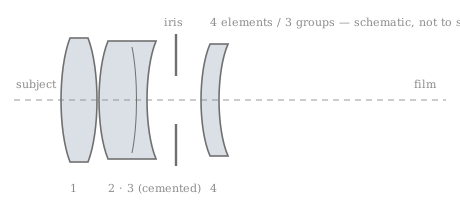
- 4 elements / 3 groups
- Aperture range
- f/3.5
- Min. focus
- 1.5 m
- Weight
- 340 g
- Filter
- 48 mm
- Years manufactured
- 1955
- Country
- Japan
What reviewers say
- Fujishiro (藤白, Old Lens Japan) (blog) — The early type is a budget spec in a cost-no-object brass barrel — clean, transparent rendering with big melting bokeh, rainbow ghosts and a faint veil of flare wrapping the frame; a hidden gem that left him wanting the faster Komuras. via machine translation — corrections welcome
- Fujishiro (藤白, Old Lens Japan) (blog) — The lighter late type is a different animal from the soft early lens — crisp and sharp stopped down with vivid color and beautiful highlight bleed wide open; pro-grade advertising-lens rendering for under ¥10,000. via machine translation — corrections welcome
- Yoshihiro Ueno (上野由日路, LensHolic) (blog) — Very sharp on the plane of focus — Komura's reputation from the day it launched — with busy, painterly background bokeh that never distracts, from a rare 1923-pattern Ernostar construction he expects collectors to re-evaluate. via machine translation — corrections welcome
- Hicks K (ひっくすK) (blog) — Surprisingly clear, transparent drawing that stays composed even in backlight; the stiff focus ring, not the optics, is the real handling challenge on a modern body. via machine translation — corrections welcome
Optical formula — Tele-Sonnar
History
When Sankyo Koki brought its Komura brand to the Nikon rangefinder in the late 1950s, the 135mm f/3.5 was one of the initial four lenses in the line — alongside the 35mm f/2.8, 80mm f/1.8 and 105mm f/2.8 — and the budget grade of a 135mm range that climbed through f/2.8 and f/2.5 all the way to an f/2. Finished in black with a chrome nose and chrome mount, it gave Nikon S shooters a third-party counterpart to Nippon Kogaku’s own Nikkor-Q 13.5cm f/3.5, from a maker whose reputation rested on selling sharp lenses cheaply. No production figure was ever published, no S-mount price list survives, and the Nikon version was never even directly dated — the third-party record simply runs thinner than Nikon’s own — but examples in Nikon mount still surface on the Japanese market and on eBay.
Sankyo Koki was founded in 1951 and adopted the Komura name in 1955 — by Japanese accounts a fusion of the surnames of president Mitsuru Kojima (小島満) and managing director Inamura (稲村). The firm built its reputation on sharp, inexpensive lenses for other makers’ cameras, particularly liked in commercial and advertising work, and its rangefinder-era catalog ran in Leica screw mount and, briefly, Nikon S — Nikon versions conventionally wore an “N” on the barrel, though no such marking (and no bundled finder) is documented for the 135mm f/3.5, unlike its 35mm and 80mm siblings. The company later followed the market into SLR glass — the five-element Super-Komura and Komuranon 135s are different, later designs that share nothing but the focal length — renamed itself Komura Lens MFG. in 1969, and ceased operations in 1980.
What dating exists belongs to the Leica-mount lens: a first version in 1955, sold until 1957, and a second version that year with black-painted aperture and focus rings. The S-mount lens was among the initial four but was never directly dated, so a late-1950s window is all the record supports. Its optics are similarly half-documented. A first-hand Japanese review of the 1955 screw-mount lens supports a four-element, three-group tele-Sonnar; lens-db’s reading of the 1963 Komura brochure — a three-element triplet — has never been confirmable; and Japanese reviewers shooting the late screw-mount type describe an uncemented four-element construction in the original 1923 Ernostar pattern, one of them assigning a triplet to the earliest production. What sat behind the chrome nose of the Nikon-mount lens specifically was never explicitly recorded anywhere.
The barrels do carry one useful signal, though it is not one the literature mentions. Photographed screw-mount examples split cleanly by their engraving: the earlier lenses read 135m.m. f:3.5 with the maker given as Sankyo Kōki Tokyo, the later ones f=135mm 1:3.5 with Sankyo Kōki Japan. The same pair of styles, in the same order, turns up on the Komura 105mm f/2.8. No source consulted records the pattern, and put it forward as an observation drawn from comparing examples while building this catalogue rather than as an established fact — but if it holds across the line, the bezel dates a Komura at a glance, and it would go some way toward ordering a family whose serial record is otherwise thin.
On modern mirrorless bodies the screw-mount lenses have earned the 135/3.5 a quiet reappraisal in Japan. Reviewers report an unusually luxurious build for a budget lens — brass barrels and a sixteen-blade aperture on documented examples — and two distinct characters: early lenses render with a gentle glow, big melting bokeh and the occasional rainbow ghost, while the lighter late type snaps sharp with vivid color once stopped down. The busy, painterly background blur, once dismissed as ugly and now prized as texture, is exactly the sort of transitional-design signature that has turned the humble Komura into a “hidden gem” of the Japanese old-lens scene — and the Nikon-mount version is its least-documented form.
This history is AI-written, from the sources listed at the foot of the page. Where the record is silent it says so rather than filling the gap — but no human wrote these sentences.
Example photos
More sample photos elsewhere
- Old Lens Japan (オールドレンズジャパン) — Sankyo Koki KOMURA 135mm f3.5 L39 early-type review with sample photos (same RF optic, Leica-screw variant)
- Tosh (Tosh@Blog) — KOMURA 135mm F3.5 early type, Leica L mount: sample photo collection for the 1955 rangefinder telephoto
These photographers keep all rights to their work — enjoy it at the source.
Sample photo wanted — shot with a Komura 135mm f/3.5? We'd love to feature it (with credit).
Live listings
Asking price, USD: a median of $50 across 12 fixed-price listings on 2026-10-19 (middle half $40–$81). Tracked since 2026-09-06, 8 days: up 6% from $47.
By day
| Date | Median | Middle half | Listings |
|---|---|---|---|
| 2026-10-19 | $50 | $40–$81 | 12 |
| 2026-10-18 | $50 | $40–$81 | 12 |
| 2026-10-17 | $50 | $40–$81 | 12 |
| 2026-10-16 | $50 | $40–$81 | 12 |
| 2026-10-15 | $50 | $40–$81 | 12 |
| 2026-09-21 | $47 | $40–$80 | 12 |
| 2026-09-18 | $50 | $40–$80 | 13 |
| 2026-09-06 | $47 | $40–$78 | 13 |
Asking prices from the listings scanned, not sales; junk-flagged rows and auction lots excluded; other currencies are not converted.
- DDP US Sankyo Koki Tokyo KOMURA 135mm f3.5 LTM #2230542 kjm 196-98-10 260423
- Sankyo Kohki KOMURA 135mm f3.5 Leica LTM 39mm #3234033 kjm 136-119-8 240910
- Sankyo Kohki Komura 135mm f/3.5 Lens from JAPAN [Exc+3]
- Sankyo Kohki Komura 135mm f3.5 Rangefinder Lens
- Sankyo Kohki KOMURA 135mm f3.5 Leica LTM 39mm 172-113-6 #3232489 mtd 250830
- Sankyo Kohki Komura 135mm f/3.5 Lens from JAPAN [Exc+3]
- Sankyo Tokyo Komura 135mm f3.5 L39
- Komura 135mm F/3.5 Leica L39 Lens Rare From JP#2107
- Sankyo Kohki KOMURA 135mm f3.5 Leica LTM 39mm 172-113-6 #3232489 mtd 250830
- [Exc+3] Tested! Sankyo Kohki Komura 135mm f/3.5 Lens from JAPAN
- Sankyo Kohki Komura 135mm f/3.5 Lens From JAPAN 109188
- [Exc+3] Tested! Sankyo Kohki Komura 135mm f/3.5 Lens from JAPAN
- Sankyo Kohki Japan Komura 135mm f/3.5 Prime 16-Bladed Full Frame Lens, FD Mount
- Sankyo Kohki Komura 135mm f/3.5 Lens From JAPAN 109188
- Exc+5 Sanyo Kohki Komura 135mm f/3.5 MF Lens Telemore 1.5x for Canon FD Japan
- Komura 135mm f/3.5 telelens – Leica LTM / M39-schroefvatting
- Komura 135mm F/3.5 L39 LTM Leica Thread Mount Lens [Near Mint] From Japan
- Sankyo Koki Tokyo KOMURA 135mm F3.5 Lens e15936
- Exc+5 Sanyo Kohki Komura 135mm f/3.5 MF Lens Telemore 1.5x for Canon FD Japan
- Sankyo Kohki W-Komura Uni Auto KIT 24mm f/3.5-135mm f/2.8 Nikon F
Show 6 more listings
- [As-is For parts READ] Sankyo Koki KOMURA 135mm f/3.5 Lens from JAPAN
- [As-is For parts READ] Sankyo Koki KOMURA 135mm f/3.5 Lens from JAPAN
- DDP US Sankyo KOMURA 135mm f3.5 LTM 168-153-8 #2240261 mtd 251222 sold as is
- DDP US Sankyo KOMURA 135mm f3.5 LTM 168-153-8 #2240261 mtd 251222 sold as is
- Komura 135mm F3.5 中望遠 オールドレンズ MF / Komura 135mm f3.5 Lマウント
- AK 4992 ⑧★ R70107 SANKYO KOHKI 三協光機 KOMURA コムラ 135mm F3.5 ★
Buying from Yahoo! Auctions outside Japan. It is a domestic marketplace: sellers ship within Japan, and most will not register an overseas buyer. A proxy service bids on your behalf, receives the item and forwards it, for a fee and a wait. Buyee, Jauce and ZenMarket each accept a Yahoo auction number directly. Listed alphabetically for information — none is recommended over another, and none of these is an affiliate link.
Listings updated 2026-10-19. Links go to the shop or marketplace that carries the item.