Nikkor-T(·C) 50cm f/5
Nippon Kogaku · Nikon S · 1952 · Triplet
Also known as: Nikkor 50cm f/5 · Nikkor 500mm f/5 · Nikkor-T·C 50cm f/5 · Nikkor-T.C 50cm f5 · Nikkor-T C 50cm f/5 · Nikkor-T 50cm f/5 · Nikkor-T 500mm f/5 · Nikkor-T·C 500mm f/5 · Nippon Kogaku 500mm f/5 · 50cm f5 Nikkor
Variants & identification
| Variant | Mount | Years | Serial ranges | Production |
|---|---|---|---|---|
| Nikkor-T·C (1952) | Nikon S | 1952 | 647001–647090 (infinity marked INF., parallel-milled aperture grip) 647099–647123 (infinity marked oo, cross-hatched aperture grip) | ~123 by serial span |
| Nikkor-T (plain T) | Nikon S | — | 647201–647528 | ~328 by serial span; the 157 auction figure (Leitz auction note, via camera-wiki) attaches to this variant but matches no observed serial span |
How to tell them apart
Nikkor-T·C (1952):
- Engraved T·C
- Two grip sub-variants: early lenses with INF. infinity mark and parallel-milled aperture grip, later ones with oo mark and cross-hatched grip
Nikkor-T (plain T):
- Engraved plain T, the ·C dropped
- Nikkor-T (plain T): Auction descriptions sometimes call this variant 'uncoated' — almost certainly a reading of the dropped ·C engraving rather than a statement about the glass.
Specifications
- Formula
- Triplet
- Construction
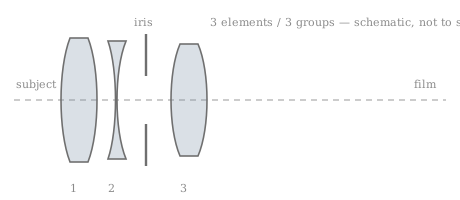
- 3 elements / 3 groups
- Aperture range
- f/5
- Min. focus
- 8 m
- Filter
- 110 mm
- Years manufactured
- 1952–1961
- Country
- Japan
- Original price
- $550 (today $6,510)
What reviewers say
- Michael Wescott Loder (blog) — First-hand account of a working photojournalist's example: at more than twenty pounds it is barely transportable and certainly not handholdable, but it focuses beautifully, the view through the reflex housing's finder is clear, and it isolates subjects as well as or better than the 400mm Nikkor — his restored sample still yields decent pictures, though age and fungus have cost it some contrast.
Optical formula — Triplet
History
In September 1952 Nippon Kogaku announced its longest rangefinder-era lens before the equipment needed to use it had even reached the market: the Nikkor-T·C 50cm f/5, a preset three-element telephoto nearly three feet long, $550 at launch, taking 110mm filters and focusing no closer than eight metres. It has no rangefinder coupling at all — the lens was built to be aimed and focused through the Prism Reflex Housing, a mirror box that turns a Nikon S-series rangefinder into a makeshift single-lens reflex — and it was the first of the four reflex-housing telephotos Nippon Kogaku would make, arriving roughly two years before its own housing was actually on sale. Somewhere between 300 and 450 were built by the serial record, which makes it one of the rarest of all S-mount Nikkors.
The housing’s story explains the odd sequencing. The Model I housing, patterned on the Leitz PLOOT, was announced in 1952 but apparently not marketed until late 1954, and fewer than 200 were sold; the improved Model II followed around May 1956 at $129.50, its serials running 471101–471769, with 45° prism finders and, late in the run, 90° pentaprisms. For its first two years, then, the 50cm f/5 was effectively a lens waiting for its viewfinder. The diaphragm was a preset — rumors of a manual-diaphragm version circulate but no confirmed example has surfaced — and the “19 lb” weight that follows this lens around describes the complete outfit of lens, housing, and camera, not the lens alone.
Two variants are distinguished by engraving. The original Nikkor-T·C occupies serials 647001–647123, about 123 lenses, and itself splits into an early style with the infinity position marked INF. and a parallel-milled aperture grip and a later style marked oo with a cross-hatched grip. The plain Nikkor-T, with the ·C dropped from the engraving, runs 647201–647528, about 328 more — auction descriptions calling it “uncoated” are almost certainly reading the missing ·C rather than the glass. The production total is genuinely unsettled at roughly 300–450: Pacific Rim Camera’s estimate of about 300, with a serial ceiling in the 6472xx range, is contradicted by the confirmed example at 647528, and a 157-unit figure from a Leitz auction note attaches to the plain-T variant only and matches no observed serial span.
The buyers were almost all professionals who needed the reach — Michael Wescott Loder’s surviving example belonged to Luis deCasenave, a photojournalist for El Mundo in San Juan, who worked it at the racetrack on a Nikon SP. The lens outlived its own system gracefully: an N-F adapter let it mount the Nikon F, and the same optics were still cataloged as F-mount preset lenses in Nikon’s 1965 price list. It should not be confused with the Reflex-Nikkor 50cm f/5 of 1961, the catadioptric mirror lens that succeeded it as Nikon’s 500mm f/5 — an entirely different design that dominates search results and auction listings under this focal length.
This history is AI-written, from the sources listed at the foot of the page. Where the record is silent it says so rather than filling the gap — but no human wrote these sentences.
Example photos
Sample photo wanted — shot with a Nikkor-T(·C) 50cm f/5? We'd love to feature it (with credit).
Live listings
- Rare [Top MINT in Box ]Nikon Nikkor T.C 50cm f5 Lens Leica Visoflex I From JAPAN
- Nikon Nikkor-T.C 50cm f5 Lens for Leica Visoflex I Collector Rare
Listings updated 2026-10-19. Links go to the shop or marketplace that carries the item.