Nikkor-T 35cm f/4.5
Nippon Kogaku · Nikon S + Nikon F + Bronica · 1959
Also known as: Nikkor 35cm f/4.5 · Nikkor 350mm f/4.5 · Nikkor-T 35cm f4.5 · Nikkor-T 350mm f/4.5 · Nippon Kogaku Nikkor-T 35cm · 350mm f/4.5 Nikkor-T · 350/4.5 Nikkor · 35cm f/4.5
Variants & identification
| Variant | Mount | Years | Serial ranges | Production |
|---|---|---|---|---|
| Nikon S (via Prism Reflex Housing) | Nikon S | 1959–1964 | 354501–355121 (the entire production run, one continuous block) 101507 (single prototype) | ~620–650 (two independent serial datasets: Pacific Rim ~650, a 621-lens confirmed serial span); a 429 figure circulates via lens-db, unverifiable — it would leave roughly a third of a continuous serial block unused |
| Bronica | Bronica | — | — | — |
| F-mount short mount (1960s catalogs) | Nikon F | — | — | — |
How to tell them apart
Nikon S (via Prism Reflex Housing):
- The only Nikon rangefinder lens with a semi-automatic diaphragm: cocked to full aperture by hand for focusing, it snaps down to the preset taking stop by spring action at the press of a release button
- All-black finish; some examples in black crinkle paint with a black rather than chrome aperture scale
- Reversible 82mm screw-in shade doubles as a Series IX filter holder
- Bronica: Examples delivered in Bronica mount fall within the same 354501–355121 serial block — no separate serial series and no per-mount production split.
- F-mount short mount (1960s catalogs): The same optics cataloged for the Nikon F as a short-mount telephoto from early 1963, mounting via the LNP2350 rotating adapter coupler and keeping the semi-automatic diaphragm; still cataloged in 1965.
Serial-range notes
- 354712
- Observed example, sitting inside the single published production block.
- 101507
- Single prototype, numbered far outside the production block.
- 354501–355121
- One continuous block covering the whole run, June 1959 to 1964; Bronica-mount deliveries sit within the same sequence.
Specifications
- Construction
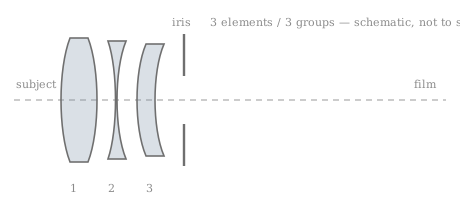
- 3 elements / 3 groups
- Aperture range
- f/4.5–f/22
- Diaphragm blades
- 9
- Min. focus
- 4 m
- Dimensions
- 95 × 300 mm
- Weight
- 1700 g
- Filter
- 82 mm
- Years manufactured
- 1959–1964
- Country
- Japan
- Original price
- $398 (today $4,290)
What reviewers say
No reviews aggregated yet — this family is still in the research queue. Written one? We'd love to index it.
Optical formula
History
No other lens in the Nikon rangefinder system has anything like its diaphragm. The Nikkor-T 35cm f/4.5 — introduced in June 1959, the last of Nippon Kogaku’s four reflex-housing telephotos to appear — is the only Nikon RF lens with a semi-automatic diaphragm: cocked to full aperture by hand for focusing, it snaps down to the preset taking stop by spring action the moment the release button is pressed. It has no rangefinder coupling at all. Like every long Nikkor of the era it focuses only through the Prism Reflex Housing, which turns an SP or S3 into an improvised single-lens reflex — and only about 620 to 650 of them were ever made.
The housing it depended on was itself a modest seller. The Model I — announced in 1952, though apparently not marketed until late 1954, and patterned on the Leitz PLOOT — sold fewer than 200 units. The Model II of around May 1956, at $129.50, did better: serials run 471101–471769, still under 800 housings, paired first with 45° prism finders and late in life with a 90° pentaprism. Onto this platform Nippon Kogaku had already hung the 50cm f/5 (1952), the 18cm f/2.5 (1953) and the 25cm f/4; the 35cm f/4.5 completed the set in the same month the Nikon F arrived to render the whole contraption obsolete — which is precisely what explains its diaphragm, an SLR convenience grafted onto a rangefinder accessory system in its final hour.
Physically it is a simple, massive thing: three elements in three groups behind a nine-bladed iris stopping down to f/22, about 1.7 kg and 300 mm of all-black barrel — a few examples wear black crinkle paint with a black rather than chrome aperture scale — focusing to 4 m, with a reversible 82mm screw-in shade that doubles as a Series IX filter holder, priced at $398. The serial record is unusually tidy: a single prototype numbered 101507, then one continuous production block from 354501 to 355121. Two independent serial datasets agree on roughly 620–650 lenses — Pacific Rim Camera counts about 650, and the confirmed span accounts for 621 — while a lower figure of 429 circulates via lens-db but cannot be verified and would leave nearly a third of a continuous serial block unused. The date carries its own small confusion: June 1959 is the best-supported introduction, Japanese Wikipedia gives February 1960, and the 1958 sometimes seen in English Wikipedia is simply an error.
It stayed in the rangefinder price sheets until 1964, but the optics outlived the mount. By January 1963 Nikon’s US price list was already cataloging it for the Nikon F as a short-mount telephoto — mounted via a rotating adapter coupler and still carrying its semi-automatic diaphragm — and it remained in the 1965 list; a number of examples were also delivered in Bronica mount, drawn from the same serial block, for that system’s 6×6 SLRs. For a lens built in the hundreds, it led a surprisingly mobile life across three systems.
This history is AI-written, from the sources listed at the foot of the page. Where the record is silent it says so rather than filling the gap — but no human wrote these sentences.
Example photos
Sample photo wanted — shot with a Nikkor-T 35cm f/4.5? We'd love to feature it (with credit).
Live listings
- Nikon Nikkor-T 4.5/35cm 350mm f/4.5 Nippon Kogaku Japan
- [Optisch NEUWERTIG] SEHR SELTEN Nikon NIKKOR-T 35cm f/4.5 Objektiv N-F...
Listings updated 2026-10-17. Links go to the shop or marketplace that carries the item.