Nikkor-T 10.5cm f/4
Nippon Kogaku · Nikon S + Nikon F · 1960 · Triplet, 3e/3g (+ − +)
Also known as: Nikkor 10.5cm f/4 · Nikkor 105mm f/4 · Nikkor-T 10.5cm f4 · Nikkor T 10.5cm f/4 · Nikkor-T 105mm f/4 · Mountain Nikkor · Nippon Kogaku 10.5cm f/4
Variants & identification
| Variant | Mount | Years | Serial ranges | Production |
|---|---|---|---|---|
| Nikon S (1960) | Nikon S | 1960 | 406906–409867 (block shared with F-mount serials) 409911–411314 | ~2,000 across both mounts combined, ~3 years on market (Pacific Rim, whose narrower observed span 408500–410500 matches the figure; Rotoloni concurs) vs a full intermixed serial span of ~5,900 numbers; no per-mount split published |
| Nikon F (March 1960) | Nikon F | 1960 | 405401–409331 (dual feet/m distance scale) 408945–411308 (single-scale barrels, feet or metres) | — |
How to tell them apart
Nikon S (1960):
- Slim chrome-and-black satin aluminium barrel that widens toward the mount — the silhouette behind the Berg-Elmar comparison
- 1.2m minimum focus, limited by the body helicoid (the F version reaches 0.8m)
- Dedicated clip-on hood mounts reversed for storage; the hood grips the filter rim, so it cannot be used together with a clamp-on A36 filter — only with the rare 34.5mm screw-in
Nikon F (March 1960):
- Barrel flares at the base to meet the wider F-mount throat
- Preset aperture, f/4–f/22, 9 blades — no automatic diaphragm
- 0.8m minimum focus; extends nearly 3cm at closest focus
- LENS MADE IN JAPAN engraving
- Nikon S (1960): External styling differs from the F version in many details unrelated to the mount; of the two, the S barrel is usually judged the better-looking and better-handling. It sold worst of all — buyers were already migrating to the F system, and the S-mount 10.5cm f/2.5 stood right beside it — and is now the scarcer version, trading at roughly twice the F version's price.
- Nikon F (March 1960): A rangefinder-era optical design re-housed for the F: the preset iris has no rationale beyond cost on an SLR with auto-diaphragm stablemates. Serials are intermixed with the S version in one sequence — no per-mount production split published.
Serial-range notes
- 405401–411314
- One intermixed sequence covering both the S and F versions — quantities computed from any span count both mounts together and must not be read as per-mount production.
Specifications
- Formula
- Triplet, 3e/3g (+ − +)
- Designed by
- Wakimoto Zenji (脇本善司)
- Construction
- 3 elements / 3 groups
- Aperture range
- f/4–f/22
- Diaphragm blades
- 9
- Dimensions
- 95 mm long
- Weight
- 250 g
- Filter
- 34.5 mm
- Years manufactured
- 1960
- Country
- Japan
What reviewers say
- Agata Urbaniak (35mmc) (blog) — Surprisingly light for its near-10cm length, with decent image quality wide open for a triplet — a long lens needn't be fast to separate a subject smoothly — but the darkened corners she kept getting (possibly her adapter) and the less-than-compact size sent her back on her quest for a pocketable telephoto.
- Richard Haw (blog) — Sharp and well corrected even wide open, rendering skin with an exquisite subtle glow and giving photos natural depth that makes subjects pop — excellent for portraiture, let down only by poor flare resistance and saw-tooth aperture discs at f/5.6.
- aremo-koremo (カメラが欲しい、レンズが欲しい、あれもこれも欲しい) (blog) — Startlingly good in the focal plane wide open for three elements, with smooth, gentle bokeh and only a trace of veiling flare visible at pixel level — and the F version's 0.8m close focus is a world away from the 105/2.5's 1.2m — leaving him asking how this was ever the budget option. via machine translation — corrections welcome
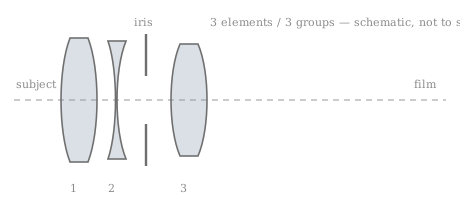
Optical formula — Triplet, 3e/3g (+ − +)
History
The Nikkor-T 10.5cm f/4 is the lens Nippon Kogaku wasn’t supposed to make: a three-element budget telephoto from a company whose name rested on premium glass, sold at half the price and half the weight of its own celebrated 10.5cm f/2.5 — and, in Nikon designer-historian Haruo Sato’s (佐藤治夫) telling, probably the first Nikon telephoto designed with the ordinary consumer as its imagined customer. Enthusiasts dubbed it the “Mountain Nikkor” after the Leitz Berg-Elmar, the mountain Elmar, whose slim flaring silhouette it recalls; the nickname was never Nikon’s, but it stuck. The gamble failed in the marketplace — roughly 2,000 were made across its two mounts in about three years before the f/2.5’s popularity finished it off — and failure accomplished what success never could: the cheap Nikkor is now a scarce collector’s piece trading well above lenses that outsold it many times over.
The optics were designed by Zenji Wakimoto (脇本善司) — the same hand behind the utterly different Nikkor-S 8.5cm f/1.5, a pairing Sato offers as proof of his range. The mass-production drawings went out in December 1959, with Exakta and Praktica versions planned alongside the Nikon mounts before both were aborted, and the lens reached the market in spring 1960: the F-mount version dated March, the S-mount release following that spring. That timing made it simultaneously one of the last Nikkors designed for the rangefinder and among the first sold for the F — and it completed Nikon’s budget counterpart to the era’s “three sacred treasures” kit of 35, 50 and 105, joining the 3.5cm f/3.5 and 5cm f/2. Sato frames it as the origin of a house doctrine: a cheap lens reaches the most hands, so it must uphold the quality of the whole Nikkor name — in some ways a harder brief than any flagship.
A triplet is the textbook minimum — the fewest elements that can correct the Seidel aberrations and both chromatic errors at once — and exactly right for a modest-aperture medium telephoto, where the short glass path also buys clean color and tone. Wakimoto tuned it to his signature balance: spherical aberration left slightly overcorrected, so the lens is gently soft wide open and snaps to high-contrast sharpness from half a stop down, reaching near-peak performance by f/5.6 and peaking between f/8 and f/11. Modern users keep rediscovering the same lens — sharp in the focal plane even at f/4, chromatic aberration well controlled, distortion too slight to notice, smooth and undramatic in the out-of-focus areas, genuinely weak only against flare. The design’s completeness had a long afterlife: new optical designers at Nikon have traditionally cut their teeth on precisely this specification, a 105mm f/4 triplet.
The two versions share one serial sequence, observed from 405401 to 411314, with S- and F-mount lenses intermixed throughout — so any quantity computed from a span covers both mounts, and no per-mount production split exists. That span of some 5,900 numbers sits awkwardly against the published total of about 2,000, a tension the record has not resolved. Rotoloni files the lens among the puzzles — a deliberately slow lens released at a late date, from the maker of the sharpest and most popular medium telephoto of the day — and the market agreed at the time: the S version, arriving just as its buyers defected to the F system with the 10.5cm f/2.5 already on the shelf, sold worst of all, and is today the rarer and more expensive of the two.
This history is AI-written, from the sources listed at the foot of the page. Where the record is silent it says so rather than filling the gap — but no human wrote these sentences.
Example photos
More sample photos elsewhere
- Agata Urbaniak — 'mountainnikkor' tag in her photostream (63 photos, Nikkor-T 10.5cm f/4 on Leica M Monochrom typ 246, ARR)
- Nak Gnehc — 'nikkort105cmf4' tag page (38 photos shot on Nikon D800 + Nikkor-T 10.5cm f/4, ARR)
- Agata Urbaniak — 'Nikkor-T 10.5cm f/4: The Mountain, the Berg, and the Molehill' review on 35mmc with six sample photos
These photographers keep all rights to their work — enjoy it at the source.
Sample photo wanted — shot with a Nikkor-T 10.5cm f/4? We'd love to feature it (with credit).
Live listings
Asking price, USD: a median of $350 across 23 fixed-price listings on 2026-10-19 (middle half $230–$420). Tracked since 2026-09-06, 9 days: up 1% from $350.
By day
| Date | Median | Middle half | Listings |
|---|---|---|---|
| 2026-10-19 | $350 | $230–$420 | 23 |
| 2026-10-18 | $350 | $230–$420 | 23 |
| 2026-10-17 | $350 | $230–$420 | 23 |
| 2026-10-16 | $350 | $230–$380 | 22 |
| 2026-10-15 | $360 | $280–$420 | 17 |
| 2026-09-21 | $350 | $250–$420 | 20 |
| 2026-09-18 | $350 | $250–$380 | 19 |
| 2026-09-11 | $350 | $250–$420 | 20 |
| 2026-09-06 | $350 | $250–$420 | 20 |
Asking prices from the listings scanned, not sales; junk-flagged rows and auction lots excluded; other currencies are not converted.
- *** Nikon Nikkor-T 10.5cm 105mm f/4 F mount Nippon Kogaku Camera Lens From JAPAN
- Nikon Nikkor T 105mm f/4 Lens For S Mount From JAPAN #904
- [Exc +5] Nikon Nikkor-T 10.5cm f/4 Nikon F Mount 105mm MF Lens From Japan
- Nikon Nikkor-T 105mm F/4 Lens #39833 E5
- Nikon Nikkor-T 10.5cm f4.0 manual focus lens Ser.#407672 with caps. "F" mount #2
- Nikon NIKKOR P 105mm F4 Lens
- [Exc+4] Nikon Nikkor-T 10.5cm F4 Lens From JAPAN
- [Near MINT+++ / Rare] Nikon Nippon Kogaku Nikkor-T 10.5cm 105mm F/4 From JAPAN
- Nikkor-T 105/4 10.5cm F/4 Nikon Camera F-Mount Lens
- ◆◇MOUNTAIN-NIKKOR NIKKOR-T 1:4 f=10.5cm Nippon Kogaku Japan Nikon◇◆
- Nikon RF Nikkor-T 10.5cm/4 #410217, c.1959, 1425 made, chrome Nikon 10.5cm Finder, case, Ex-
- Japan Nikon F NIKKOR-T 10.5cm/4 Mountain Nikkor MF Lens
- Nikon Nippon Kogaku Tokyo NIKKOR-T 10.5cm F4 Fully Functional K487
- Japan Nikon Nikkor-T 10.5cm/4 for Nikon S Rangefinder Lens
- RARE NIPPON KOGAKU NIKKOR-T 10.5cm F/4 F Mount Lens from Japan #939
- Nikon Rangefinder Nikkor-T 10.5cm f4 telephoto lens. Case and Finder. Nikon S2.
- Nikon Nippon Kogaku Tokyo NIKKOR-T 10.5cm F4 Fully Working K487
- Nippon Kogaku 10.5cm F4 Nikon S-mount 3133
- Nikon Nikkor-T 4/10,5cm Tele Lens Nippon Kogaku Japan f/4/105 for Nikon F
- Nikon Nikkor-T 10.5cm F4 Lens Excellent Cond Fully Functional
Show 6 more listings
- Nippon Kogaku Nikkor-T 10.5cm f4 Preset #406501 FOR F MOUNT F F2 F3 VERY CLEAN
- Nikon 105mm f4 Nikon F Mount Nippon Kogaku RAR Nikon F F2 FTN
- Nippon Kogaku Nikkor-T 105mm F4 - Nikon S Mount — SN 408286
- Nikon Nikkor-T 10.5cm f/4 Telephoto Prime Lens Nikon S Mount Rangefinder H1016
- Nikon Nikkor-T 10.5cm 105mm F4 S Mount Telephoto Manual Focus Lens Used H0904
- Nikon Nikkor-T 4/10.5cm lens for Rangefinder Nikon Nippon Kogaku w. matching ho
Listings updated 2026-10-19. Links go to the shop or marketplace that carries the item.