W-Nikkor(·C) 3.5cm f/3.5
Nippon Kogaku · Nikon S + LTM · 1948 · Tessar
Also known as: W-Nikkor C 3.5cm f/3.5 · W-Nikkor.C 3.5cm f3.5 · W-Nikkor·C 3.5cm F3.5 · W-Nikkor 3.5cm f/3.5 · W-Nikkor 35mm f/3.5 · Nippon Kogaku W-Nikkor-C 35mm f/3.5 · W-Nikkor·C 1:3.5 f=3.5cm · 3.5cm f3.5
Variants & identification
| Variant | Mount | Years | Serial ranges | Production |
|---|---|---|---|---|
| Nikon S (1948 baseline) | Nikon S | 1948 | 612-prefix first batch: sequence 1–123 (confirmed 61242–612123) 910-prefix second batch: sequence to 1810 (confirmed 9107–9101810) 425240–433954 (old-style six-digit blocks) 434001(?)–440567 (new style: chrome confirmed 434005–439610, black 438552–440567) 440737–443143 (final block, plain W-NIKKOR) | >19,000 total across both mounts — 2,400 MIOJ-era + 8,000 old style + 9,000 later style, in line with 19,791 summed from serial spans (123 + 1,810 + 8,715 + 9,143); no per-mount S/LTM split published |
| Leica screw mount | LTM | — | 910-prefix second batch (9107–9101810), shared with Nikon S 425240–433954 old-style blocks, shared with Nikon S | — |
How to tell them apart
Nikon S (1948 baseline):
- Red C on the name ring marks coating; the final serial block drops the ·C and reads plain W-NIKKOR
- MIOJ engraved on the rear of occupation-era lenses
- Aperture set by a ring at the front of the barrel; the earliest lenses have no click-stops
- First-batch aperture scale runs in the reverse direction of every later Nikkor
- Minimum aperture f/16 on early lenses, f/22 from ~429722
- Leica screw mount: Optically identical — the same objective assembly in a different barrel — and drawn from the same serial blocks as the S-mount lens: Nikon treated the two mounts as a single model. LTM examples are recorded from the 910-prefix second batch through the 425240–433954 old-style blocks; the 612-prefix first batch and the post-1954 new-style blocks record S-mount examples only. Typically sold as the kit lens on Japanese Barnack copies (Nicca kits in the US market); scarcer and priced higher than the S-mount version today.
Serial-range notes
- 612-prefix
- First batch, March 1948: reversed aperture scale, f/16 minimum, MIOJ engraving; occupation-era lenses are crudely finished, with cheaper iris-blade material and thinner chrome than later production.
- 910-prefix
- Second batch from 1949, still MIOJ-era; f/16 minimum.
- 425240–427975
- Six-digit blocks from 1950; MIOJ gives way to plain Made in Japan at ~426380, and the Tokyo front marking to Nippon Kogaku Japan at ~427810.
- ~429722
- Minimum aperture changes from f/16 to f/22, the two overlapping between ~429722 and ~429858.
- 434001+
- 1954 facelift: narrower front ring with a usable filter thread, bringing the barrel in line with Nikon's newer wide-angle Nikkors; chrome, 160 g.
- 438552–440567
- Black-barrel lenses, infinity marked oo, 100 g, overlapping the tail of the chrome run; a switch to light-alloy construction in December 1956 is the last documented production change.
- 440737–443143
- Final block: ·C dropped, plain W-NIKKOR with clockwise engraving. No discontinuation date was ever published — the run simply stops here.
Specifications
- Formula
- Tessar
- Construction
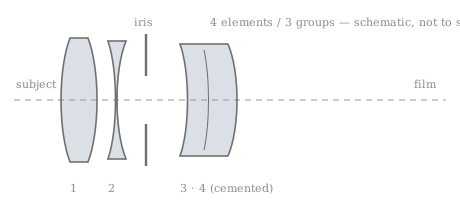
- 4 elements / 3 groups
- Aperture range
- f/3.5
- Min. focus
- 0.91 m
- Weight
- 190 g
- Filter
- 34.5 mm (Leica screw mount)
- Years manufactured
- 1948
- Country
- Japan
What reviewers say
- Richard Haw (blog) — Sharp in the center even wide open, with heavy vignetting, strong spherical aberration, and flare-prone period coatings — a charming sunny-day time machine he recommends to Nikon rangefinder shooters, steering frequent shooters to the f/2.5 instead.
- Shoot Film, Ride Steel (blog) — A tiny, softly rendering Tessar whose gentle drawing flatters even harsh midday light and which barely flares at all — perfectly imperfect, cheap, and now the resident 35 on the author's Canon 7.
- Yas_photo (お撮みカメラ日記) (blog) — On a Leica M10 the Tessar delivers a crisp focus plane from a very compact barrel, with considerable vignetting wide open and somewhat restless bokeh — charming enough to invite further experiments. via machine translation — corrections welcome
- abikooldle (オールドレンズをマウントアダプターで楽しむブログ) (blog) — Less of an optical story than its faster f/2.5 and f/1.8 successors, but the fact of its existence a mere three years after the surrender would, in the author's words, fill a two-hour drama on its own. via machine translation — corrections welcome
Optical formula — Tessar
History
When Nippon Kogaku’s first camera, the Nikon I, went on sale in March 1948, the W-Nikkor·C 3.5cm f/3.5 was the wide-angle beside it — one of the company’s original consumer lenses, in customers’ hands less than three years after the surrender. It is a Tessar type, four elements in three groups, the slowest and plainest member of what became a three-lens family of S-mount 35s, and the one with the longest run: more than 19,000 were built across roughly a decade, beginning with a first batch — the 612-prefix lenses — whose aperture scale runs in the opposite direction of every other Nikkor produced.
Japanese sources — the Japanese Wikipedia lens genealogy, echoed by old-lens blogs — credit the design to Saburō Murakami (村上三郎), working in the immediate postwar years when the Allied voiding of German patents outside Germany let Japanese makers rework Zeiss recipes freely; the result is a modified Tessar that brought a distinctly Zeiss-flavored drawing to Nikon’s own bayonet and, in identical optics, to Leica-thread bodies. Coating was a genuine selling point in 1948 — the red C on the name ring advertised it — and the company’s coatings of this era have proven notably durable on surviving examples.
The production run reads like a chronicle of Nikon’s postwar decade written in engravings. Occupation-era lenses carry MIOJ on the rear; Made in Japan takes over at around serial 426380, and the Tokyo front marking gives way to Nippon Kogaku Japan around 427810. The minimum aperture stretched from f/16 to f/22 near serial 430000, and in 1954 the barrel was redesigned to match its newer siblings, with a narrower front ring and a usable filter thread. Black 100-gram barrels overlap the chrome late in the run, and a switch to light-alloy construction in December 1956 is the last documented change. When it ended is genuinely unknown: no published source records a discontinuation date, and the final serial block — plain W-NIKKOR, the ·C at last dropped — carries no dates at all.
The Leica-screw version is not a separate lens. It shares the S-mount serial blocks outright — Nikon treated the two mounts as a single model — with LTM examples recorded from the 1949 second batch through the old-style blocks, while the first batch and the post-facelift blocks record S-mount only. Most screw-mount examples left the factory as kit lenses on Japanese Barnack copies such as the Nicca, which is how many reached the American market. Today the f/3.5 remains the cheapest door into the S-mount 35s: reviewers find it sharp centrally even wide open, heavily vignetted, happiest in daylight — a lens whose appeal is inseparable from the moment that produced it.
This history is AI-written, from the sources listed at the foot of the page. Where the record is silent it says so rather than filling the gap — but no human wrote these sentences.
Example photos

More sample photos elsewhere
- Flickr tag page "W-Nikkor 3.5cm f3.5" — film samples from multiple photographers, notably Maryland Photos shooting the lens on a Nikon S2 (Ilford Pan 50 / FP4 Plus) plus LTM copies on Leica and Bessa bodies (all rights reserved)
- Maryland Photos — 13 W-Nikkor 3.5cm f/3.5 film samples on Nikon S2 (S-mount) and Leica IIIc / Bessa R (LTM copy), each photo's title states body, lens, and film stock (all rights reserved)
- Clay Kippen — 25 recent samples, mostly Nikon S3 + W-Nikkor·C 3.5cm f/3.5 (S-mount) on Kentmere and Fomapan film around Baltimore, 2026; a few older frames in the results use the 3.5cm f/2.5 W-Nikkor·C instead (all rights reserved)
These photographers keep all rights to their work — enjoy it at the source.
Sample photo wanted — shot with a W-Nikkor(·C) 3.5cm f/3.5? We'd love to feature it (with credit).
Live listings
Asking price, USD: a median of $330 across 44 fixed-price listings on 2026-10-19 (middle half $300–$500). Tracked since 2026-09-06, 10 days: unchanged from $330.
By day
| Date | Median | Middle half | Listings |
|---|---|---|---|
| 2026-10-19 | $330 | $300–$500 | 44 |
| 2026-10-18 | $330 | $300–$500 | 44 |
| 2026-10-17 | $330 | $300–$500 | 44 |
| 2026-10-16 | $350 | $300–$500 | 45 |
| 2026-10-15 | $330 | $300–$450 | 37 |
| 2026-09-21 | $360 | $300–$500 | 41 |
| 2026-09-19 | $360 | $300–$500 | 42 |
| 2026-09-18 | $360 | $300–$500 | 42 |
| 2026-09-11 | $330 | $300–$400 | 28 |
| 2026-09-06 | $330 | $300–$400 | 28 |
Asking prices from the listings scanned, not sales; junk-flagged rows and auction lots excluded; other currencies are not converted.
- Nippon Kogaku Tokyo W-Nikkor C 3.5cm f/3.5 Lens Nikon S
- Nikon Nippon Kogaku W-Nikkor C 3.5cm 35mm f/3.5 Wide Angle Lens for S Mount V19
- Nippon Kogaku W-Nikkor-C 3.5cm f/3.5 Lens Nikon S Mount #Z-31334
- [Near MINT] Nippon Kogaku Nikon W NIKKOR C 3.5cm F3.5 Lens for S From JAPAN
- "Near Mint+++" Nikon W-Nikkor C 3.5cm 35mm f3.5 L39 Leica Screw Mount Lens JAPAN
- Video*[Exc+5] Nikon W-NIKKOR.C 35mm f/3.5 Lens S Mount From JAPAN #1day shipping
- Nikon W-Nikkor C 35mm 3.5cm f/3.5 LTM L39 Rangefinder Lens Canon Leica - 401
- [Near MINT] Nikon Nippon Kogaku W-Nikkor C 35mm 3.5cm f/3.5 Lens LTM L39 JAPAN
- Nikon Nippon Kogaku W-Nikkor.C 35mm F/3.5 Lens for Leica L39 #56922 C2
- [NEUWERTIG mit Haube] Nikon Nippon Kogaku W-Nikkor C 3.5cm f/3.5 Objektiv aus...
- Nikon W-Nikkor C 3.5cm 35mm f3.5 L39 Leica Screw Mount Lens From JAPAN
- [MINT+++] Nikon W-Nikkor-C 3.5cm F/3.5 Nippon Kogaku Lens Nikon S From JAPAN
- [MINT] Nippon Kogaku W-Nikkor 3.5cm f/3.5 LTM L39 Leica Screw Lens RF From JAPAN
- [Near Mint] Nikon W-NIKKOR 3.5cm f/3.5 for S-mount From JAPAN
- "NEAR MINT" Nikon W-Nikkor 3.5cm 35mm f/3.5 Black Wide Angle Lens for S JAPAN
- [MINT] Nikon W-Nikkor C 3.5cm 35mm f3.5 Nippon Kogaku Leica L39 LTM From JAPAN
- [Exc+5] Nikon W-Nikkor 3.5cm 35mm f/3.5 Black Wide Angle Lens for S From JAPAN
- [Near MINT] Nikon Nippon Kogaku W-Nikkor.C 35mm f/3.5 Wide Lens LTM L39 JAPAN
- [MINT+++] Nikon Nippon Kogaku W-NIKKOR C 35mm F/3.5 S Mount Lens From JAPAN
- Nikon W-NIKKOR C 3.5cm F3.5 Leica S Mount Old Lens
Show 35 more listings
- Nikon W-Nikkor 3.5cm f/3.5 Wide Angle Vintage Lens for S mount Mint in bubble
- ▶️【N MINT Case L39】 Nikon W-NIKKOR C 3.5cm 35mm F3.5 LTM Leica Screw from JAPAN
- Nikon W-Nikkor.C S Mount 3.5cm f/3.5 L#431570
- [Near MINT] Nikon Nippon Kogaku W-Nikkor.C 35mm f/3.5 Wide Lens LTM L39 JAPAN
- Nikon W-Nikkor 35mm F3.5 Black Lens For Nikon S Range Finder Camera GOOD+
- Nikon W-Nikkor.C 35mm Wide Angle F/3.5 Ltm L39 Leica Screw Mount - Condition VG
- Nikon Nippon Kogaku W-Nikkor.C 35mm F/3.5 Lens for Leica L39 #60676 C2
- Vintage Nippon Kogaku W-Nikkor C 3.5/3,5cm lens for Nikon Rangefinder
- [Near MINT] Nikon W-Nikkor C 35mm 3.5cm f/3.5 Lens for S S2 SP S3 From JAPAN
- Nikon RF W-Nikkor 3.5cm/3.5 #427731, chrome, type-III, made in Japan, TOKYO, caps, case, Mint-
- W-Nikkor 3.5cm F3.5 LTM Screw Mount M39
- Rare Black "NEAR MINT+3" Nikon W-NIKKOR 3.5cm 35mm f3.5 Lens Leica L39 LTM JAPAN
- "Mint+++" Nikon W-Nikkor 3.5cm 35mm f/3.5 Black Wide Angle Lens for S JAPAN
- Rare Black Belt[MINT]Nikon W-NIKKOR 3.5cm 35mm f3.5 Lens Leica L39 LTM JAPAN
- Vintage Nippon Kogaku W-Nikkor C 3.5/3.5cm lens for Nikon Rangefinder
- [Near Mint-] Nikon Nippon Kogaku Tokyo W-Nikkor C 3.5cm F/3.5 S Mount Lens JP
- Nikon W-Nikkor C 3.5cm F3.5 Weitwinkel Festbrennweite Nikon S Excellent aus J...
- Nikon LTM W-Nikkor 3.5cm/3.5 #426475, c.1949, chrome, MIOJ TOKYO, batch #50031544, caps, case, Ex-
- W-Nikkor-C 3.5 cm F/3.5 R A R E
- Nikon W Nikkor C 3.5cm 35mm f/3.5 Nippon Kogaku
- W-Nikkor-C 3.5cm F/3.5 Nippon Kogaku Lens Nikon S — Original Caps, Soft Case
- Nikon W-Nikkor C 3.5cm 35mm f/3.5 Manual Focus Lens L39 Mount #V1336
- A Item Nikon W NIKKOR 35mm F3.5 Black S Mount E.P Engraving 11422
- Nippon Kogaku W-Nikkor C 3,5/3,5cm Objektiv Leica Schraubkupplung für Rangefin
- Nippon Kogaku Japan W-Nikkor C 3.5/3.5cm lens for Nikon Rangefinder
- Nippon Kogaku W-Nikkor 3.5/3.5cm lens for Leica Screw Mount M39 RF coupled (LTM)
- Rare in Box *Top MINT* Nikon W-Nikkor C 3.5cm 35mm f/3.5 MF Lens L39 From JAPAN
- NIPPON KOGAKU W-NIKKOR 35MM F3.5 FOR NIKON S MOUNT #5848
- Leica IIIf Black Dial Camera W-Nikkor.C 35mm f/3.5 LTM, Case, FILPO #602329 C
- W-Nikkor-C 3.5 cm F/3.5 R A R E
- Nikon S2 35mm f/3.5 W Nikkor C B#6150449 L#431570
- Nippon Kogaku W-Nikkor.C 35mm F3.5 LTM - MIOJ / 910 Batch — SN 9101546
- Nippon Kogaku Tokyo 910 Batch W-Nikkor.C 35mm 3.5cm f3.5 LTM S#: 910xxx MIOJ
- Nikon W-Nikkor 35mm f/3.5 C Manual Lens As Is
- Nikon Nippon Kogaku W-Nikkor.C 35mm F/3.5 Lens for Leica L39 #56922C2
Buying from Yahoo! Auctions outside Japan. It is a domestic marketplace: sellers ship within Japan, and most will not register an overseas buyer. A proxy service bids on your behalf, receives the item and forwards it, for a fee and a wait. Buyee, Jauce and ZenMarket each accept a Yahoo auction number directly. Listed alphabetically for information — none is recommended over another, and none of these is an affiliate link.
Listings updated 2026-10-19. Links go to the shop or marketplace that carries the item.