W-Nikkor(·C) 3.5cm f/1.8
Nippon Kogaku · Nikon S + LTM · 1956 · Xenotar-derived
Also known as: W-Nikkor 3.5cm f/1.8 · W-Nikkor·C 3.5cm f/1.8 · W-Nikkor.C 3.5cm f1.8 · W-Nikkor C 3.5cm f/1.8 · W-NIKKOR•C 3.5cm f/1.8 · W-Nikkor 35mm f/1.8 · Nikkor-W 3.5cm f/1.8 LTM · Nikon 35mm f/1.8 rangefinder · Nippon Kogaku 3.5cm f/1.8 · 3.5cm f1.8
Variants & identification
| Variant | Mount | Years | Serial ranges | Production |
|---|---|---|---|---|
| Nikon S (1956) | Nikon S | 1956 | 351801–354934 (·C-marked: black filter-ring batch 351802–351868 from Sep 1956, chrome filter ring from 351873) 355003–356087 (plain W-Nikkor, no ·C) 356325–360091 (late blocks with U.S.PAT / J.PAT markings; ~8,291 total by serial span) | ~6,500 (CameraQuest) of 8,372 total per RFF serial survey |
| Leica screw mount | LTM | — | 181238–182209 (·C-marked) 182337–182842 (no ·C) | 1,471 of 8,372 total per RFF serial survey (CameraQuest: ~1,500; ~1,605 by serial span) |
| SP Limited Edition (2005) | Nikon S | 2005 | 0001–2500 (matching body serials; serials confirmed to 2453; No.0001 held by the JCII museum) | 2,500 sets |
How to tell them apart
Nikon S (1956):
- Engraved 3.5cm, not 35mm
- Family marked both W-Nikkor·C and plain W-Nikkor across the run
SP Limited Edition (2005):
- Modern multicoating — so not strictly identical optics, though the 7e/5g formula is unchanged
- Sold only as a set with the Nikon SP reissue body, ¥724,500
- Coarser 43 × 0.75mm filter thread on the 2005 version vs the original's fine 43 × 0.5mm (Rockwell)
- Leica screw mount: The only LTM Nikkor given its own serial sequence — every other screw-mount Nikkor shares serials with the bayonet run.
- SP Limited Edition (2005): Built by Tochigi Nikon. Same 7e/5g formula per Nikon's own SP Limited spec sheet, with modern multicoating. Richard Haw additionally reports the 2005 lens omits the radioactive lanthanum rear glass, and relays a secondhand report that a bad batch of optical cement gives some examples a tendency toward balsam separation — his report only, unconfirmed elsewhere.
Serial-range notes
- 351802–351868
- First S-mount batch carries a black filter ring (from Sep 1956); chrome filter rings from 351873 on.
- earliest S-mount batch (~first 75–100)
- Black-painted aperture rings — real and period-documented; the count is disputed — about 100 by one account, roughly the first 75 by another.
Specifications
- Formula
- Xenotar-derived
- Construction
- 7 elements / 5 groups
- Aperture range
- f/1.8
- Diaphragm blades
- 9
- Min. focus
- 0.91 m
- Weight
- 160 g
- Filter
- 43 mm (0.5 mm pitch) (Nikon S (1956), Leica screw mount) · 43 mm (0.75 mm pitch) (SP Limited Edition (2005))
- Years manufactured
- 1956
- Country
- Japan
What reviewers say
- Agata Urbaniak (35mmc) (blog) — A "GAS killer" that became her favorite and most-used lens — very sharp stopped down with perfectly straight lines even at the edges, well-controlled vignetting, and pleasing bubbly bokeh; flare is the notable weakness, showing even stopped down.
- Richard Haw (blog) — Highly recommended — there is simply no alternative fast 35 for S-mount: quite sharp in the centre even wide open, with distortion he rates as not bad at all — "quite nice for a vintage Nikkor" — though coma marks the far corners until f/4 and the old coatings make ghosts and flare "quite terrible."
- Ken Rockwell (blog) — An excellent lens — superb sharpness on Velvia, no distortion even under the microscope, no lateral color fringes, and the best 35 there is for a Nikon rangefinder — though the contemporary 1958 Summicron is sharper in the corners with much less coma.
- Camera no Naniwa staff (カメラのナニワ, Umeda) (blog) — Resolving power that makes you question whether this is really a half-century-old lens — veiled and soft wide open, crisp across the whole frame stopped down, with minimal distortion; their most impressive lens discovery of the year, shot on a black-paint Nikon SP. via machine translation — corrections welcome
- Gigantoptik (기간트옵틱) (blog) — Reviewing the 2005 SP Limited reissue: a must-own for Nikon RF devotees — sharp even wide open with a veil-like f/1.8–2.3 softness and pleasing swirl bokeh that make it "an optimal portrait lens." via machine translation — corrections welcome
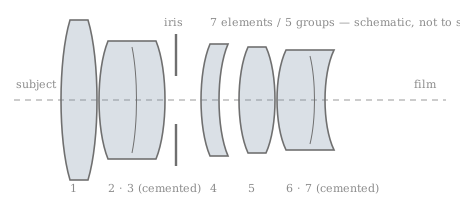
Optical formula — Xenotar-derived
History
When the W-Nikkor 3.5cm f/1.8 appeared in September 1956 (Japanese Wikipedia alone says July), it was the world’s brightest wide-angle lens — and the lead held: Leitz took years to answer it. The design was a genuinely new type by Hideo Azuma (東秀夫), a Xenotar-derived front group paired with a rear cemented doublet acting as a field flattener, seven elements in five groups, and the first use of lanthanum glass — a recipe distinctive enough that Nikon patented it in the United States, the patent granted in 1959. Reviewers keep confirming what the spec sheet promised: distortion near zero for a 1950s wide-angle, resolution that embarrasses lenses decades younger, and only the era’s coatings — flare-prone in any backlight — betraying its age.
Production was modest by fast-fifty standards: 8,372 total per the RFF serial survey, which CameraQuest splits at roughly 6,500 in Nikon S mount and 1,500 in Leica screw mount (the survey itself counts 1,471 LTM examples, observed in a ·C-marked serial block at 181283–182158 and a plain-W-Nikkor block at 182456–182797). The earliest S-mount examples carry black-painted aperture rings — real and period-documented in a 1956 advertisement and a 1958 brochure, though the count is disputed: about 100 per CameraQuest, roughly the first 75 per 35mmc. Practical details stayed compact: 43mm filters, a 3-foot minimum focus, and a nine-bladed diaphragm that modern users prize for its sunstars.
The design earned a second life. In 2005 Nikon revived the lens for the SP Limited Edition — 2,500 sets at ¥724,500, each lens serial-matched to its reissued SP body (set No.0001 sits in the JCII museum), built by Tochigi Nikon. Nikon’s own spec sheet confirms the same 7e/5g formula, now with modern multicoating — so not strictly identical optics, but as direct an endorsement as a fifty-year-old wide-angle can get.
This history is AI-written, from the sources listed at the foot of the page. Where the record is silent it says so rather than filling the gap — but no human wrote these sentences.
Example photos
More sample photos elsewhere
- lynnb's snaps' 6-photo album "W-Nikkor 3.5cm f/1.8 LTM" — the lens on a Leica CL, B&W film at Manly Beach, Sydney (Flickr, all rights reserved)
- Flickr 'wnikkor35cmf18' tag page — 40+ genuine samples of the W-Nikkor 3.5cm f/1.8 by Agata Urbaniak, NateVenture, Alex Aguilera and others, on Nikon S2/S3 and Leica bodies (Flickr)
- jonmanjiro's 210 photos tagged 'nikon35mmf18ltm' — W-Nikkor 3.5cm f/1.8 (LTM version) shot on Leica film bodies in Japan (Flickr, all rights reserved)
These photographers keep all rights to their work — enjoy it at the source.
Sample photo wanted — shot with a W-Nikkor(·C) 3.5cm f/1.8? We'd love to feature it (with credit).
Live listings
Asking price, USD: a median of $3,300 across 29 fixed-price listings on 2026-10-19 (middle half $840–$5,000). Tracked since 2026-09-06, 10 days: up 222% from $1,000.
By day
| Date | Median | Middle half | Listings |
|---|---|---|---|
| 2026-10-19 | $3,300 | $840–$5,000 | 29 |
| 2026-10-18 | $3,300 | $840–$4,900 | 30 |
| 2026-10-17 | $3,300 | $840–$4,900 | 30 |
| 2026-10-16 | $3,300 | $840–$4,900 | 29 |
| 2026-10-15 | $1,500 | $700–$4,900 | 31 |
| 2026-09-21 | $1,200 | $770–$4,900 | 33 |
| 2026-09-19 | $1,000 | $720–$3,800 | 35 |
| 2026-09-18 | $1,000 | $720–$3,800 | 35 |
| 2026-09-11 | $1,000 | $750–$3,500 | 34 |
| 2026-09-06 | $1,000 | $750–$3,700 | 35 |
Asking prices from the listings scanned, not sales; junk-flagged rows and auction lots excluded; other currencies are not converted.
- Nikon W Nikkor C 3.5cm 35mm f1.8 Nikon S Mount Lens Read*[Near MINT] From JAPAN
- Nikon W Nikkor C 3.5cm 35mm f1.8 Nikon S Mount Lens [Near MINT] From JAPAN
- [Exc+5] Nikon W Nikkor 3.5cm 35mm f/1.8 MF Wide Lens for S Mount From JAPAN
- [Near MINT] Nikon 3.5cm 35mm f1.8 W-Nikkor Wide Angle S Mount From JAPAN
- Vintage "Mint w/ Case" Nippon Kogaku W-NIKKOR 35mm f/1.8 Nikon S Mount JAPAN
- [Exc+5] Nikon Nippon Kougaku W Nikkor 3.5cm f1.8 S Mount Lens + SC-NZ From JAPAN
- [Almost MINT] Nikon 3.5cm 35mm f1.8 W-Nikkor S Mount Wide Angle Lens From JAPAN
- [Vintage Almst MINT+] Nikon Nippon Kogaku W-NIKKOR 3.5cm 35mm F1.8 S Mount JAPAN
- Rare U.S. PAT [Almost MINT] Nikon W Nikkor 35mm f/1.8 Lens S Mount From JAPAN
- Rare Exc++ Nikon Nippon Kogaku W-NIKKOR 3.5cm 35mm F1.8 Lens S Mount #4962
- [MINT+] Nikon Nippon Kogaku W Nikkor 35mm f/1.8 Wide Angle Lens S Mount JAPAN
- Nippon Kogaku W-Nikkor 35mm F1.8 - Nikon S Mount (94-96%new)
- Nippon Kogaku W-Nikkor 35mm F1.8 - Nikon S Mount — SN 352764
- Nikon SP 35mm Rangefinder Film Camera With W-Nikkor 35mm F1.8 Wide Angle Lens
- Nikon W-Nikkor C 35mm f1.8 lens Nippon Japan rangefinder near mint RARE 97754
- 【 N MINT 】 OLYMPIC BLACK PAINT 632 / Nikon S3 w/ W-Nikkor-C 3.5cm 35mm F1.8 Lens
- [Top MINT] Nikon SP Black Limited Edition W-Nikkor C 35mm f/1.8 camera JAPAN
- Nikon W-Nikkor 35mm f1.8 Nippon coated - Leica M - Rangefinder converted
- [MINT] Nikon SP Black Limited Edition W-Nikkor C 35mm F/1.8 Lens #6622
- Nikon S3 Olympic Black Paint + W-Nikkor 35mm F/1.8 CLA By KantoCamera #49818 D2
Show 14 more listings
- Nikon Nikon SP Reissue with W-Nikkor 35mm F1.8 Rengefinder Camera Tested [Exc+]
- [UNUSED in Box] Nikon SP Limited Edition Black W-Nikkor 3.5cm F1.8 Camera JAPAN
- Nikon S3 Black Reissue / W-NIKKOR-C 3.5cm f/1.8 From Japan E0508
- Full Set[Unused] Nikon SP Limited Edition Black W-Nikkor C 35mm f/1.8 JAPAN
- Nippon Kogaku W-Nikkor 3.5cm f/1.8 Lens for M39/LTM Mount [MINT/READ] #Z-82617
- [Unused] Nikon SP Black Limited Edition W-Nikkor C 35mm f/1.8 Lens from Japan
- [Unused] Nikon SP Black Limited Edition Camera W-Nikkor C 35mm f/1.8 Lens JAPAN
- [Unused] Nikon SP Black Limited Edition Camera W-Nikkor C 35mm f/1.8 Lens JAPAN
- Nikon SP - Black Paint Set / Limited Edition 2005 / with W-Nikkor.C 35mm F1.8 — SN 001951
- [Used] 《Average Condition》 Nikon W-NIKKOR (L) 35mm F1.8 【A rare L-mount lens
- NEW Nikon SP - Black Paint Set / Limited Edition 2005 with W-Nikkor.C 35mm F1.8
- [NEAR MINT] Nippon Kogaku W-NIKKOR 3.5cm 35mm f/1.8 Lens Leica L39 Nikon JAPAN
- Nippon Kogaku W-Nikkor 35mm F1.8 LTM — SN 181593
- RARE [Near MINT] NIKON W-NIKKOR C 3.5cm 35mm F/1.8 Nippon Kogaku From JAPAN
Listings updated 2026-10-19. Links go to the shop or marketplace that carries the item.