Ultra Wide-Heliar 12mm f/5.6 SL Aspherical
Cosina Voigtländer · Nikon S + Nikon F · 2003 · Symmetrical
Known as “UWH”
Also known as: Voigtländer Ultra Wide-Heliar 12mm f/5.6 Aspherical SL · Voigtlander Ultra Wide Heliar 12mm F5.6 SL · ULTRA WIDE-HELIAR 12mm F5.6 SL Aspherical · Voigtlander SL 12/5.6 · Cosina Voigtländer SL 12mm f/5.6 · Voigtlander 12mm f5.6 SL Nikon F · U-W Heliar 12/5.6 Aspherical SL · フォクトレンダー ULTRA WIDE-HELIAR 12mm F5.6 SL Aspherical · UWH 12mm
Variants & identification
| Variant | Mount | Years | Serial ranges | Production |
|---|---|---|---|---|
| Nikon F bayonet (the only version built) | Nikon F (Nikon S via FS adapter) | 2003–2007 | — | — |
How to tell them apart
- Nikon F bayonet on the lens itself — an example sitting on a Nikon S or Contax rangefinder is on Cosina's FS adapter, not a native mount
- A flat disc: φ63.5 × 16.2mm and 200g, against φ50.5 × 38.2mm and 162g for the L39 version of the same optics
- Focus click stops at 1m and 0.5m, and no rangefinder coupling on any body — scale focus only
- Nine blades, half-stop clicks from f/5.6 to f/22
- No filter thread and no filter adapter, where the L39 version takes filters through an optional adapter
- Rear cap carries a shoe that stores the bundled 12mm viewfinder
- Nikon F bayonet (the only version built): Built only in the Nikon F bayonet, and only as a mirror-lock-up lens: the rear cell sits deep in the mirror box, so Cosina lists it as fitting the Nikon F, F2, F3, F4, F5 and the Nikkormat series apart from the meterless FS, while CameraQuest reports Cosina guaranteeing only the F and F2. It reaches a Nikon S or classic Contax rangefinder body on Cosina's separately sold FS adapter, which clamps to the body with a breech ring and takes the lens on a bayonet, and can be left on the camera while lenses are swapped. Focus stays on the lens's own scale whatever it is mounted to — nothing couples to a rangefinder, and no S-mount version of this lens was ever made.
Specifications
- Formula
- Symmetrical
- Construction
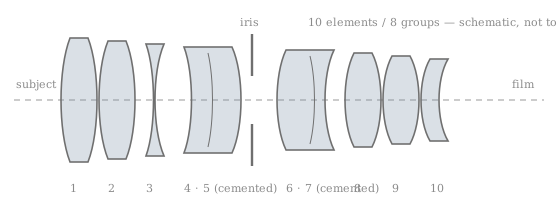
- 10 elements / 8 groups
- Aperture range
- f/5.6–f/22
- Diaphragm blades
- 9
- Min. focus
- 0.3 m
- Dimensions
- 63.5 × 16.2 mm
- Weight
- 200 g
- Years manufactured
- 2003–2007
- Country
- Japan
- Material
- All metal
- Original price
- ¥115,000 excluding tax at the March 2003 Japanese release (today ¥131,000); $699 in the United States, finder and caps included
What reviewers say
- Stephen Gandy (CameraQuest) (blog) — The widest non-fisheye lens ever made in Nikon F mount and, on the FS adapter, the widest ever available to a Nikon or classic Contax rangefinder — machining and finish he rates above the Leica-screw version's, close enough to look like 1950s production.
- Shanpūhatto A (シャンプーハットA), Kakaku.com (blog) — Tried half as a joke, and it mounted even on bodies with no mirror lock-up; he metered off the rear screen and found exposure manageable, but rates the corner falloff on digital very heavy and the accessory finder worst of all, leaving him to correct parallax in his head — he ends by saying a rangefinder handles the lens more easily than an SLR does. via machine translation — corrections welcome
Optical formula — Symmetrical
History
Cosina put its 12mm f/5.6 Ultra Wide-Heliar Aspherical into a Nikon F bayonet and called it the SL — its own catalogue dates the release to March 2003, CameraQuest to that August. It is an SLR lens in an SLR mount, and it was never built in Nikon S mount at all; it belongs in a Nikon rangefinder encyclopedia only because of a small breech-ring adapter Cosina sold alongside it. The design is symmetrical rather than retrofocus, so the lens sits deep in the mirror box: the whole barrel is 16.2mm long, the mirror has to be locked up before the lens will go on, and Cosina lists it as fitting the Nikon F, F2, F3, F4, F5 and the Nikkormats apart from the meterless FS. Lock the mirror up and it covers 121° through ten elements in eight groups, with an aspherical element correcting the distortion — on Stephen Gandy’s reckoning at CameraQuest, the widest non-fisheye lens ever made in the mount.
Cosina advertised five mounts for the one lens. The bayonet is Nikon F; adapters released at the same time carried it to Nikon S, to the classic Contax C mount, to Leica screw and to Leica M, and the argument Cosina made in its own copy was the Bessa R2S and R2C, which had never had a 12mm in their native mounts and now could have this one. The FS adapter is the piece that matters here: it clamps onto the rangefinder body with a breech ring, the lens locks into it bayonet-style, and it can stay on the camera while lenses are changed. It was a separate purchase, listed by CameraQuest at $135 beside the lens’s own $699. What it does not do is make the 12mm an S-mount lens. Focus remains on the lens’s own scale, with click stops at 1m and 0.5m and nothing coupled to the rangefinder, and framing is done through the accessory 12mm finder that came in the box, stored on a shoe built into the rear cap. Gandy, who sold the lens in the United States, tried the adapter in the other direction — as a general route for Nikkor SLR lenses onto his Nikon and Contax rangefinders — and found the body’s own focusing helical fills the inside of it: his 20/2.8, 28/2, 50/2, 50/1.4 and 105/2.5 all fouled, though a 50/3.5 Macro and an 85/1.8 went on. The F-mount 21/4 Nikkor will not seat in it properly either.
The lens itself is a flat disc with an all-metal barrel, 63.5mm across and 200g, with a nine-blade diaphragm running f/5.6 to f/22 in half-stop clicks and close focus at 0.3m. Gandy rated its machining and finish above the Leica-screw 12mm’s and thought the SL pair looked as though they had come off a production line in the late 1950s. There is no filter fitting: Cosina’s sheet for the L39 version offers an optional filter adapter, the SL’s names no filter size at all. It listed at ¥115,000 before tax in Japan and $699 in the United States, finder and caps included — against ¥105,000 for the silver L39 lens, so the Nikon mount carried a premium of about ten thousand yen. Production ended in March 2007, and Cosina’s discontinuation record gives no figure for how many were built.
A Japanese user review from 2007 is blunt about living with it. The writer on Kakaku.com tried one half as a joke and found Cosina’s compatibility list conservative — the lens went onto a D50 and a New FM2, neither of which has mirror lock-up, as well as a D200 — and reported that mounted it looks like a pancake lens with the hood taken off, thinner still, and rather handsome for it. No meter works with it, but he found that manageable: he read exposure off the rear screen, bracketed when unsure, and called it surprisingly easy once he had the knack. Canon bodies, reached through a mount adapter, went worse: the lens would not even enter the mirror boxes of a 10D or a 20D, threw an error on a 1D Mark II after a single frame, and set the mirror of a film EOS clattering against the barrel at every release. His real complaints were the corner falloff, very heavy on a digital sensor and heavy enough that he thought a modern ultra-wide zoom the better lens, though he suspected film would be kinder; and above all the accessory finder, which left him correcting parallax in his head. His verdict was that if you are going to use this lens at all, a rangefinder body handles it more easily than an SLR does — the rangefinder he had in mind being a Leica M, reached with an F-to-M adapter or by buying the L-mount version outright, rather than the Nikon S body Cosina’s own FS adapter was built for.
This history is AI-written, from the sources listed at the foot of the page. Where the record is silent it says so rather than filling the gap — but no human wrote these sentences.
Example photos
More sample photos elsewhere
These photographers keep all rights to their work — enjoy it at the source.
Sample photo wanted — shot with a Ultra Wide-Heliar 12mm f/5.6 SL Aspherical? We'd love to feature it (with credit).
Live listings
The listings collector hasn't run for this family yet — check back soon, or search the marketplaces directly meanwhile.