Nikkor-S(·C) 8.5cm f/1.5
Nippon Kogaku · Nikon S + LTM + Contax RF · 1953 · Sonnar
Also known as: Nikkor 8.5cm f/1.5 · Nikkor 85mm f/1.5 · Nikkor-S.C 8.5cm f/1.5 · Nikkor-S·C 8.5cm f/1.5 · Nikkor-SC 8.5cm f1.5 · Nikkor-S 8.5cm f/1.5 · Nikkor-S 85mm f/1.5 · Nippon Kogaku 8.5cm f/1.5 · 8.5cm f1.5 · Nikkor 85mm f/1.5
Variants & identification
| Variant | Mount | Years | Serial ranges | Production |
|---|---|---|---|---|
| Nikon S | Nikon S | 1953 | 264301–266065 (main block, shared with the Leica and Contax versions) | 685 of 1,353 total across all three mounts (factory records via Rotoloni) — serial spans imply ~1,755 and period literature claimed ~2,000 for the whole run, so the published figures conflict |
| Leica screw mount | LTM | 1953 | 264301–266065 (within the shared main block) 367001–367082 (dedicated late Leica-only block) | 489 (factory records via Rotoloni) |
| Contax rangefinder mount | Contax RF | 1953 | 264301–266065 (within the shared main block) | 179 (factory records via Rotoloni) |
How to tell them apart
- Black-painted barrel over brass, with a chrome mount collar and rear grip — the standard and only finish. This is one of the few Nikon rangefinder lenses never offered in chrome.
- Listing trap: auction and dealer copy tags some examples "rare black paint" and stays silent on others that look identical, and English translations of Japanese listings sometimes render the two-tone description as though black and chrome were separate versions. They are not — every example is the same black lens.
- The real variation across the run is knurling and the infinity marking, not finish.
Nikon S:
- Flared front barrel taking 60mm filters — unusually, the front differs between the S and Leica versions
- Marked S·C throughout the main block; the only plain-S bayonet example is the 267354 engraving error
- Engraved 8.5cm, not 85mm
Leica screw mount:
- Straight nose with two hood lugs and a 58mm filter thread, unlike the flared S-mount front
- Tripod foot on the barrel, absent from the S-mount version
- Late 3670xx block is marked plain S with broad knurling
Contax rangefinder mount:
- Engraved C on the barrel — the only external difference from the S-mount version
- Contax rangefinder mount: Serialized within the shared 264301 main block; no dedicated Contax serial block exists. Differs from the S-mount lens only by an internal focusing shim matched to the Contax helicoid, plus the C engraving. The rarest of the three mounts.
Serial-range notes
- 264354 · 264398 · 264401 · 264464 · 264494 · 264666 · 264847 · 264857 · 265033 · 265128 · 265345 · 265612 · 265756 · 265855 · 265933 · 367046
- Sixteen photographed examples, spanning the main block end to end and reaching into the late Leica-only block. Every one is black-barrelled; no chrome-barrelled example is documented anywhere. Wear on 264494 shows brassing through the front ring — factory black paint over brass, not anodizing and not a later repaint.
- 264301–266065
- Main production block, running from January 1953 — all three mounts serialized together. Early lenses have fine knurling with infinity marked INF. — an auction estimate puts this earliest form at fewer than 500 pieces; broad knurling with ∞ appears from 265665, overlapping the fine-knurled span rather than cleanly replacing it. The block's numbering accounts for ~1,673 lenses.
- 267354
- A single plain-S-marked S-mount lens — an engraving error for 367354.
- 367001–367082
- Late Leica-mount-only block spanning 82 numbers, with about 78 lenses reportedly built — possibly to special order. Plain S marking (the ·C dropped) and broad knurling.
Specifications
- Formula
- Sonnar
- Designed by
- Murakami Saburo (村上三郎) — began the design · Wakimoto Zenji (脇本善司) — carried it to completion
- Construction
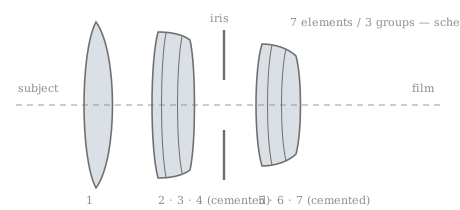
- 7 elements / 3 groups
- Aperture range
- f/1.5
- Diaphragm blades
- 16
- Min. focus
- 1 m
- Weight
- 564 g
- Filter
- 60 mm (Nikon S, Contax rangefinder mount) · 58 mm (Leica screw mount)
- Years manufactured
- 1953
- Country
- Japan
- Original price
- $299.50 US list at introduction (today $3,520); the 8.5cm f/2 listed at $175
What reviewers say
- Gigantoptik (기간트옵틱) (blog) — His unhesitating telephoto pick if limited to three Nikon RF lenses: shockingly sharp at f/1.5 with well-restrained aberrations — "the very best of the few old lenses that shine even brighter on digital." via machine translation — corrections welcome
- Richard Haw (blog) — A delicate, dreamy portrait rendering wide open — heavy vignetting and chromatic aberration included — that cleans up beautifully by f/2.8, with an exquisite 16-bladed near-circular iris; a collector's lens rather than a daily shooter, and he points everyday users to the cheaper Nikkor-P·C 8.5cm f/2 instead.
- Kasyapa for LEICA (MapCamera) (blog) — On a 60-megapixel Leica M11 it renders soft and transparent wide open with remarkably rich gradation and gloriously huge period ghosts, yet snaps to fine-lined sharpness by f/4 — one lens, delicious two ways. via machine translation — corrections welcome
Optical formula — Sonnar
History
Domon Ken (土門拳) and Kimura Ihei (木村伊兵衛), the two towering documentary photographers of postwar Japan, both adopted this lens — Kimura so devotedly that it came to be called “Kimura Ihei’s trusted blade” (木村伊兵衛の懐刀). At a time when only Leica glass carried real prestige, the fastest telephoto Nippon Kogaku had ever built did as much as any lens to establish Nikkor’s reputation: a 564-gram Sonnar with a sixteen-bladed, near-circular iris, made in barely 1,353 examples across three rangefinder mounts, and unsurpassed in speed among 85mm Nikkors until the 85mm f/1.4 Ai-S arrived in 1981 — twenty-eight years on.
Nothing about it came easily. The optical design was begun by Murakami Saburo (村上三郎) and carried to completion by Wakimoto Zenji (脇本善司), who inherited the project and tightened its aberration correction. The first trial blueprint was drawn in July 1950, the drawings were redone eight times into 1952, and seven distinct trial lenses were built along the way — including experiments at f/1.4 and with a four-element cemented group — before the design settled as a Sonnar of seven elements in three groups: a large front element ahead of two cemented triplets, in effect an oversized sibling of the Nikkor-S·C 5cm f/1.4. A January 1951 introduction date still circulates from period dealer literature, but Nikon’s own development chronology and the earliest serials — the main block opens in January 1953 — place actual production two years later.
All three mounts were serialized together in a single block beginning at 264301, the versions differing internally only by a focusing shim; the Contax lens is identified by nothing more than an engraved C on the barrel. Unusually for a rangefinder-era telephoto Nikkor, the fronts differ too: the S-mount version wears a flared barrel taking 60mm filters, while the Leica version has a straight nose with hood lugs, a tripod foot, and a 58mm thread, and a small Leica-only block appeared late in the run at 367001, marked plain S in the post-1956 manner. Every one of them left the factory in black paint with a chrome mount collar — this is one of the few Nikon rangefinder lenses never offered in chrome at all, which is why a “rare black example” in a sales listing is simply the ordinary lens. (The chrome-versus-black story belongs to its slower stablemate, the 8.5cm f/2, which began all-chrome and later went black.) Factory records count 685 S-mount, 489 Leica, and 179 Contax lenses — 1,353 in all — though the serial spans imply closer to 1,750 and period literature claimed about 2,000, so the true total remains contested. What kept every figure small was the price: $299.50 in the United States at introduction against $175 for the 8.5cm f/2, with that sixteen-blade iris alone costly to manufacture, so the lens most photographers dreamed of was one few could buy.
Adapted to modern cameras it shows two distinct personalities, and that is precisely its appeal. Wide open it renders with a delicate, transparent glow — heavy vignetting, visible chromatic aberration, and gloriously oversized ghosts included — that photographers have always read as flattering rather than flawed; stopped down it cleans up almost completely by f/2.8 and turns genuinely sharp by f/4, fine-lined enough for a 60-megapixel sensor. The same double character that once softened coarse-grained film portraits now makes it one of the rare early Nikkors whose reputation has grown, not shrunk, in the digital era.
This history is AI-written, from the sources listed at the foot of the page. Where the record is silent it says so rather than filling the gap — but no human wrote these sentences.
Example photos
More sample photos elsewhere
- Agata Urbaniak — photostream tag 'nikkorsc85cmf15' (215 photos, Nippon Kogaku Nikkor-S.C 8.5cm f/1.5 S-mount on Leica SL typ 601 / M Monochrom typ 246)
- Frankie Chu — 15 photos with 'Nikkor-S.C f1.5 f=8.5cm Nippon Kogaku' (LTM, on Leica M Monochrom), incl. Hong Kong street work
- Flickr community tag page 'nikkorsc85cmf15' — multi-photographer pool of photos taken with the 8.5cm f/1.5 (~85+ photos, 5 pages)
These photographers keep all rights to their work — enjoy it at the source.
Sample photo wanted — shot with a Nikkor-S(·C) 8.5cm f/1.5? We'd love to feature it (with credit).
Live listings
Asking price, USD: a median of $2,800 across 9 fixed-price listings on 2026-10-17 (middle half $2,500–$4,900). Tracked since 2026-09-06, 7 days: unchanged from $2,800.
By day
| Date | Median | Middle half | Listings |
|---|---|---|---|
| 2026-10-17 | $2,800 | $2,500–$4,900 | 9 |
| 2026-10-16 | $2,800 | $2,500–$4,900 | 9 |
| 2026-10-15 | $3,500 | $2,800–$4,900 | 6 |
| 2026-09-21 | $3,500 | $2,800–$5,600 | 5 |
| 2026-09-18 | $3,500 | $2,800–$5,600 | 5 |
| 2026-09-11 | $2,800 | $2,500–$3,500 | 6 |
| 2026-09-06 | $2,800 | $2,500–$3,500 | 6 |
Asking prices from the listings scanned, not sales; junk-flagged rows and auction lots excluded; other currencies are not converted.
- Rare!! Nikon NIKKOR-S.C 85mm f/1.5 for CONTAX RF Mount from Japan
- Rare!! Nikon NIKKOR-S.C 85mm f/1.5 for CONTAX RF Mount from Japan
- [N MINT] Nikon Nikkor SC S.C 85mm f/1.5 S mount Lens From JAPAN
- [MINT] Nikon NIKKOR S.C 8.5cm 85mm f1.5 Lens Leica L39 Nippon Kogaku from JAPAN
- ⏯️Rare!![Almost MINT] Nippon Kogaku Nikkor-S.C 85mm f1.5 for Nikon S Mount JAPAN
- RARE L39 [NEAR MINT] Nikon Nippon Kogaku Nikkor-S 8.5cm 85mm f1.5 Lens FromJAPAN
- NIKON NIKKOR-S・C 8.5CM F1.5 Lens Vintage
- Nippon Kogaku 1.5/8.5cm Nikkor-S Leica LTM mount Outfit
- Lens Model NIKKOR S C 8.5CM F1.5 NIKON
- Nippon Kogaku 1.5/8.5cm Nikkor-S Leica LTM mount outfit
- RARE 8.5cm [Near MINT] Nikon Nikkor-S 8.5cm F/1.5 film camera lens From JAPAN
Listings updated 2026-10-17. Links go to the shop or marketplace that carries the item.