Nikkor-Q(·C) 5cm f/3.5
Nippon Kogaku · LTM + Nikon S · 1945 · Tessar derivative
Also known as: Nikkor 5cm f/3.5 · Nikkor 50mm f/3.5 · Nikkor-Q·C 5cm f/3.5 · Nikkor-Q.C 5cm f/3.5 · Nikkor-QC 5cm f3.5 · Nikkor-Q 5cm f/3.5 · Nikkor 5cm f/3.5 collapsible · Nikkor 50mm f/3.5 · Nippon Kogaku 5cm f/3.5
Variants & identification
| Variant | Mount | Years | Serial ranges | Production |
|---|---|---|---|---|
| Leica screw mount, collapsible (1945) · Tessar derivative, 4e/3g — Elmar type, the iris behind the first element | LTM | 1945 | 7050001–7052782 (the postwar 705xxxx block; Nikon S examples interleaved in the same sequence) | ~2,782 in the shared 705xxxx block (both mounts combined, from Dec 1945) — no factory total published |
| Nikon S (705xxxx block) · Tessar derivative, 4e/3g — Elmar type, identical to the Leica-screw collapsible | Nikon S | — | 7050001–7052782 (shared block; the handful of known S examples sit among the Leica-screw units) | — |
| Leica screw mount, rigid (1955) · Tessar derivative, 4e/3g — iris moved behind the second element, closer to a true Tessar than the Elmar-type collapsible | LTM | 1955–1956 | 213301–218881 | ~5,581 |
How to tell them apart
Leica screw mount, collapsible (1945):
- Marked NIKKOR-Q·C with 'Tokyo' engraving, serials in 'Nippon Kogaku No.' style
- 10 aperture blades
- Collapsible Elmar-style barrel, but the aperture ring sits behind the front ring rather than on the Elmar's front-mounted tab
Nikon S (705xxxx block):
- Marked NIKKOR-Q·C with 'Tokyo' engraving; 10 aperture blades — identical to the Leica-screw collapsible apart from the mount
Leica screw mount, rigid (1955):
- Rigid barrel; marked Q·C with Nippon Kogaku Japan engraving
- Nikon S (705xxxx block): Only a handful of Nikon S-mount examples have surfaced, all within the 705xxxx block, and no S-mount catalog listing is documented anywhere. No per-mount production split exists.
Serial-range notes
- 50349–502131
- Prewar Hansa Canon blocks, 'Nippon-Kogaku Nr.' engraving; 501410–502131 carry a modified aperture.
- 502213–502386
- Canon-fit block, ~1940; ~2,038 across the entire prewar 50xxx–502xxx sequence.
- 460001–460374
- Canon-fit block, 'Nippon-Kogaku No.' engraving; ~374.
- 570395–571115
- Wartime Canon-fit block, marked Q·C Tokyo — coated; ~721.
- 610001–610433
- Canon-fit Q·C Tokyo block; ~433.
- 7050001–7052782
- The postwar collapsible block, December 1945 on — Nikon S and Leica-screw examples interleaved in one sequence; every known S-mount example falls here.
- 213301–218881
- Rigid Leica-screw version, 1955–56; ~5,581.
Specifications
- Formula
- Tessar derivative
- Construction
- 4 elements / 3 groups
- Aperture range
- f/3.5
- Min. focus
- 0.91 m
- Filter
- 34.5 mm (Leica screw mount, rigid (1955))
- Years manufactured
- 1945–1956
- Country
- Japan
What reviewers say
- Agata Urbaniak (35mmc) (blog) — An odd duck among fifties — the rigid LTM version is neither fast nor sharp and flares badly in a variety of ways, but its stunning contrast, micro-contrast, and build quality deliver lovely images with real character for those who value rendering over technical perfection.
- Richard Haw (blog) — Sharp in the centre wide open with weak corners, a lovely spherical-aberration glow, and sphero-chromatic aberration plus flare as the main enemies — he loves it but recommends it only to collectors and old-lens devotees: expensive, rare, and quirky, a lens to preserve rather than shoot daily.
- Bryan Garris (Valdosta in Film) (blog) — Lower contrast than modern glass with a classic look and the smooth out-of-focus rendering typical of a Tessar, but poor corner performance unless stopped well down — he concedes a Leitz Elmar is probably the better buy if you just want a Tessar.
- kazahaya (カザハヤ, 半世紀遅れのカメラレビュー) (blog) — The attainable way into the earliest Nikkors — prewar Hansa Canon examples run to millions of yen while the postwar Leica-screw lens can still be found, though survivors are few and prices high; its rendering carries Nikkor's origin point into the present. via machine translation — corrections welcome
Optical formula — Tessar derivative
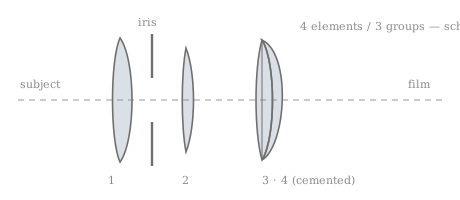
History
In December 1945, four months after the surrender, Nippon Kogaku restarted civilian lens production with this lens: the collapsible Nikkor-Q·C 5cm f/3.5, the company’s first postwar photographic lens by its own official chronicle, opening the 705xxxx serial block. It could hardly be a more modest vessel for that distinction — a four-element, three-group Tessar derivative (the Q stands for quatuor, four) copied so closely from the Leitz Elmar 50mm f/3.5 that even the iris sits in the Elmar’s position behind the front element, itself a clone of the Zeiss Tessar. A clone of a clone, built in a country whose industry lay in ruins — and the seed of everything Nikkor became.
The design was already a decade old by then. It dates to the mid-1930s, when Canon — then incapable of making its own optics — turned to Nippon Kogaku to supply lenses for the Kwanon prototypes and the Hansa Canon, Japan’s first 35mm cameras. The serial record traces that whole life: prewar Hansa Canon blocks with “Nippon-Kogaku Nr.” engravings (a later sub-block with a modified aperture), Canon-fit runs around 1940, and wartime blocks already marked Q·C Tokyo — coated. The postwar collapsible carried the Q·C Tokyo markings and ten aperture blades into the 705xxxx block, about 2,782 lenses from December 1945 onward.
Its place in an S-mount catalog is, honestly, marginal. The 705xxxx block interleaves Leica-screw and Nikon S examples in a single sequence, but only a handful have ever surfaced in Nikon mount, and no S-mount catalog listing is documented anywhere — this was a Leica-screw and Canon-fit lens first, an S-mount lens almost incidentally. It earns its page not as a system staple but as the origin point: the lens Nippon Kogaku chose, or defaulted to, when it started over.
The design got one last act as a rigid Leica-screw lens in 1955–56 — about 5,581 made, serials 213301–218881, with the iris moved behind the second element, closer to a true Tessar — before roughly two decades of production ended. Shooters today report exactly what a 1930s Tessar formula behind early coating should deliver: decent central sharpness, weak corners, a pronounced spherical-aberration glow in the highlights, and severe flare when the sun enters the frame — with contrast ranging from the collapsible’s muted classic look to the rigid version’s stunning micro-contrast, a rendering one Japanese reviewer credits with carrying Nikkor’s origin point into the present.
This history is AI-written, from the sources listed at the foot of the page. Where the record is silent it says so rather than filling the gap — but no human wrote these sentences.
Example photos
More sample photos elsewhere
- Tveljus — Antibes street scenes, Nicca 3F + Nikkor-Q·C 5cm f/3.5 (ARR photo series)
- reds613 — Tokyo on film (Shinjuku, Ochanomizu), Leica IIIf + Nikkor-Q.C 5cm f/3.5 (ARR series)
- Richard Haw — Repair: Nikkor-Q·C 5cm f/3.5 (Collapsible), with film samples shot on a Nicca 3S
These photographers keep all rights to their work — enjoy it at the source.
Sample photo wanted — shot with a Nikkor-Q(·C) 5cm f/3.5? We'd love to feature it (with credit).
Live listings
Asking price, USD: a median of $300 across 15 fixed-price listings on 2026-10-19 (middle half $220–$480). Tracked since 2026-09-06, 10 days: up 20% from $250.
By day
| Date | Median | Middle half | Listings |
|---|---|---|---|
| 2026-10-19 | $300 | $220–$480 | 15 |
| 2026-10-18 | $300 | $220–$480 | 15 |
| 2026-10-17 | $300 | $220–$480 | 15 |
| 2026-10-16 | $300 | $220–$500 | 16 |
| 2026-10-15 | $250 | $190–$480 | 14 |
| 2026-09-21 | $250 | $190–$480 | 13 |
| 2026-09-19 | $220 | $160–$300 | 12 |
| 2026-09-18 | $220 | $160–$300 | 12 |
| 2026-09-11 | $250 | $190–$300 | 11 |
| 2026-09-06 | $250 | $190–$480 | 12 |
Asking prices from the listings scanned, not sales; junk-flagged rows and auction lots excluded; other currencies are not converted.
- NIKKOR-Q.C 5cm 50mm f3.5 f/3.5 Lens Nippon Kogaku Leica L #214781 kjm 240131
- Vintage [Exc+5] Nippon Kogaku Japan Nikon NIKKOR-Q.C 5cm 50mm F3.5 L39 lens A79
- Vintage [Exc+5] Nippon Kogaku Japan Nikon NIKKOR-Q.C 5cm 50mm F3.5 L39 lens A79
- [Exc+5] Nippon Kogaku Nikon NIKKOR-Q.C 5cm 50mm F3.5 L39 For Leica Lens JAPAN
- [Near MINT] Nikon Nikkor-Q.C 5cm f/3.5 L39 LTM Leica Screw Mount Lens JAPAN
- NIKKOR-Q C 50mm 5cm F3.5 L-mount fully functional K146
- [Exc+3] NIKKOR-Q.C 5cm 50mm f3.5 f/3.5 Lens Nippon Kogaku Leica screw mount JP
- Nikon Nippon Kogaku NIKKOR-Q・C 5cm F3.5 L39 Leia L Mount Lens from Japan!!
- Nippon Kogaku Nikkor Q C 1:3.5/ 5 cm 50mm Rigid lens For Leica TM39 M39 (LTM)
- Nikon Nippon Kogaku Nikkor-Q.C 50mm F/3.5 Lens for Leica L39 #56153 C2
- Nikon Nippon Kogaku Nikkor-Q.C 50mm F/3.5 Lens for Leica L39 #56154 C2
- NIKKOR-Q.C 50mm f3.5 Lens Coll. collapsible Nippon Leica LTM DDP US #7052292
- [Rare] Nikon Nikkor Q.C 50mm 5cm F/3.5 L39 LTM Leica Screw Mount Lens from Japan
- Nikon Nippon Kogaku Nikkor-Q.C 5cm 50mm f3.5 Lens, LTM L39 M39 Mount Rangefinder
- Nippon Kogaku Nikkor-Q.C 50mm F3.5 LTM - Collapsible — SN 7051385
- Rare! Nippon Kogaku Tokyo Nikkor-Q.C 5cm f3.5 Collapsible Lens for Leica L39 LTM
- Nippon Kogaku Nikkor-Q.C 50mm F3.5 LTM - Collapsible (85%new)
- Rare Nippon Kogaku Tokyo Nikkor QC 5cm F3.5 Lens Cleaned Vintage Glass
- Selten! Nippon Kogaku Tokyo Nikkor-Q.C 5cm f3.5 Faltobjektiv für Leica L39 LTM
Listings updated 2026-10-19. Links go to the shop or marketplace that carries the item.